Nicotine Regulations in Malta: Rules, Compliance & B2B Guide
Understanding nicotine regulations in Malta is important for manufacturers, importers, distributors and B2B buyers involved in tobacco, electronic cigarettes, refill containers and other nicotine-related products.
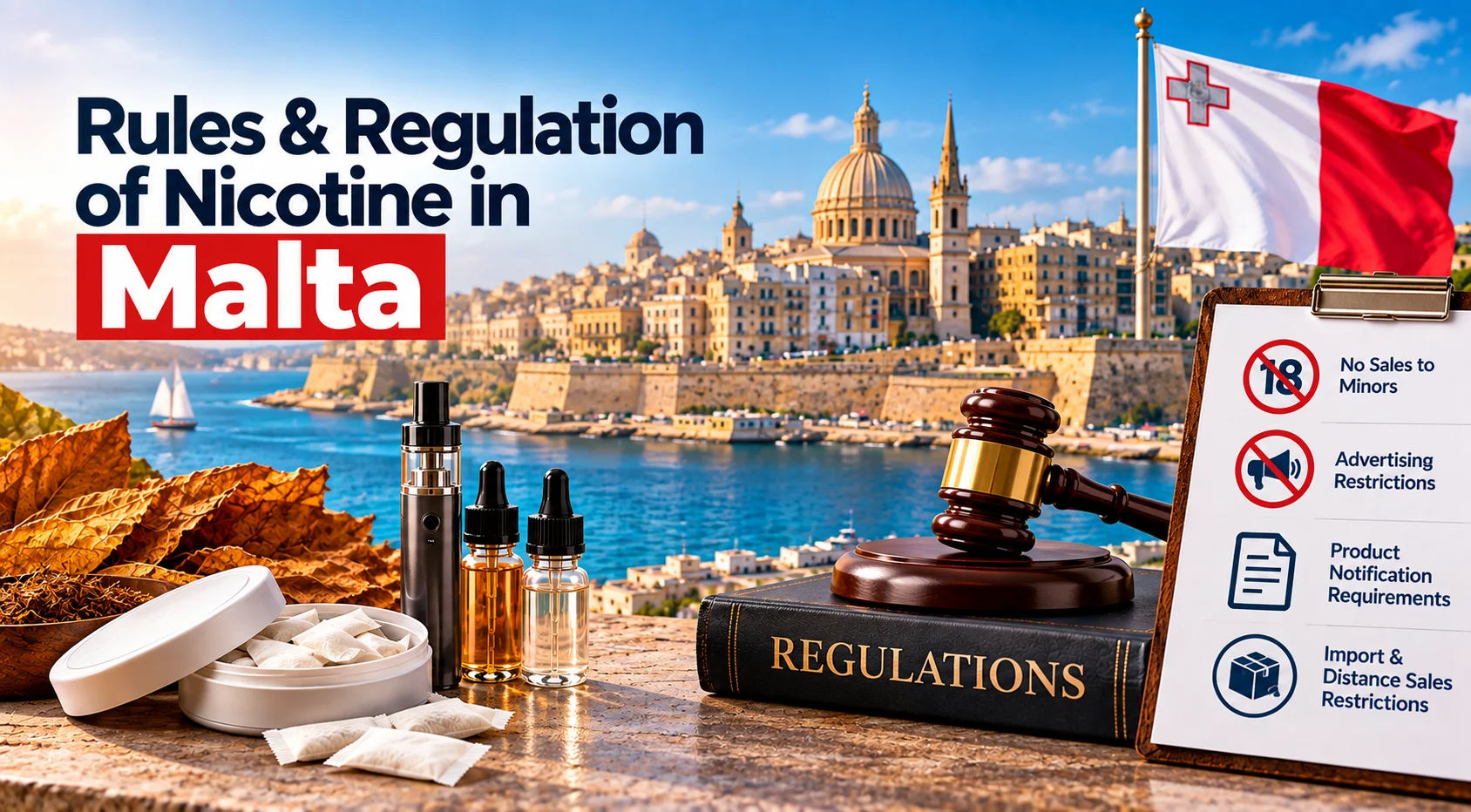
Malta regulates tobacco and related products through national legislation that implements the EU Tobacco Products Directive. The framework covers the manufacture, presentation and sale of tobacco and related products, including electronic cigarettes and refill containers.
For international businesses, compliance depends on the exact product category, intended use, supply-chain role and whether the product is being supplied to businesses or consumers.
What Are the Main Nicotine Regulations in Malta?
Malta’s Manufacture, Presentation and Sale of Tobacco and Related Products Regulations, 2016 (S.L. 315.10) established strengthened requirements for tobacco products and introduced specific provisions for products such as electronic cigarettes and herbal products for smoking. The Superintendent of Public Health is the competent authority responsible for implementation.
The regulatory framework covers areas including:
- Product requirements
- Product notification
- Packaging and presentation
- Electronic cigarettes
- Refill containers
- Advertising and promotion
- Import controls
- Distance sales
- Market compliance
Businesses should assess the rules applicable to their specific product before placing it on the Maltese market.
Electronic Cigarette and Vape Regulations in Malta
Electronic cigarettes and refill containers are specifically regulated in Malta.
Manufacturers and importers intending to place electronic cigarettes or refill containers on the Maltese market must submit the required notification to the Superintendent of Public Health through the EU Common Entry Gate (EU-CEG). The notification is generally required six months before the intended placing on the market.
Manufacturers and importers also have annual reporting responsibilities covering areas such as sales volumes, consumer preferences, mode of sale and relevant market-survey information.
Product Notification Requirements
Malta requires manufacturers and importers of tobacco products, herbal products for smoking, electronic cigarettes and refill containers to notify the competent authority before making covered products available for sale.
The Maltese authority states that this notification is not itself an authorisation or proof of conformity. Products must still comply with the applicable requirements of S.L. 315.10. Products found on the market without a valid notification may be seized.
For B2B suppliers, product documentation and regulatory records should therefore be prepared before commercial launch.
E-Cigarette Advertising Restrictions in Malta
Advertising and promotion of electronic cigarettes and refill containers are subject to significant restrictions in Malta.
Official guidance states that e-cigarettes and refill containers cannot be advertised or promoted directly or indirectly through:
- Television and on-demand television
- Radio
- Internet advertising
- Commercial email
- Other information-society services
- Certain printed publications
Restrictions also cover certain sponsorship and product-placement activities. Non-promotional information may be provided when requested by a consumer.
Businesses should therefore review digital marketing, websites, email campaigns and promotional materials before targeting the Maltese consumer market.
Importing Nicotine and Tobacco Products into Malta
Importers bringing tobacco, tobacco-related products or electronic cigarettes into Malta from countries outside the European Union are subject to import controls.
Malta’s Port Health Services is responsible for import controls for relevant products entering Malta from third countries. Imported products can only be placed on the Maltese market when they comply with S.L. 315.10.
For international suppliers, this means product compliance should be reviewed before shipment rather than after goods arrive.
Cross-Border Distance Sales
Cross-border consumer sales are another important part of nicotine regulations in Malta.
Malta prohibits cross-border distance sales of tobacco products, herbal products for smoking and both nicotine and non-nicotine electronic cigarettes or refill containers to consumers located in Malta.
Businesses established in Malta that conduct permitted cross-border distance sales to consumers in other EU Member States must register with the Superintendent of Public Health and also meet applicable requirements in the destination Member State.
The Maltese rules specifically distinguish consumer distance sales from B2B transactions; the cited distance-sales registration requirements do not apply to business-to-business sales.
Novel Tobacco Products
Malta also has a notification system for novel tobacco products.
Manufacturers and importers intending to place novel tobacco products on the Maltese market must submit the required notification through the EU-CEG system six months before the intended market placement.
Companies developing new tobacco or nicotine-related products should therefore determine whether the product falls into a regulated novel-product category before commercialisation.
What B2B Nicotine Buyers Should Check
Companies purchasing nicotine or nicotine-related products for manufacturing should first identify the exact product classification and intended application.
A practical procurement checklist includes:
- Product classification
- Intended use
- Nicotine concentration
- Product specification
- Purity requirements
- Certificate of Analysis (CoA)
- Safety Data Sheet (SDS)
- Batch identification
- Traceability information
- Packaging requirements
- Import documentation
- Applicable Maltese and EU requirements
The regulatory requirements for a nicotine raw material can differ from those applicable to a finished consumer product such as an e-cigarette or tobacco product.
Quality Documentation for Nicotine Supply
For B2B procurement, buyers should maintain clear technical documentation for each nicotine batch.
Important documents may include:
- Certificate of Analysis
- Safety Data Sheet
- Product specification
- Batch number
- Manufacturing information
- Packaging details
- Shipping documentation
- Traceability records
Clear documentation can help procurement and quality teams verify incoming material and maintain consistent internal records.
Malta Compared With Other European Markets
Nicotine regulations are not identical across European markets. Businesses supplying multiple countries should therefore review each destination’s requirements separately.
For comparison, you can also read our existing McCoy NIC regulatory articles:
Nicotine Regulations in Ireland — useful for comparing Ireland’s requirements for nicotine-inhaling products and retail licensing.
Nicotine Regulations in Denmark — useful for comparing product composition, nicotine limits, flavours, packaging and labelling requirements.
Nicotine Regulations in Switzerland — useful for comparing product safety, notification, labelling, sales and market-surveillance requirements.
Nicotine Regulations in Portugal — useful for comparing Portugal’s requirements for e-cigarettes, nicotine liquids and nicotine pouches.
Nicotine Rules and Regulations in the United Kingdom — useful when comparing the UK’s separate regulatory framework with EU markets.
Malta Compliance Checklist for Manufacturers and Exporters
Before supplying nicotine-related products to Malta, businesses should review:
Product:
Confirm classification, composition, nicotine concentration and intended application.
Regulatory:
Check whether notification, reporting or other market-entry requirements apply.
Quality:
Maintain CoA, SDS, specifications and batch traceability.
Packaging:
Verify applicable packaging, labelling and health-warning requirements.
Advertising:
Review consumer-facing advertising and promotional activities, particularly for electronic cigarettes.
Import:
Confirm customs, import and documentation requirements before shipment.
Sales:
Check whether the proposed sales channel involves consumer distance sales and whether restrictions apply.
Why Destination-Specific Compliance Matters
A product that complies with the requirements of one European market may require additional review before being supplied to another.
For example, Malta has specific notification requirements for electronic cigarettes and refill containers, significant advertising restrictions and a prohibition on cross-border consumer distance sales into Malta.
International manufacturers and B2B buyers should therefore assess the destination market before production, shipment and commercialisation.