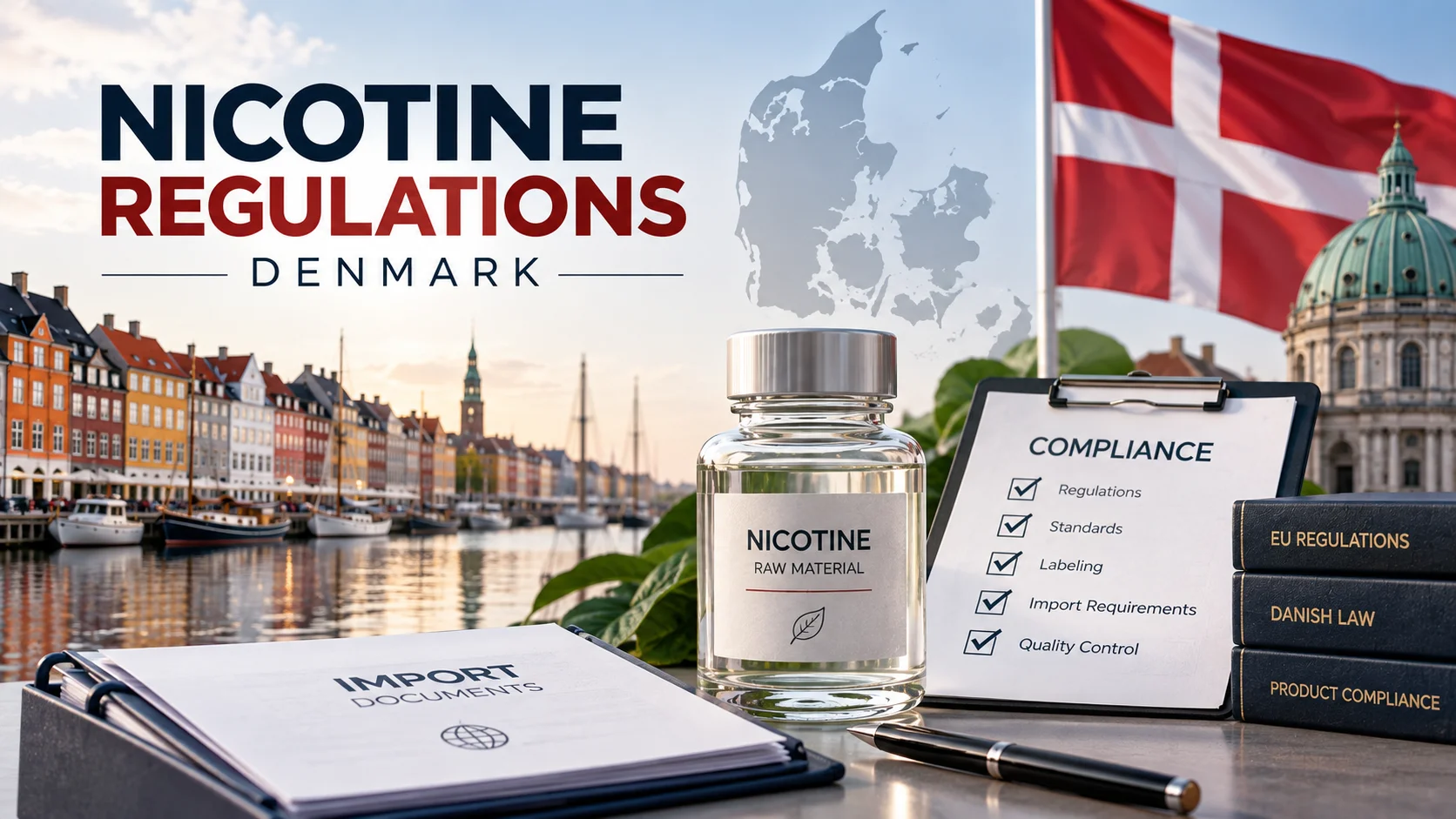
Nicotine regulation in Denmark is important for manufacturers, importers, distributors, and B2B buyers supplying nicotine-related products to the Danish market.
Understanding the rules and regulations of nicotine in Denmark is important for manufacturers, importers, distributors, and B2B buyers involved in nicotine and related products. Denmark introduced significant new requirements for nicotine products and tobacco surrogates from 1 July 2025, with the transition period ending on 31 March 2026. From 1 April 2026, products that do not meet the new requirements can no longer be sold in Denmark.
For international businesses, understanding these requirements is particularly important when evaluating products, documentation, packaging, and market-entry requirements for Denmark.
Key Nicotine Regulations in Denmark
The Danish regulatory framework covers several areas, including product composition, nicotine content, flavours, packaging, labelling, and market compliance.
The Danish Safety Technology Authority states that the new rules apply to companies that manufacture, import, distribute, or trade relevant nicotine products, tobacco surrogates, and certain tobacco products.
1. Nicotine Content Requirements
One of the important changes concerns nicotine pouches and similar tobacco-surrogate products.
Under the Danish requirements, a nicotine pouch may contain a maximum of 9.0 mg of nicotine per pouch.
Manufacturers and buyers supplying the Danish market therefore need to verify product specifications carefully before placing products on the market.
2. Restrictions on Flavours
Denmark has also introduced restrictions on characteristic flavours in tobacco surrogates such as nicotine pouches.
Under the current rules, nicotine pouches and similar products may only have tobacco or menthol flavours. Other characteristic flavours, including fruit or sweet flavours, are not permitted.
This is an important consideration for manufacturers developing products specifically for the Danish market.
3. Packaging Requirements
The rules also introduce standardisation requirements for packaging of tobacco surrogates.
Packaging must follow prescribed requirements and cannot use certain distinctive logos, colours, or other features that make products particularly attractive.
Businesses should therefore review packaging specifications before supplying products to Denmark.
4. Product Ingredients and Additives
The Danish regulations include requirements concerning ingredients and restrictions on certain additives in tobacco surrogates.
Manufacturers should review the formulation and ingredient profile of products intended for the Danish market and ensure that the applicable requirements are met before distribution.
5. Labelling and Health Warnings
Denmark has also introduced requirements concerning labelling and health warnings for electronic cigarettes and nicotine refill containers.
The rules include updated requirements for information that must appear on relevant products and packaging.
Accurate labelling is therefore an important part of compliance for businesses supplying nicotine-related products in Denmark.
6. The Transition Period Has Ended
A significant date for businesses is 1 April 2026.
The Danish authorities provided a transition period from 1 July 2025 to 31 March 2026, allowing certain products manufactured before the new rules came into force to be sold during the transition period.
From 1 April 2026, covered products that do not comply with the requirements introduced from 1 July 2025 can no longer be sold in Denmark.
This makes current product and packaging compliance especially important for manufacturers and importers.
7. What International Buyers Should Check
Businesses sourcing nicotine-related materials or products for the Danish market should consider several factors before shipment.
A practical compliance checklist can include:
- Product specifications
- Nicotine concentration
- Flavour profile
- Ingredients and additives
- Packaging format
- Labelling requirements
- Health warnings
- Required documentation
- Import requirements
- Destination-market compliance
Businesses should also distinguish between regulations applying to nicotine raw materials and those applying to finished nicotine products such as nicotine pouches or e-cigarettes. The applicable requirements can differ depending on the product, intended use, and market.
8. Importance of Supply-Chain Documentation
For international B2B procurement, documentation and traceability can play an important role in managing regulatory requirements.
Buyers may need clear information about product specifications, batch identification, quality documentation, and supply-chain records.
For more information, read our article on Why Batch Traceability Is Becoming More Important in the Global Nicotine Supply Chain.
9. Denmark Compared With Other European Markets
Nicotine regulations can vary between European markets. Requirements applicable in Denmark should therefore not automatically be assumed to apply in Sweden, Switzerland, or the United Kingdom.
For comparison, businesses can also read:
- Rules & Regulations of Nicotine in Sweden
- Rules & Regulations of Nicotine in Switzerland
- Nicotine Rules and Regulations in the United Kingdom
Comparing destination-specific requirements can help international buyers identify differences before entering or supplying a particular market.
10. Why Compliance Matters for International Suppliers
For manufacturers and suppliers, compliance should be considered before production, packaging, shipment, and market distribution.
A product that meets the requirements of one country may require changes before being supplied to another market. Businesses should therefore confirm the current rules applicable to the specific destination and product category.
Our article on Cross-Border Shipping Rules for Nicotine Products provides additional information on how international nicotine trade can be affected by changing regulatory requirements.
Conclusion
The rules and regulations of nicotine in Denmark have undergone important changes since July 2025. Key requirements include restrictions on nicotine content, flavours, ingredients, packaging, and labelling for covered nicotine products.
With the transition period ending on 31 March 2026, businesses supplying covered products to Denmark need to ensure that products placed on the market comply with the applicable requirements from 1 April 2026 onward.
For international manufacturers and B2B buyers, reviewing product specifications, documentation, packaging, and destination-market requirements before shipment can help support a more structured compliance process.