Understanding the Role of Specifications in Industrial Nicotine Procurement
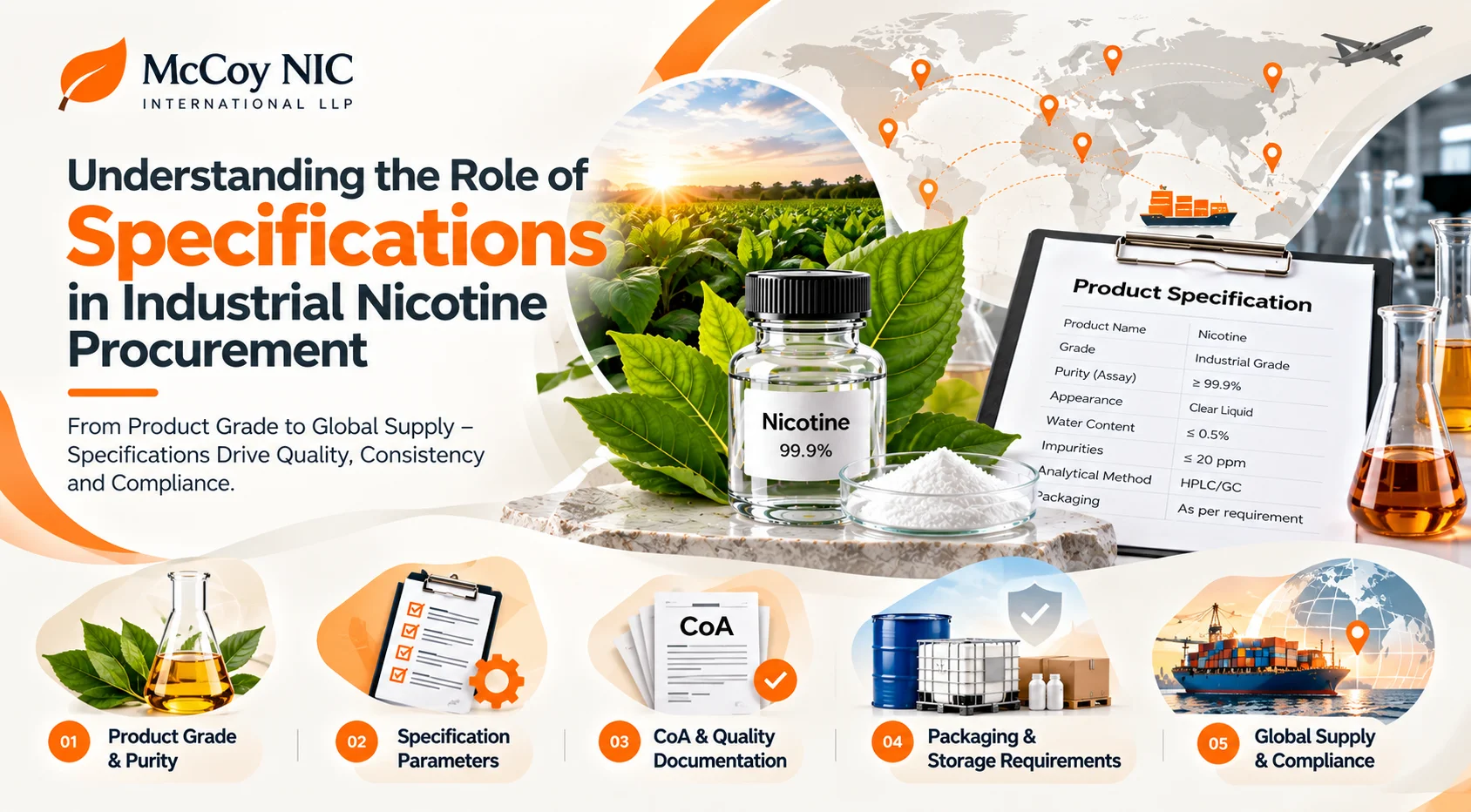
Industrial nicotine procurement specifications help manufacturers and qualified B2B buyers define the material they require before evaluating suppliers or placing an order. Clear specifications establish a common reference for product identity, purity, quality parameters, documentation, packaging, and acceptance requirements.
In industrial procurement, a product name alone may not provide enough information to confirm whether a material is suitable for a buyer’s requirements. Purchasing and quality teams should review the applicable product specification and confirm that the supplier’s documentation corresponds to the material being offered.
For businesses sourcing nicotine raw materials, a structured specification review can support clearer communication, more consistent supplier comparisons, and better quality documentation.
What Are Industrial Nicotine Procurement Specifications?
Industrial nicotine procurement specifications are the documented requirements used to describe and evaluate a particular nicotine raw material. These requirements should be agreed between the buyer and supplier before an order is finalized.
Depending on the product and intended application, the specification may identify the product grade, required assay or purity, relevant physical and chemical parameters, analytical methods, packaging requirements, and applicable acceptance criteria.
Specifications should be product-specific. Buyers should not assume that every nicotine product has identical requirements or that one specification is suitable for every manufacturing application.
1. Confirm Product Identity and Grade
The first step is to identify the exact material being requested. Buyers should distinguish between product categories and confirm the relevant grade, chemical identity, and intended application with the supplier.
For example, McCoy NIC provides information about several product categories:
These categories should not be treated as interchangeable simply because they relate to nicotine. Buyers should review the specific product information and confirm that the material meets their documented requirements.
2. Understand Purity and Assay Requirements
Purity or assay is an important parameter in many industrial raw-material specifications. However, a stated purity value does not, by itself, establish every aspect of product quality.
Buyers should confirm the agreed assay limit, the reporting basis, the analytical method where relevant, and any additional quality parameters required for their application.
It is also important to distinguish a supplier’s commercial specification from the requirements of a particular pharmacopoeial monograph or other external standard. Compliance with a named standard should only be claimed when supported by the applicable testing and documentation.
A clear specification helps the purchasing team and quality team evaluate the same requirements when reviewing a quotation, approving a supplier, or checking incoming material.
3. Review the Certificate of Analysis (CoA)
A Certificate of Analysis (CoA) provides batch-specific analytical results and other relevant information for a material. It helps buyers compare reported results with the agreed product specifications.
When reviewing a CoA, procurement and quality teams may check:
- Product name and grade
- Batch or lot identification
- Reported assay or purity
- Relevant test parameters and results
- Analytical methods, where provided
- Test dates and document authorization
- Conformance with agreed acceptance criteria
The CoA should correspond to the supplied batch, and any discrepancies should be clarified before the material is accepted under the buyer’s quality procedures.
For more information, visit the McCoy NIC Certifications and Compliance Documents page and review the available information about relevant quality documentation.
4. Consider Batch Traceability and Consistency
Batch traceability helps businesses connect a specific delivery with its associated identification and quality records. It is particularly relevant when manufacturers purchase raw materials repeatedly and need to maintain organized procurement records.
Buyers can ask how batch numbers are recorded, how the supplied batch relates to its CoA, and what documentation accompanies each shipment.
Comparing records from different batches may also help a buyer assess whether the agreed quality requirements are being met over time. Any acceptance decision should be based on the applicable specification and the buyer’s established quality procedures.
Read our related article: Why Batch Traceability Is Becoming More Important in the Global Nicotine Supply Chain.
5. Check Packaging and Storage Requirements
Packaging and storage requirements should be considered alongside the product specification. The appropriate arrangement depends on the material’s characteristics, the packaging system, transportation conditions, and applicable safety requirements.
Buyers should confirm the proposed packaging format, container identification, storage instructions, and relevant safety documentation before finalizing an order.
Nicotine is acutely toxic and requires appropriate handling. Businesses must follow the applicable Safety Data Sheet (SDS), workplace safety procedures, transport rules, and legal requirements. Packaging and storage arrangements should be confirmed with qualified personnel rather than assumed from a product name alone.
6. Align Specifications with the Intended Application
Different industrial applications may require different quality parameters, documentation, and acceptance criteria. A specification suitable for one process may not meet another buyer’s requirements.
Before requesting a quotation, purchasing teams should communicate the intended business application and identify the parameters that are essential for supplier evaluation.
Technical and quality teams should review the proposed specification together. This helps ensure that commercial decisions are based on the actual material requirements rather than on price or a general product description alone.
For additional product-related information, see the McCoy NIC Frequently Asked Questions page.
7. Use Specifications When Comparing Supplier Quotations
A fair supplier comparison requires quotations based on comparable requirements. If suppliers quote against different grades, quality limits, packaging arrangements, or documentation expectations, their prices may not represent equivalent offers.
B2B buyers should compare quotations using the same specification wherever possible and clarify any differences before making a decision.
Other considerations may include documentation availability, supplier communication, delivery terms, expected lead times, and the supplier’s ability to meet the agreed requirements.
Our guide on Factors That Affect Bulk Nicotine Procurement provides further information about procurement considerations.
8. Prepare a Clear Procurement Specification Checklist
Before sending an enquiry, buyers can prepare a specification checklist covering the main information needed for supplier evaluation.
A practical checklist may include:
- Product identity and required grade
- Agreed assay or purity requirements
- Relevant quality parameters and acceptance limits
- Analytical methods or standards, where applicable
- CoA and other required quality documentation
- Batch traceability expectations
- Packaging and storage requirements
- Order quantity and commercial terms
- Destination market and applicable compliance requirements
- Expected delivery schedule
The exact checklist should be adapted to the product and intended application. Buyers should confirm all critical requirements with the supplier before placing an order.
How McCoy NIC Supports Specification-Based Procurement
McCoy NIC International LLP provides product information and B2B support to help customers discuss relevant product specifications, quality documentation, and procurement requirements.
Buyers can review the available information for the relevant product category and clarify any additional requirements during the enquiry process. Documentation, commercial conditions, and supply arrangements should be confirmed for the specific product and order.
To discuss product requirements or request relevant documentation, visit the McCoy NIC Request COA and Price page.
Frequently Asked Questions
Why are specifications important in industrial nicotine procurement?
Specifications define the product and quality requirements that buyers and suppliers use when evaluating quotations, reviewing documentation, and assessing incoming material.
What should buyers check in a nicotine CoA?
Buyers should check the product identity, batch number, reported test results, relevant analytical methods, and whether the results meet the agreed specification.
Does a high purity value guarantee overall product quality?
No. Assay or purity is only one quality parameter. Other relevant characteristics, testing results, documentation, and application-specific requirements may also need to be evaluated.
Should all nicotine products use the same specifications?
No. Requirements depend on the product category, intended application, applicable standards, and the buyer’s documented quality needs.
When should procurement specifications be agreed?
Specifications should be clarified before an order is finalized so that both parties understand the required material, acceptance criteria, documentation, and commercial expectations.