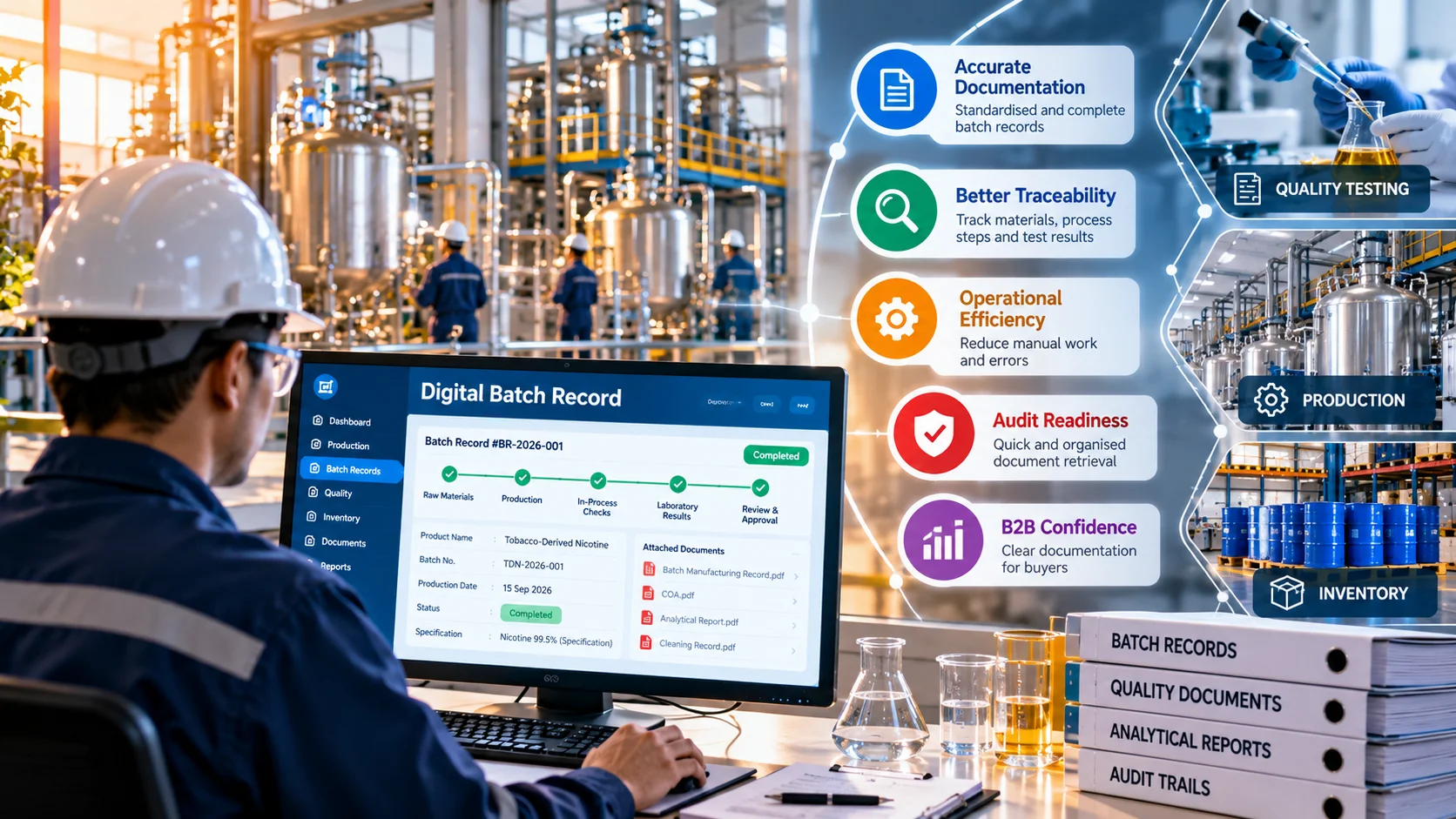
The Business Case for Digital Batch Records in Manufacturing
Digital batch records are becoming an important consideration for manufacturers seeking better documentation, improved traceability and more efficient quality processes. As manufacturing operations become increasingly data-driven, businesses are evaluating how digital systems can reduce manual administrative work and make production information easier to review, retrieve and manage.
For companies operating in quality-sensitive industries, including specialty chemicals and pharmaceutical ingredient supply chains, batch documentation plays an important role in demonstrating what happened during production, which materials were used, what checks were performed and whether the required records are complete.
Moving from paper-based documentation to a well-designed digital system can offer operational benefits. However, the business case depends on implementation costs, process requirements, employee training, data security and the quality of the underlying information.
What Are Digital Batch Records?
Digital batch records are electronic records used to document activities and information associated with the manufacture or processing of a particular batch. Depending on the system and the manufacturing process, these records may include:
- Batch identification and product details
- Raw material identification and quantities
- Production instructions and completed process steps
- Dates, times and operator entries
- In-process checks and test results
- Deviations, investigations and corrective actions
- Review and approval information
- Links to relevant quality and production documents
A digital batch record system may be integrated with manufacturing execution systems, enterprise resource planning platforms or quality management software. The level of integration varies by facility and business requirements.
Digital records do not automatically guarantee accurate documentation. Their value depends on appropriate system design, controlled access, reliable data capture, documented procedures and effective oversight.
1. Reducing Manual Documentation Work
Paper-based batch records can involve repeated handwriting, manual calculations, document transfers and repeated data entry. These activities consume time and may create opportunities for transcription errors, incomplete fields or inconsistent formatting.
A properly configured digital system can standardise data entry, guide users through required steps and reduce unnecessary duplication. Certain systems can also capture information directly from connected equipment or other validated data sources, where appropriate.
The potential business benefit is not simply replacing paper with a screen. It is making routine documentation more consistent and easier to complete correctly.
Before implementation, manufacturers should identify which tasks genuinely need automation and which require human review or approval.
2. Improving Batch Traceability
Traceability helps organisations connect a finished or intermediate batch with the materials, production activities, checks and documents associated with it.
Digital batch records can make these connections easier to search and review. For example, an authorised user may be able to locate a batch identifier and retrieve its associated production entries, material references and relevant quality records from a connected system.
This can support internal investigations, customer enquiries and supply-chain documentation requests.
Traceability is especially useful when buyers need to understand the documentation associated with a supplied ingredient. Businesses can also strengthen their documentation approach by understanding the role of a Certificate of Analysis (CoA) and the information used to evaluate product quality.
However, traceability depends on accurate source data and reliable links between records. A digital platform cannot compensate for incorrect material identification or missing entries.
3. Making Quality Review More Efficient
Quality teams often need to review batch documentation for completeness, consistency and compliance with applicable procedures. Paper records may require staff to locate files, check handwritten entries and reconcile information across multiple documents.
Digital systems can make certain review activities easier through searchable records, standardised fields, configured alerts and clearly defined review workflows.
Where appropriate, a system may flag missing information or entries that require further review. These functions can help teams identify documentation issues earlier, although automated alerts do not replace professional assessment.
A structured approach to documentation also complements broader quality practices, including understanding nicotine purity, assay results and analytical reporting.
The goal is to improve visibility and consistency while preserving the responsibility of authorised personnel to assess and approve relevant records.
4. Strengthening Data Integrity and Record Control
Manufacturing records need to remain accurate, complete, accessible and appropriately protected throughout their required retention period.
A digital batch record system should therefore be assessed for controls such as:
- Role-based user access
- Secure authentication
- Appropriate audit trails for relevant changes
- Record version control
- Backup and recovery arrangements
- Record retention and retrieval
- Controlled review and approval workflows
- Documented procedures for system operation
Audit trails can help establish who made a change, when it occurred and what information was affected, where the system is designed and configured to capture these events.
Regulatory expectations depend on the industry, jurisdiction, record type and applicable requirements. For example, the US Food and Drug Administration provides guidance on electronic records and electronic signatures under 21 CFR Part 11. Manufacturers should determine whether those requirements apply to their specific operations rather than assuming every digital record system is automatically compliant.
Digitalisation should strengthen data governance, not create an additional source of uncontrolled information.
5. Supporting Audit Readiness and Document Retrieval
When an internal review, customer assessment or regulatory inspection requires production information, teams need to retrieve the relevant records accurately and within an appropriate timeframe.
A searchable digital archive can reduce dependence on physical filing systems and make it easier to assemble records associated with a particular batch. Controlled access and consistent naming conventions can further improve retrieval.
This can also support buyer-facing documentation workflows. Businesses evaluating a supplier may request product specifications, relevant quality documents, traceability information or supporting analytical records.
For B2B buyers assessing suppliers, reviewing documentation alongside quality certificates and related information can help clarify what evidence is available for evaluating a product.
Nevertheless, digital storage alone does not establish audit readiness. Records must be complete, maintained according to applicable requirements and supported by appropriate procedures and trained personnel.
6. Evaluating the Financial Business Case
Digital batch record projects require an initial investment. Costs may include software licensing, system configuration, integration, data migration, validation or qualification where required, cybersecurity controls, training and ongoing support.
Manufacturers should compare these costs with measurable operational opportunities.
Useful indicators include:
- Time required to complete and review batch records
- Frequency of missing or incomplete entries
- Time spent searching for historical records
- Number of repeated manual data-entry activities
- Documentation-related investigation workload
- Training and system maintenance costs
A simple business case can compare the current process with the expected process after implementation.
For example, if a facility spends substantial staff time locating records or correcting incomplete documentation, a digital workflow may offer value by reducing some of that effort. The actual financial benefit should be established using the organisation’s own baseline data rather than assumed savings.
A phased implementation can also help businesses assess the results before expanding the system across additional production lines or facilities.
7. Common Implementation Challenges
Digital batch records can introduce challenges if the project focuses only on software selection.
Process standardisation: Inconsistent procedures should be reviewed before they are transferred into a digital workflow.
Employee adoption: Operators, supervisors and quality personnel need suitable training and clear instructions.
System integration: Connections with ERP, laboratory and manufacturing systems require careful planning to avoid inconsistent or duplicated data.
Data migration: Existing records must be transferred or archived in a way that preserves their meaning, accessibility and required retention.
System governance: Access rights, change control, backup procedures and responsibilities need to be defined and maintained.
Compliance assessment: Applicable recordkeeping and electronic-signature requirements should be assessed for the intended use and jurisdiction.
A successful implementation combines technology with documented processes, accountable ownership and ongoing performance review.
8. What B2B Buyers Should Understand
Digital batch records are primarily a manufacturing and quality-management tool, but they can also improve the organisation of information used in supplier communication.
Buyers should understand what documentation a supplier can provide, how batch identifiers connect to relevant quality records, and which information is available for review or verification.
For nicotine ingredients and other specialty materials, product specifications, batch identification and analytical documentation are distinct but related elements of supplier evaluation. Buyers can use resources such as the bulk nicotine procurement guide to understand broader procurement considerations.
A supplier’s use of digital records should not be treated as proof of product quality by itself. Buyers should assess the actual documentation provided, its relevance to the product and batch, and whether it meets their technical and regulatory requirements.