Nicotine Regulations in Europe: EU Rules for Buyers in 2026
Nicotine regulations in Europe are an important consideration for manufacturers, importers, distributors and B2B procurement teams sourcing nicotine ingredients or nicotine-containing products. Businesses must understand the difference between chemical safety obligations, product-specific rules, customs requirements and national restrictions before entering a European market.
The European Union has established regulatory frameworks covering chemicals, tobacco products and electronic cigarettes. However, the requirements applicable to a particular shipment depend on the product’s composition, classification, intended use and destination country.
For buyers, checking these requirements before placing an order can help reduce documentation gaps, customs delays and avoidable compliance risks.
1. Understanding the European Regulatory Framework
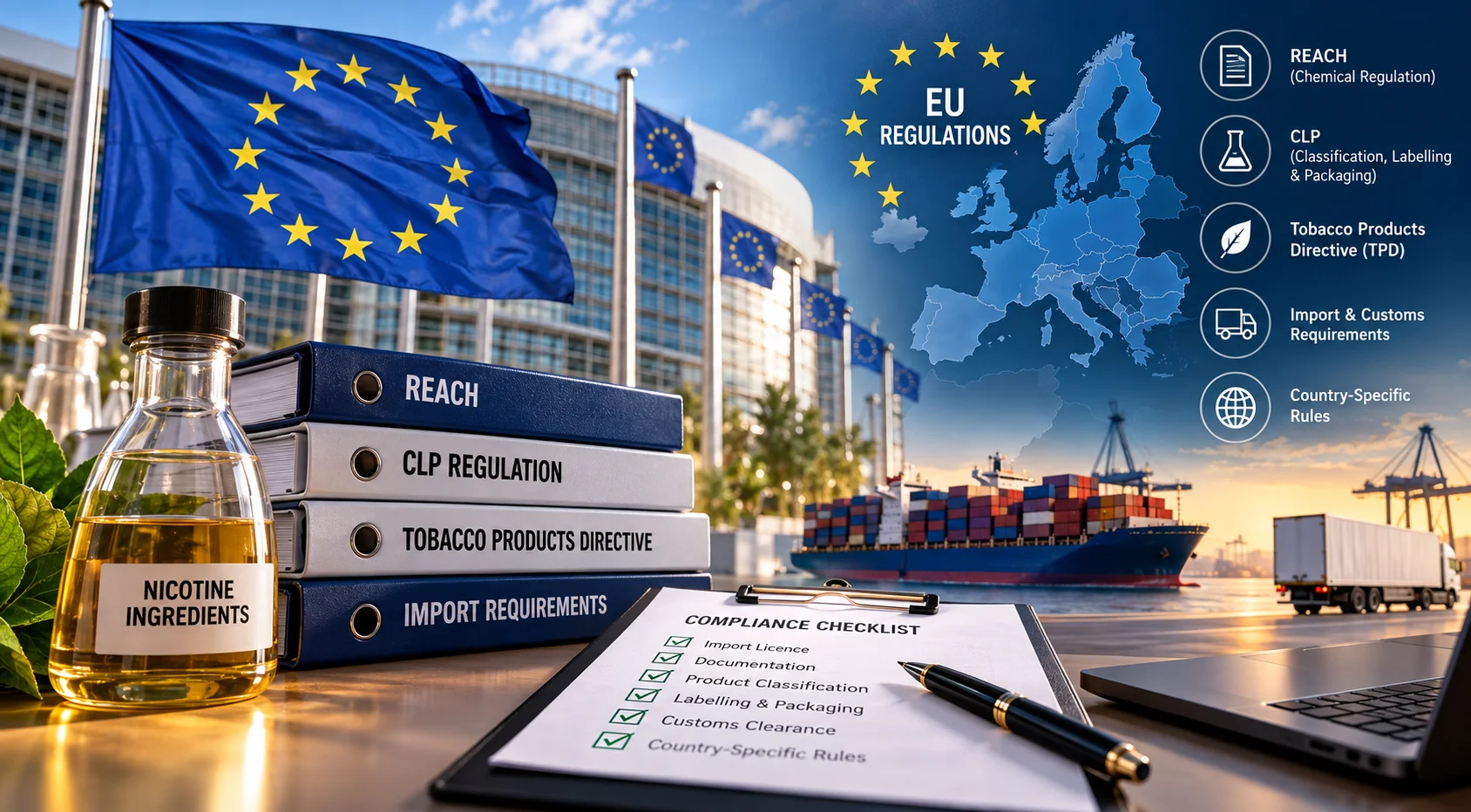
Europe is not governed by one single nicotine-specific import rule covering every product and application. Several legal frameworks may be relevant, depending on the material being imported.
Key areas to review include:
- REACH: The EU framework for the Registration, Evaluation, Authorisation and Restriction of Chemicals.
- CLP Regulation: The framework governing the classification, labelling and packaging of hazardous substances and mixtures.
- Tobacco Products Directive (TPD): EU rules covering specified tobacco and related products, including electronic cigarettes.
- Customs and import requirements: Product classification, duties, origin information and relevant import formalities.
- National requirements: Additional restrictions or product rules that may apply in individual European countries.
The European Commission provides information about REACH chemical regulations, tobacco product regulation and importing into the EU.
Buyers should identify which frameworks apply to their actual product rather than assuming that all nicotine-related materials are regulated identically.
2. REACH Requirements for Nicotine Ingredients
REACH is one of the main EU regulations governing chemical substances. It places responsibilities on manufacturers and importers to identify and manage chemical risks and provide appropriate safety information throughout the supply chain.
For businesses importing nicotine as a chemical substance, the relevant questions include:
- Is the substance within the scope of REACH?
- Who is legally responsible for any applicable registration obligations?
- Does an existing registration cover the substance and the relevant use?
- Are any applicable restrictions or authorisation requirements relevant?
- Is suitable safety information available to downstream users?
Under REACH, registration obligations can depend on factors such as the substance, annual tonnage, exemptions and the identity of the responsible legal entity. Buyers should not assume that every imported substance automatically requires the same registration or that a supplier’s statement alone proves compliance.
Businesses should consult the European Commission’s REACH overview and relevant European Chemicals Agency resources when evaluating a specific transaction.
3. CLP Rules: Classification, Labelling and Packaging
The EU Classification, Labelling and Packaging (CLP) Regulation establishes rules for identifying chemical hazards and communicating them through appropriate labelling and packaging.
For nicotine ingredients and nicotine-containing chemical mixtures, businesses should verify the applicable classification using the actual composition and relevant hazard information.
Depending on the product, checks may include:
- Correct hazard classification.
- Required hazard pictograms and label information.
- Appropriate packaging.
- Applicable Safety Data Sheet (SDS) information.
- Relevant language and market-specific requirements.
The European Commission reported that the revised CLP Regulation entered into force in December 2024, with different dates of application for different provisions. Businesses should therefore check which provisions apply to their products and when.
Official reference: European Commission — Revised CLP Regulation.
A supplier’s label or SDS should be reviewed for accuracy and applicability to the destination market rather than accepted without verification.
4. Tobacco Products Directive and Electronic Cigarettes
The Tobacco Products Directive (Directive 2014/40/EU) governs specified tobacco and related products placed on the EU market. Its scope includes electronic cigarettes and refill containers, which are subject to particular safety, quality, notification, packaging and labelling requirements.
For example, the Directive sets requirements for nicotine concentration and container volumes for covered electronic cigarettes and refill containers. Manufacturers and importers must also meet applicable product notification and packaging obligations.
However, these finished-product rules should not automatically be applied to every raw nicotine ingredient. A chemical ingredient sold for an industrial purpose may raise different regulatory questions from a finished e-cigarette liquid or consumer product.
Buyers should determine whether the product falls within the Directive’s scope and check the relevant national implementation measures.
Official reference: European Commission — Product Regulation.
EU-CEG Notification Requirements
Under the EU Tobacco Products Directive (2014/40/EU), manufacturers and importers of tobacco products, electronic cigarettes, and refill containers must submit the required product information to the relevant EU Member State authorities before placing covered products on the market. The EU Common Entry Gate (EU-CEG) is the reporting system used for these notifications. For new or substantially modified e-cigarettes and refill containers, notification is generally required six months before the planned market launch. These obligations apply to the product categories covered by the Directive, not automatically to every bulk nicotine chemical.
Official source: European Commission – EU-CEG notification guide.
Country-Specific Nicotine Regulations in Europe
Although the EU Tobacco Products Directive establishes a common framework for covered products, national rules may differ, particularly for nicotine pouches and other product categories. Businesses should review the requirements of the specific country where a product will be marketed. For more information, see our guide to the global legal status of nicotine pouches and snus in 2026.
5. Import Documentation European Buyers Should Check
Documentation requirements depend on the product, transaction, destination and transport method. Before dispatch, buyers should agree on the documents required with the supplier, customs representative and carrier.
Common documents to review include:
Certificate of Analysis (COA): Helps verify batch-specific test results and whether the material meets the agreed specification.
Safety Data Sheet (SDS): Provides relevant hazard, handling, storage and emergency information.
Technical Data Sheet (TDS): Describes product characteristics and technical specifications where available.
Commercial invoice and packing list: Support the commercial transaction and shipment details.
Transport documentation: Depends on the mode of transport and applicable requirements. Additional dangerous-goods documents may be required if the shipment is classified accordingly.
Permits and declarations: May be needed where the specific product or transaction is subject to additional controls.
These documents serve different purposes. A COA does not replace an SDS, and a complete document package does not by itself establish that every import authorisation or regulatory obligation has been met.
6. Country-Specific Rules Across Europe
Although EU legislation establishes common frameworks, buyers should not assume that every European country has identical requirements.
EU member states may have national measures, enforcement procedures and product-specific restrictions that affect a transaction. Countries outside the EU may operate under different legal frameworks altogether.
Before confirming an order, buyers should establish:
- The exact destination country.
- The product’s composition and intended use.
- The applicable customs classification.
- Whether any licences, registrations or permits are required.
- Whether national restrictions or product-specific rules apply.
- Which documents must accompany the shipment.
The European Commission’s Access2Markets portal can help businesses investigate tariffs, import procedures and product requirements. Additional confirmation may be necessary from the relevant national authority.
For example, buyers reviewing requirements for Germany, France and the Netherlands should check the applicable national rules alongside relevant EU legislation. Requirements may vary depending on product classification, intended use and destination market. Buyers should confirm the current requirements with the relevant authorities before importing.
7. What B2B Buyers Should Ask Their Suppliers
A structured supplier review can help procurement teams identify missing information before an order is placed.
Buyers should consider asking:
- Can the supplier provide a current, product-specific COA and SDS?
- Are the product specifications consistent with the intended application?
- Is information available to support the applicable chemical compliance assessment?
- Can the supplier provide the agreed packaging and transport details?
- Are any additional documents needed for the destination country?
- Have the buyer and supplier agreed on delivery terms, lead time and document responsibilities?
Suppliers should provide accurate information and avoid claiming that a product is approved for all European markets unless that statement is properly supported.
McCoy NIC provides product-related information through its pure nicotine product page and available certification and documentation information. Buyers should confirm that any document available is appropriate for their specific product, intended use and destination.
8. Regulatory Developments to Monitor in 2026
European businesses should continue monitoring official updates to chemical legislation and tobacco-control rules. Changes may involve implementation dates, product requirements, national restrictions or proposed revisions to existing legislation.
A proposal or consultation should not automatically be treated as a rule already in force. Buyers should check whether a measure is proposed, adopted, published, effective or subject to a future compliance date.
For current information, consult the European Commission’s official regulatory pages and the relevant national authority. Review the original legal text or notice before making decisions about sourcing, labelling, product specifications or shipment timing.