Where India’s Nicotine Rules Actually Stand: A Plain-English Guide to the Patchwork
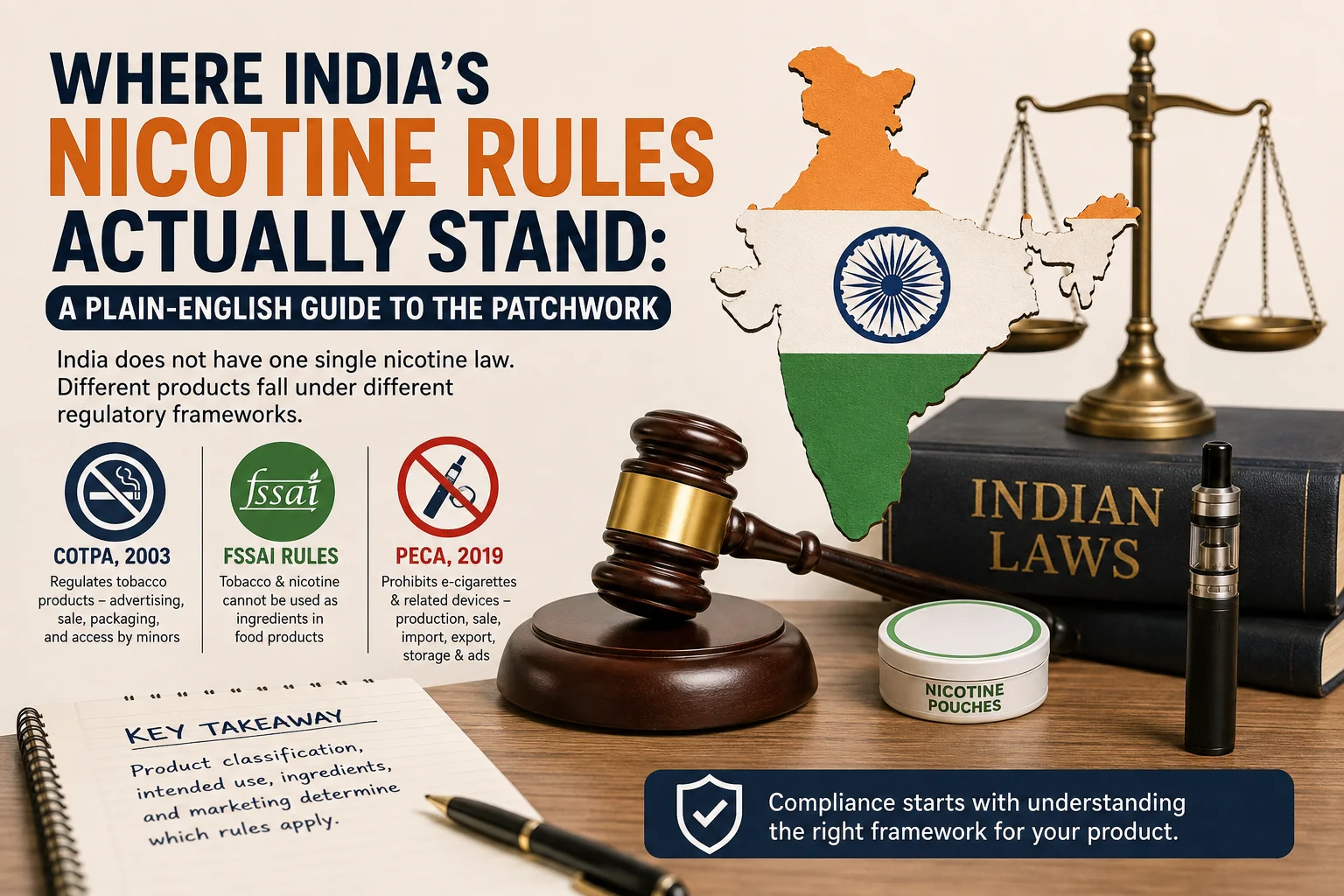
India does not have a single law that governs “nicotine” as a category. Instead, what a product is called, how it’s sold, and how it’s classified determines which of several overlapping laws applies to it — and for some of the newest products on the market, none of them apply cleanly. Here’s where things stand.
E-cigarettes: a clear, nationwide ban
Electronic nicotine delivery systems are the one area where India’s position is unambiguous. The Prohibition of Electronic Cigarettes Act (PECA), passed in 2019, bars the production, manufacture, import, export, transport, sale, distribution, storage and advertisement of e-cigarettes and similar devices across the country. The law was introduced primarily on youth-protection grounds, and enforcement covers the entire supply chain rather than just retail sale. In practice, a grey market persists through online and cross-border channels, but there is no legal domestic market for vapes.
Conventional and smokeless tobacco: COTPA and state gutkha bans
Cigarettes, bidis, gutkha, khaini, and other tobacco products fall under the older Cigarettes and Other Tobacco Products Act (COTPA), 1975. COTPA mandates health warnings, restricts advertising, bans sale to minors, and prohibits sale within 100 yards of educational institutions. Separately, most Indian states have used food-safety powers under the FSSAI’s regulations on tobacco-containing food products to ban gutkha and pan masala formulations that mix tobacco or nicotine into a chewable product, since these are treated as adulterated food rather than a standalone tobacco product.
Nicotine pouches: the grey zone
Tobacco-free oral nicotine pouches — sold under international brand names as well as by domestic manufacturers — are where the framework gets murky. They aren’t “electronic,” so PECA doesn’t apply. They contain no tobacco leaf, so COTPA’s core definitions don’t cleanly capture them either. That leaves the Drugs and Cosmetics Act, 1940, and its accompanying rules, under which low-dose nicotine gums and lozenges (up to 2 mg) are exempted from licensing requirements as over-the-counter nicotine replacement therapy. Pouches marketed at higher strengths — some products tested by the ICMR’s National Institute of Cancer Prevention and Research have been found to contain nicotine levels far above that exemption threshold — don’t fit within it, leaving no clearly defined licensing pathway either way.
The result is a genuine grey area rather than a settled legal position. Different trackers and legal commentators describe the situation differently — some treat pouches as effectively prohibited by extension of existing tobacco and drug law, others describe them as not specifically banned and available through a largely unregulated retail and online market. A handful of states have applied local drug-law powers to restrict sale within their borders, but there is no uniform national rule specific to nicotine pouches as a category.
Pressure is building for a dedicated framework
That gap has drawn increasing attention from public health researchers and advocates over the past year, particularly after studies flagged nicotine pouches sold with very high per-pouch nicotine content and inconsistent labelling. Calls have grown for lawmakers to either extend COTPA and PECA to explicitly cover oral nicotine products, or to create a standalone regulatory category — covering permissible nicotine strength, packaging and health warnings, age verification, and flavour restrictions — similar to frameworks already in place in parts of Europe. No such law has been enacted as of this writing, but the direction of policy discussion suggests dedicated nicotine-pouch rules are a matter of when, not if.
What this means for the industry
For manufacturers, formulators and distributors, the near-term takeaway is that the absence of a pouch-specific law is not the same as a stable status quo. Compliance expectations are being shaped in real time by state-level enforcement action, drug-law interpretation, and public health advocacy — any of which could inform the shape of a future central rule. Businesses sourcing nicotine extract or synthetic nicotine for formulation should keep documentation, strength disclosure, and labelling practices ahead of where the law currently sits, rather than only where it sits today.
This article is for general informational purposes and does not constitute legal advice. Regulatory positions can change with little notice — businesses should confirm current requirements with qualified legal counsel before making compliance decisions.