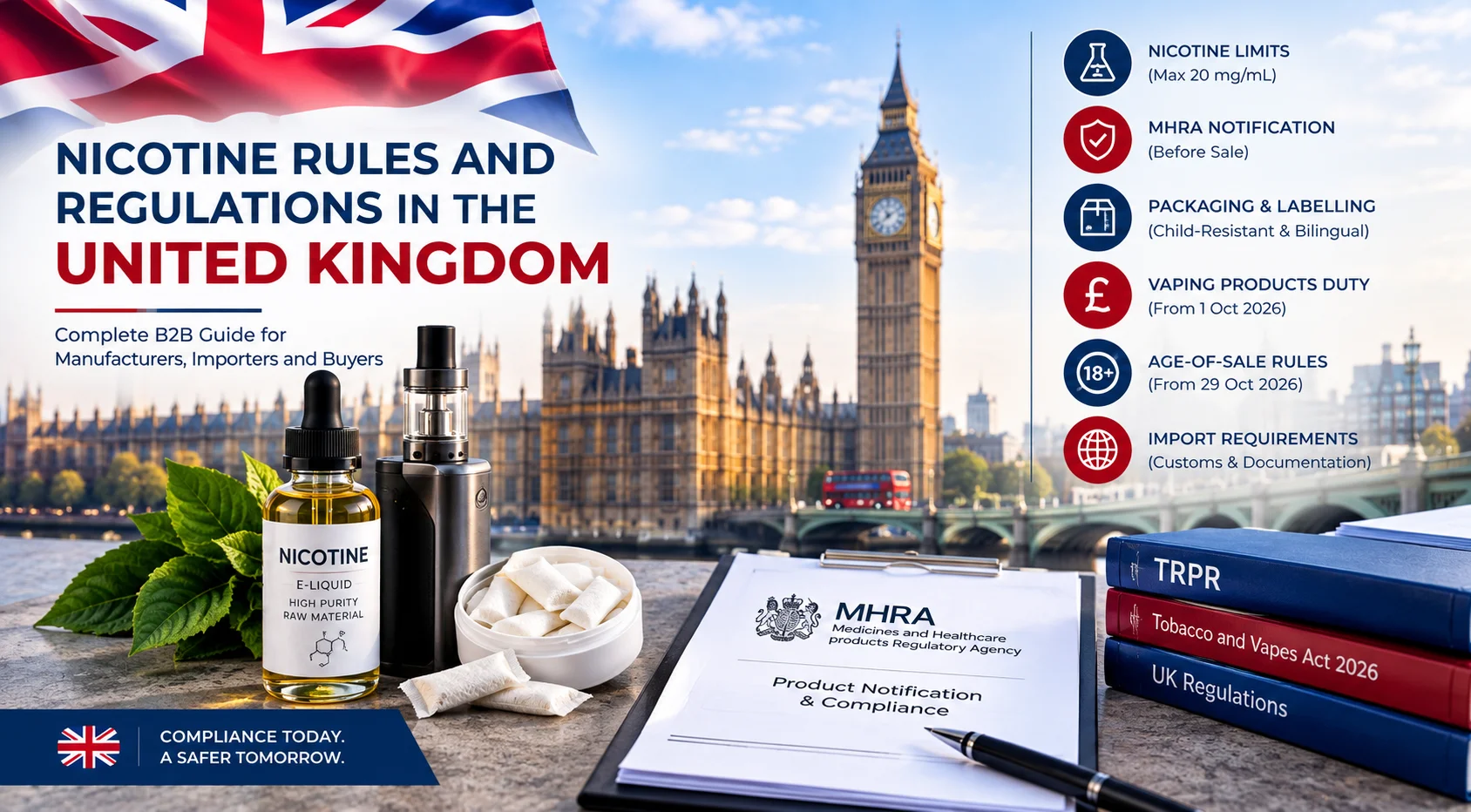
Understanding nicotine rules and regulations in the United Kingdom is important for manufacturers, importers, wholesalers and B2B buyers involved in nicotine and vaping products.
The UK regulatory framework covers product safety, nicotine concentration, packaging, labelling, product notification, sales restrictions and, from 1 October 2026, Vaping Products Duty. Additional measures under the Tobacco and Vapes Act 2026 also come into force later in 2026 and 2027.
For international suppliers, it is therefore important to distinguish between current requirements and upcoming UK requirements.
1. Who Regulates Nicotine Products in the UK?
The Medicines and Healthcare products Regulatory Agency (MHRA) is the competent authority for the notification scheme covering nicotine-containing vaping products in Great Britain and Northern Ireland.
The main product framework for nicotine-containing vaping products is based on the Tobacco and Related Products Regulations 2016 (TRPR), as amended.
The Tobacco and Vapes Act 2026 introduces additional powers and restrictions covering vaping and nicotine products, including age-of-sale, packaging, product standards, registration and vending-machine restrictions.
For B2B companies, the first step should therefore be identifying which regulatory requirements apply to the specific product.
2. Maximum Nicotine Concentration in the UK
One of the key requirements for nicotine-containing e-liquids is the maximum permitted nicotine strength.
Under the current TRPR framework:
Maximum nicotine strength: 20 mg/mL
This is equivalent to approximately 2% nicotine.
For example:
10 mg/mL × 10 mL = 100 mg nicotine
At the maximum permitted concentration:
20 mg/mL × 10 mL = 200 mg nicotine
The 20 mg/mL maximum applies to consumer vaping products under the TRPR framework.
3. Maximum Vaping Product Volumes
UK regulations also specify maximum volumes for certain vaping products.
E-cigarette tank / cartridge
Maximum:
2 mL
Nicotine-containing refill container
Maximum:
10 mL
Therefore, a 10 mL refill containing 20 mg/mL nicotine would contain:
20 × 10 = 200 mg total nicotine
These limits are part of the UK consumer vaping-product requirements.
4. MHRA Product Notification
Nicotine-containing e-cigarettes and refill containers must be notified to the MHRA and published before they can be sold under the applicable TRPR framework.
For manufacturers and importers, this makes product notification an important part of market-entry planning.
Businesses procuring finished vaping products should check that the relevant product notification has been published before supplying it to consumers. GOV.UK specifically advises retailers to verify the product on the relevant MHRA notified-product lists.
5. Child-Resistant and Tamper-Evident Packaging
UK requirements include child-resistant and tamper-evident packaging for nicotine-containing products covered by the relevant regulations.
This means packaging specifications should be considered during product development and procurement rather than after the product has already been manufactured.
For B2B suppliers, documentation should clearly identify the packaging configuration and applicable compliance requirements.
6. Labelling Requirements
UK vaping products are subject to specific labelling and warning requirements.
The regulatory framework is designed to ensure consumers receive information that allows them to make informed choices.
Relevant information can include:
- Nicotine concentration
- Health warnings
- Product information
- Ingredients
- Safety information
- Instructions for use and storage
The UK government is also consulting on additional standardisation of information for vaping and nicotine-product packaging, including nicotine strength, ingredients, expiry information and age-restriction symbols. These proposals should be treated as proposals, not automatically as current requirements.
7. Certain Ingredients Are Restricted
The TRPR framework also restricts certain ingredients in nicotine-containing vaping products.
The MHRA guidance identifies restrictions covering ingredients including:
- Colourings
- Caffeine
- Taurine
Products must also meet applicable safety and quality requirements.
For B2B procurement, suppliers should therefore provide sufficiently detailed product specifications for the buyer’s quality and regulatory review.
8. Single-Use Vapes Are Banned
An important UK development is the ban on single-use vapes.
The sale and supply of single-use vapes became illegal from:
1 June 2025
The ban applies to single-use vapes whether or not they contain nicotine and covers both online and physical sales. Reusable vapes remain permitted subject to applicable requirements.
Therefore, businesses supplying the UK market should distinguish between:
Reusable vaping products
and
Single-use/disposable vaping products
when evaluating product compliance.
9. New Age-of-Sale Rules From 29 October 2026
The Tobacco and Vapes Act 2026 introduces new restrictions on the sale of vaping and nicotine products.
From:
29 October 2026
it will be an offence to sell vaping or nicotine products to anyone under 18 across England, Wales, Scotland and Northern Ireland under the new framework.
The legislation also introduces restrictions concerning:
- Free promotional distribution
- Substantial promotional discounts
- Vending machines
- Product display
- Advertising and promotion
- Product standards
Some provisions apply differently across UK nations, so businesses should check the applicable jurisdiction.
10. Nicotine Pouches in the UK
The UK also regulates nicotine products that are not conventional vaping products.
The government’s 2026 guidance explicitly includes nicotine pouches, nicotine strips and nicotine pearls within the scope of certain new nicotine-product restrictions.
The guidance also states that all types of nicotine, including synthetic nicotine, are within scope of these restrictions.
This is important for B2B suppliers because regulatory assessment should not be based only on whether nicotine comes from tobacco or is synthetically produced.
11. Vaping Products Duty From 1 October 2026
A major new UK requirement for businesses is Vaping Products Duty (VPD).
It starts on:
1 October 2026
The duty applies to vaping liquid manufactured in or imported into the UK and is charged at:
£2.20 per 10 mL
The duty applies whether the vaping liquid contains nicotine or not, subject to the relevant exclusions for products such as medical or tobacco products.
Simple calculation
For a 10 mL product:
£2.20 ÷ 10 = £0.22 per mL
For a 2 mL pod:
2 × £0.22 = £0.44
For a 100 mL quantity:
100 × £0.22 = £22.00
This calculation is particularly relevant for importers, manufacturers and wholesalers planning UK pricing and landed costs.
12. Vaping Duty Stamps
From 1 October 2026, applicable vaping products released for sale in the UK will also need a vaping duty stamp, subject to the relevant duty-suspension arrangements.
HMRC states that vaping duty stamps must be attached to individual vaping products sold or supplied in the UK.
From 1 April 2027, the duty-stamp requirements become broader for vaping products outside duty suspension.
For overseas suppliers, this makes packaging and import planning increasingly important.
13. Importing Vaping Products Into the UK
Businesses importing vaping products should review both product regulations and the new excise requirements.
For imports, businesses may need to manage:
- Customs declarations
- Correct tariff classification
- Product descriptions
- Net liquid volume
- Invoices
- Packing lists
- Bills of lading
- Duty treatment
- Duty stamps
- Warehouse or duty-suspension arrangements
HMRC states that vaping products released for UK consumption from 1 October 2026 are subject to Vaping Products Duty and applicable duty-stamping requirements.
14. B2B Quality Documentation
Before purchasing nicotine or nicotine-containing materials, buyers should establish clear quality requirements.
Typical documents can include:
- Certificate of Analysis (CoA)
- Safety Data Sheet (SDS)
- Product specification
- Batch information
- Testing information
- Packaging specification
- Shipping documentation
- Regulatory documentation where applicable
For international sourcing, documentation should be reviewed before shipment rather than after the goods arrive.
You can also read our article How Manufacturers Can Reduce Risks When Sourcing Nicotine for a broader procurement and supplier-risk framework.
15. UK Nicotine Supplier Evaluation
A supplier should not be evaluated only on price.
For UK procurement, buyers can review:
- Product specification
- Nicotine concentration
- Batch documentation
- Testing capability
- Packaging
- MHRA notification where applicable
- Import documentation
- Delivery capability
- Regulatory support
- Long-term supply reliability
For broader supply-chain planning, see Building a Reliable Nicotine Raw Material Supply Chain.
16. UK Nicotine Regulation Checklist
Product
- Product category identified
- Intended use identified
- Nicotine strength confirmed
- Product volume confirmed
- Reusable/disposable status confirmed
Quality
- Product specification
- CoA
- SDS
- Batch information
- Testing requirements
UK Compliance
- Applicable TRPR requirements reviewed
- MHRA notification checked where applicable
- Packaging requirements reviewed
- Labelling requirements checked
- Age-of-sale requirements reviewed
Import & Tax
- Customs requirements checked
- Vaping Products Duty assessed
- Duty-stamp requirements assessed
- Import documentation prepared
17. Key UK Nicotine Regulations at a Glance
| Area | Requirement |
|---|---|
| Maximum nicotine strength | 20 mg/mL |
| Maximum tank/cartridge volume | 2 mL |
| Maximum nicotine refill container | 10 mL |
| MHRA notification | Required for applicable nicotine vaping products before sale |
| Packaging | Child-resistant and tamper-evident requirements |
| Single-use vapes | Sale/supply banned from 1 June 2025 |
| New age-of-sale rules | 18+ from 29 October 2026 |
| Vaping Products Duty | £2.20 / 10 mL from 1 October 2026 |
| Duty stamps | Applicable from 1 October 2026 |
| Broader duty-stamp requirement | 1 April 2027 |
The 20 mg/mL, 2 mL and 10 mL limits and MHRA notification requirements come from the existing vaping-product framework. The 2026–27 dates relate to newer UK legislation and HMRC measures.
Conclusion
The UK’s nicotine regulatory environment is evolving, particularly during 2026 and 2027.
For B2B businesses, compliance involves more than checking nicotine concentration. Companies should review product classification, nicotine strength, packaging, labelling, MHRA notification, import documentation and the new Vaping Products Duty and duty-stamp requirements.
For international suppliers, keeping product specifications and documentation aligned with the latest UK requirements can help make procurement and import processes more predictable.
Regulatory requirements can change, so businesses should verify the current requirements with the relevant UK authorities before manufacturing, importing or selling products.
FAQs
What is the maximum nicotine strength in the UK?
For consumer nicotine-containing vaping products under the TRPR framework, the maximum nicotine strength is 20 mg/mL.
What is the maximum vape tank size in the UK?
The maximum tank/cartridge capacity is 2 mL under the applicable vaping-product rules.
What is the maximum nicotine e-liquid refill size?
A nicotine-containing refill container can contain a maximum of 10 mL under the applicable TRPR requirements.
Are disposable vapes legal in the UK?
No. The sale and supply of single-use vapes has been banned since 1 June 2025, regardless of whether they contain nicotine.
What is the UK Vaping Products Duty?
From 1 October 2026, Vaping Products Duty is charged at £2.20 per 10 mL of applicable vaping liquid.