Understanding nicotine rules and regulations in Canada is important for manufacturers, B2B buyers, suppliers and businesses involved in nicotine-containing products.
Canada has different regulatory requirements depending on the type, intended use and claims associated with a nicotine product. Vaping products, nicotine replacement products and other nicotine-containing products may therefore fall under different regulatory frameworks.
For international buyers, regulatory requirements should be reviewed together with product specifications, documentation, packaging and import requirements.
For a broader understanding of procurement considerations, see our guide on Factors That Affect Bulk Nicotine Procurement: A B2B Buyer’s Guide.
1. Who Regulates Nicotine Products in Canada?
Health Canada is a key federal authority involved in regulating tobacco, vaping and certain nicotine-containing products.
The Tobacco and Vaping Products Act (TVPA) establishes requirements for tobacco and vaping products, including areas such as manufacturing, sale, promotion and labelling.
However, businesses should first determine the regulatory category of their particular product because different legislation may apply.
This is particularly important for companies importing nicotine products from another country.
2. Maximum Nicotine Concentration for Vaping Products
One of the most important requirements for vaping products is the maximum permitted nicotine concentration.
For vaping products manufactured or imported for sale in Canada, the applicable maximum concentration is:
20 mg/mL
For example, if a vaping liquid contains:
10 mg/mL × 30 mL = 300 mg total nicotine
Whereas:
20 mg/mL × 30 mL = 600 mg total nicotine
So a 30 mL product at the maximum concentration would contain:
600 mg of nicotine in total.
This calculation is useful for B2B manufacturers when reviewing formulations and product specifications.
3. Canadian Nicotine Labelling Requirements
Canadian vaping products have specific labelling requirements.
Depending on the product, required information can include:
- Product information
- Ingredient information
- Nicotine concentration
- Hazard information
- Required warnings
- First-aid information
Required information may need to be provided in English and French.
For international suppliers, this means Canadian-market packaging should be reviewed before commercial shipment.
4. Child-Resistant Packaging
Child safety is another important consideration.
Vaping products containing nicotine at or above the applicable threshold are subject to child-resistant packaging requirements.
For B2B manufacturers, packaging specifications should therefore be reviewed alongside product formulation rather than treating packaging as a separate procurement issue.
5. Nicotine Pouches in Canada
Nicotine pouches require particular attention because they are not automatically subject to exactly the same regulatory pathway as vaping products.
Health Canada’s regulatory framework distinguishes certain nicotine buccal pouches according to their dosage and intended use.
For example, the applicable 2026 regulatory changes address nicotine buccal pouches containing 4 mg or less of nicotine per dosage unit.
Therefore, businesses should not automatically apply the 20 mg/mL vaping limit to nicotine pouches.
The product category, dosage, intended use and regulatory claims should first be established.
6. Nicotine Dosage: A Simple B2B Calculation
For nicotine pouches, buyers may need to evaluate nicotine per dosage unit.
For example:
10 pouches × 4 mg nicotine/pouch
= 40 mg total nicotine in the package
However, the regulatory assessment is based on the applicable dosage-unit requirement, not simply the total nicotine contained in the package.
This distinction is important when preparing product specifications for the Canadian market.
7. Therapeutic Claims and Nicotine Products
A nicotine product making therapeutic claims can be subject to a different regulatory pathway.
For example, a product marketed with claims related to smoking cessation may fall under Canada’s Food and Drugs Act framework.
Therefore, manufacturers should distinguish between:
Product composition
and
Product claims / intended use
before determining the applicable regulatory requirements.
8. Importing Nicotine Products into Canada
International businesses should review Canadian import requirements before shipping nicotine-containing products.
Important documents may include:
- Commercial invoice
- Packing list
- Certificate of Analysis
- Safety Data Sheet
- Certificate of Origin
- Shipping documents
- Applicable regulatory/customs documentation
Documentation requirements can vary according to the product and transaction.
Our article How Manufacturers Can Reduce Risks When Sourcing Nicotine discusses documentation, supplier evaluation, testing and international sourcing risks in greater detail.
9. Quality Documentation for Canadian Buyers
For B2B procurement, regulatory compliance should be supported by appropriate technical documentation.
A buyer may review:
- Product specification
- Certificate of Analysis (CoA)
- Batch number
- Test results
- Testing methods
- SDS
- Packaging information
- Traceability information
For example, if a buyer receives 5 batches, each batch should have appropriate batch-specific documentation where required by the buyer’s quality system.
This helps procurement and quality teams maintain better records.
Our Building a Reliable Nicotine Raw Material Supply Chain article also covers documentation, batch consistency, procurement planning and supply-chain visibility.
10. Supplier Qualification for Canadian Market
Selecting a supplier should involve more than comparing price.
Canadian-market buyers can evaluate:
- Product specifications
- Quality documentation
- Testing capability
- Packaging
- Production capacity
- Lead time
- Export documentation
- Destination-country requirements
- Batch traceability
- Long-term supply capability
This approach is particularly useful for companies moving from sample quantities to regular commercial supply.
11. Bulk Nicotine Procurement for Canada
For bulk purchases, buyers should define their requirements before requesting quotations.
A useful procurement specification can include:
| Requirement | Example |
|---|---|
| Product | Nicotine raw material |
| Quantity | 100 kg |
| Purity | As per agreed specification |
| Packaging | Agreed commercial packaging |
| Documentation | CoA + SDS |
| Destination | Canada |
| Delivery | Agreed schedule |
| Testing | Agreed analytical parameters |
The exact requirements should always be determined according to the product and intended application.
For additional procurement considerations, see Factors That Affect Bulk Nicotine Procurement: A B2B Buyer’s Guide.
12. Why Supply-Chain Planning Matters
Canadian regulatory compliance is only one part of international nicotine procurement.
Businesses also need to consider:
- Supplier reliability
- Lead time
- Inventory
- Documentation
- Shipping
- Customs
- Packaging
- Quality consistency
For example, if a manufacturer normally requires 100 kg/month and the supplier’s lead time is 30 days, procurement planning should account for the expected consumption during that lead time.
This is why a structured supply-chain strategy is important.
See Building a Reliable Nicotine Raw Material Supply Chain for more information.
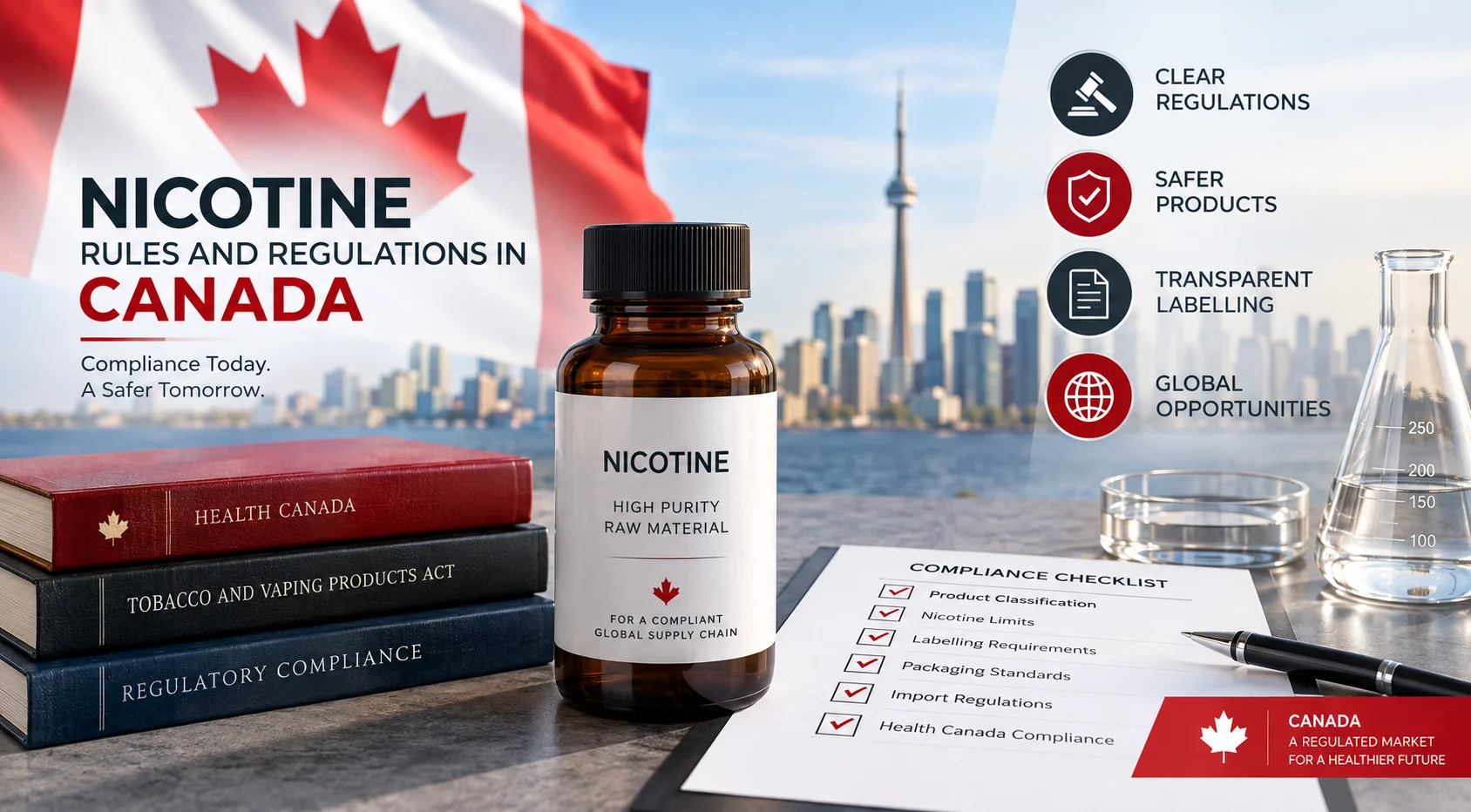
13. Canada Nicotine Regulation Checklist
Before supplying nicotine products to Canada, businesses can review:
Product
- Product category identified
- Intended use identified
- Nicotine concentration/dosage confirmed
- Product specifications finalized
Quality
- CoA available
- Batch information available
- Testing requirements confirmed
- SDS available
Packaging
- Packaging requirements reviewed
- Required warnings reviewed
- English/French labelling requirements checked
- Child-resistant requirements reviewed where applicable
Commercial
- Quantity confirmed
- MOQ confirmed
- Lead time confirmed
- Shipping terms agreed
Regulatory
- Canadian product classification reviewed
- Applicable Health Canada requirements reviewed
- Import requirements checked
- Required documentation confirmed
Conclusion
Understanding nicotine rules and regulations in Canada requires more than checking a single nicotine concentration limit.
Businesses should first identify the product category and intended use, then review the applicable requirements for concentration, dosage, packaging, labelling, documentation, imports and regulatory authorization.
For B2B buyers, combining regulatory review with proper supplier qualification and supply-chain planning can create a more structured procurement process.
Because Canadian requirements can change, businesses should verify the current requirements with the relevant Canadian authorities before manufacturing, importing or selling nicotine-containing products.
FAQs
What is the maximum nicotine concentration for vaping products in Canada?
The federal maximum for vaping products manufactured or imported for sale in Canada is 20 mg/mL.
Are nicotine pouches regulated in Canada?
Yes. Certain nicotine buccal pouches are subject to Canada’s drug regulatory framework, with requirements depending on dosage and other factors.
What is the 4 mg nicotine pouch limit?
The 2026 regulatory change addresses certain nicotine buccal pouches containing 4 mg or less per dosage unit.
Are Canadian nicotine labels required in French?
Canadian requirements include bilingual information in English and French for applicable vaping-product labelling.
Can nicotine products be imported into Canada?
Importation is possible subject to the applicable Canadian laws, regulations, product classification and import requirements.