Czech Republic Nicotine Regulations 2026: Compliance Guide for Manufacturers & B2B Buyers
Understanding nicotine regulations in Czech Republic is important for manufacturers, importers, distributors, retailers and B2B buyers involved in nicotine-containing products.
The Czech Republic regulates tobacco products, electronic cigarettes, nicotine pouches and other nicotine-containing products through national legislation together with applicable European Union requirements.
For international businesses, compliance depends on the specific product category, formulation, intended use, packaging and distribution channel. Companies planning to supply the Czech market should therefore review the requirements applicable to their particular product before manufacturing, importing or distributing it.
1. Overview of Nicotine Regulations in Czech Republic
The Czech regulatory framework covers several categories of tobacco and nicotine-related products.
These include:
- Tobacco products
- Electronic cigarettes
- E-liquids and refill containers
- Nicotine pouches without tobacco
- Other products containing nicotine
- Certain nicotine-related alternative products
Czech legislation contains specific requirements for tobacco-free nicotine pouches. Manufacturers, importers, distributors and retailers are responsible for ensuring that covered products comply with applicable requirements concerning composition, appearance, quality and characteristics.
For B2B companies, correct product classification is therefore an important first step.
2. Nicotine Pouches in the Czech Republic
Nicotine pouches without tobacco are specifically regulated under Czech legislation.
The rules require manufacturers, importers, retailers and distributors to ensure that nicotine pouches comply with prescribed requirements.
The legislation also requires information to be provided on the unit packaging, including:
- List of ingredients
- Nicotine content
- Quantity of nicotine per dose
- Batch number or equivalent production identification
- Information concerning keeping the product away from persons under 18
- Health warning
- Instructions for use and storage
- Information concerning contraindications
- Information about potential adverse effects
- Information concerning dependence and toxicity
- Manufacturer or importer contact details
Manufacturers and importers also have notification responsibilities concerning nicotine pouches intended to be placed on the Czech market.
3. Maximum Nicotine Content for Nicotine Pouches
Czech implementing rules establish specific limits for nicotine pouches.
Under the relevant regulation, a single nicotine-pouch dose may contain no more than 12 mg of nicotine. The unit package may contain no more than 240 mg of nicotine and must contain at least 20 doses.
This makes formulation and product specification particularly important for manufacturers supplying the Czech market.
B2B buyers should verify the nicotine concentration and batch documentation before purchasing products intended for the Czech consumer market.
4. Packaging and Labelling Requirements
Packaging compliance is a major consideration for nicotine products in the Czech Republic.
For regulated nicotine pouches, packaging requirements include information about ingredients, nicotine content, nicotine quantity per dose and production/batch identification.
Additional consumer and safety information is also required under Czech legislation.
Manufacturers should therefore review packaging artwork before production rather than assuming that packaging designed for another European market will automatically meet Czech requirements.
5. Age Restrictions on Nicotine Products
The Czech Republic restricts the sale or supply of nicotine pouches, electronic cigarettes and certain other nicotine-containing products to people under 18.
The legislation prohibits selling, supplying or giving covered nicotine products to persons younger than 18 years. It also establishes restrictions concerning where these products can be sold.
Retailers and distributors therefore need appropriate age-verification procedures when selling covered products.
6. Retail and Distribution Requirements
Czech rules also regulate where covered tobacco and nicotine products can be sold.
Restrictions apply to the sale of tobacco products, electronic cigarettes, nicotine pouches without tobacco and products containing nicotine through certain retail channels and vending machines.
For vending-machine sales, age verification requirements apply where necessary to prevent sales to persons under 18.
Businesses entering the Czech market should therefore review both product compliance and distribution-channel requirements.
7. Excise Tax on Nicotine Products
Taxation is another important consideration for companies supplying nicotine products to the Czech Republic.
Czech excise-tax legislation defines certain products related to tobacco products to include:
- Electronic cigarette refills
- Nicotine pouches
- Other nicotine products
The tax base for nicotine pouches and other specified nicotine products is based on the quantity of product contained in the unit package.
For 2026, the Czech Ministry of Finance announced a 50% increase in the excise-tax rate for nicotine pouches, electronic-cigarette liquids and certain other newly taxed alternative products. The ministry also states that the nicotine-pouch rate is scheduled to reach CZK 1.7 per gram in 2027.
Importers and distributors should therefore consider applicable excise obligations when calculating landed costs and pricing.
8. Electronic Cigarettes and Nicotine Liquids
Electronic cigarettes and nicotine-containing refill liquids are subject to their own regulatory requirements.
Depending on the product, businesses may need to consider:
- Nicotine concentration
- Product composition
- Packaging
- Labelling
- Safety information
- Product notification
- Import requirements
- Taxation
- Retail restrictions
Companies should avoid treating all nicotine products as one regulatory category because requirements can vary according to the product and intended use.
9. Nicotine Raw Materials for B2B Manufacturing
The regulatory assessment for nicotine raw materials can differ from the requirements applicable to finished consumer products.
A company purchasing nicotine as a manufacturing input should establish the intended use and applicable legal classification before shipment.
For B2B procurement, buyers should maintain documentation such as:
- Product specification
- Certificate of Analysis (CoA)
- Safety Data Sheet (SDS)
- Batch information
- Purity information
- Nicotine concentration
- Packaging specifications
- Manufacturer details
- Transport documentation
These records can help manufacturers maintain quality control and supply-chain traceability.
10. Importing Nicotine Products into Czech Republic
International companies planning to export nicotine products to the Czech Republic should review the requirements before shipment.
A practical pre-shipment review can include:
- Confirming the product classification
- Checking nicotine concentration
- Reviewing formulation and ingredients
- Confirming packaging requirements
- Checking labelling requirements
- Reviewing product notification obligations
- Checking customs requirements
- Confirming applicable excise taxation
- Reviewing age and retail restrictions
- Maintaining complete product documentation
The exact requirements can differ between finished consumer products and nicotine materials intended for manufacturing.
11. Czech Republic and EU Nicotine Regulations
The Czech Republic operates within the broader European Union regulatory framework, but national rules remain important.
EU-level requirements may provide the wider regulatory framework, while Czech legislation can establish additional national requirements concerning specific nicotine products, taxation, sales and packaging.
Therefore, manufacturers should not assume that compliance in another EU country automatically means compliance in the Czech Republic.
Destination-specific regulatory checks are particularly important for businesses supplying multiple European markets.
12. Czech Republic Compared With Other European Markets
Nicotine regulations differ from one European market to another.
For B2B companies selling or sourcing nicotine products internationally, comparing country-specific requirements can help identify differences in product specifications, taxation, packaging and market-entry requirements.
You can also read our other regulatory guides:
- Nicotine Regulations in Poland
- Nicotine Regulations in Ireland
- Nicotine Regulations in Portugal
- Rules & Regulations of Nicotine in Denmark
- Rules & Regulations of Nicotine in Estonia
- Nicotine Regulations in Sweden
- Nicotine Regulations in Switzerland
- Nicotine Rules and Regulations in the United Kingdom
These internal links create a useful European nicotine-regulation cluster for readers and can help search engines understand the relationship between your country-specific regulatory articles.
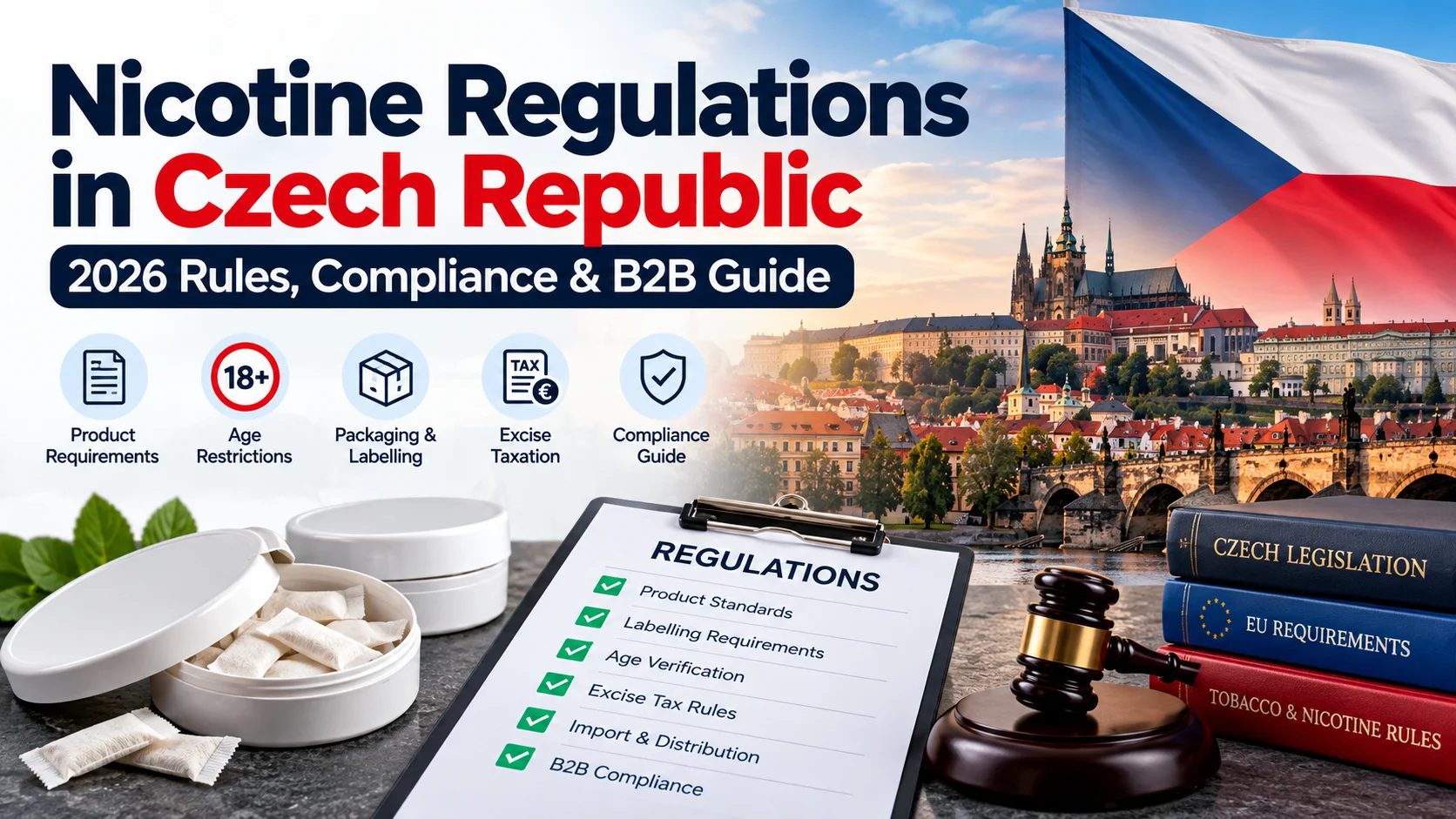
13. Compliance Checklist for B2B Buyers
Before supplying nicotine products to the Czech Republic, businesses should review:
Product Compliance
- Product category
- Intended use
- Nicotine concentration
- Ingredients
- Product specifications
- Applicable nicotine limits
Documentation
- Certificate of Analysis
- Safety Data Sheet
- Batch information
- Manufacturer details
- Product documentation
- Transport documentation
Packaging & Labelling
- Ingredients declaration
- Nicotine content
- Nicotine per dose
- Batch identification
- Health warnings
- Required safety information
- Manufacturer/importer details
Import & Tax
- Customs classification
- Import documentation
- Excise-tax requirements
- Applicable tax rate
- Distribution requirements
14. Why Czech Compliance Matters for Nicotine Suppliers
For international manufacturers and suppliers, compliance should be considered before production and shipment.
A product that complies with one European market may require additional checks before being supplied to the Czech Republic.
This is particularly relevant for nicotine pouches because Czech legislation contains specific requirements concerning nicotine content, packaging information, product notification and other compliance measures.
For international B2B buyers, maintaining reliable product documentation and batch traceability can also make regulatory and quality-control processes more structured.