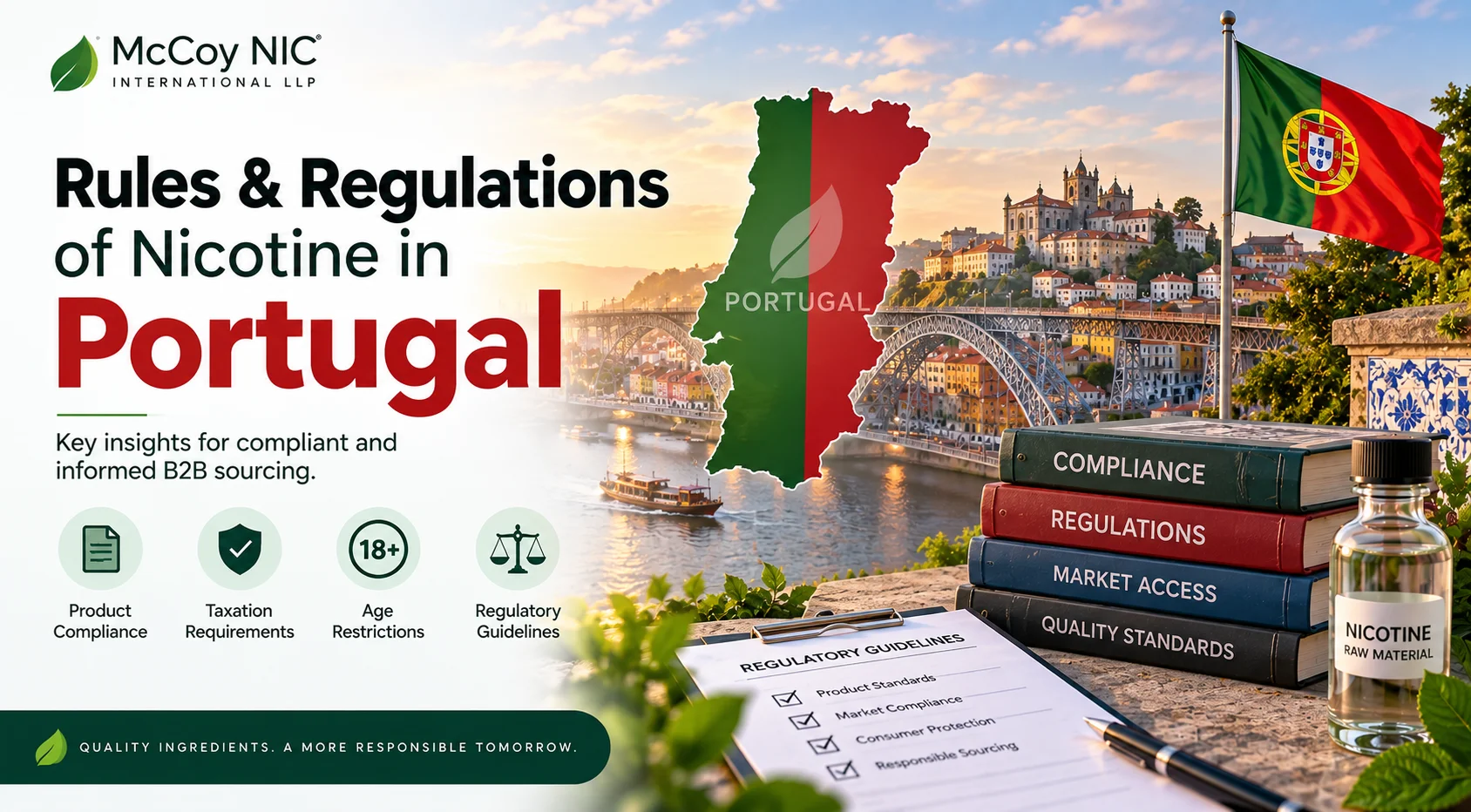
Nicotine regulations in Portugal are important for manufacturers, importers, distributors and B2B buyers involved in nicotine-containing products. Portugal applies national tobacco-control legislation together with relevant European Union requirements.
For companies working with electronic cigarettes, nicotine liquids, nicotine pouches or nicotine raw materials, understanding the applicable product category and intended use is essential before entering the Portuguese market.
What Are the Main Nicotine Regulations in Portugal?
Portugal regulates different categories of tobacco and nicotine-related products through its national tobacco-control and taxation framework.
The applicable requirements can differ depending on whether a business is dealing with electronic cigarettes, refill liquids, tobacco products, nicotine pouches or nicotine as a raw material.
For B2B manufacturers and buyers, the first step should therefore be to identify the product classification, intended application and role of the company in the supply chain.
Electronic Cigarettes and Nicotine E-Liquids in Portugal
Electronic cigarettes containing nicotine are covered by Portugal’s tobacco-control framework. Portuguese authorities also apply European Union requirements to nicotine-containing refill products.
The Portuguese market requires appropriate product information, packaging and safety information. The Portuguese economic and food-safety authority, ASAE, notes that refill liquids must comply with applicable requirements concerning hazardous substances, labelling and packaging, including the EU Classification, Labelling and Packaging (CLP) framework. Labels and packaging must provide appropriate information and warnings in Portuguese.
Businesses supplying electronic cigarettes and refill liquids should therefore review both product-specific tobacco rules and applicable chemical-safety requirements.
Product Notification and Market Entry
Manufacturers and importers introducing covered tobacco or nicotine-related products into Portugal may have notification or authorization obligations depending on the product category.
For new tobacco products, the Portuguese government states that manufacturers or importers must obtain authorization from the Direção-Geral das Atividades Económicas (DGAE) before placing a new tobacco product on the Portuguese market.
This means companies planning to introduce a new regulated product should complete the relevant regulatory process before commercialisation.
Nicotine Pouches in Portugal
Nicotine pouches are an important area of regulatory development in Portugal.
Portugal introduced taxation of certain nicotine pouches through changes to its excise-tax framework. From 1 January 2026, nicotine pouches containing natural nicotine of up to 12 mg, without tobacco, became subject to Portuguese Tobacco Tax under the applicable legislation.
The Portuguese Tax and Customs Authority states that operators must also comply with obligations applicable to other excise products, including prior communication of products intended for sale.
Individual packages of covered nicotine pouches placed on the Portuguese market must also carry the required special tax stamp.
For companies supplying nicotine pouch products to Portugal, taxation, product notification and packaging requirements should therefore be considered together.
Proposed Regulation of Oral Nicotine Products
Portugal’s regulatory framework for nicotine pouches continues to develop.
On 7 May 2026, the Portuguese Council of Ministers approved a legislative authorization proposal intended to create a specific legal framework for nicotine pouches and tobacco-free oral nicotine products.
The proposal included potential controls covering manufacturing, commercialisation, labelling, advertising and enforcement. It also proposed restrictions concerning sales to minors, maximum nicotine levels, flavours and online sales.
Because this was a legislative proposal rather than simply an existing product requirement, businesses should distinguish between rules already in force and proposed future requirements when assessing the Portuguese market.
Age Restrictions and Consumer Protection
Portugal’s tobacco-control framework contains restrictions concerning the sale, promotion and use of regulated nicotine and tobacco products.
Portuguese authorities have also extended tobacco-control measures to electronic cigarettes containing nicotine. The official government guidance states that the tobacco-control regime applies to electronic cigarettes when they use nicotine or components of such products.
Companies selling finished nicotine products should therefore review applicable age, retail, advertising and promotional requirements before entering the Portuguese market.
Advertising and Promotion of Nicotine Products
Advertising and promotion are important compliance considerations in Portugal.
The Portuguese tobacco-control framework includes restrictions on advertising, promotion and sponsorship of regulated tobacco and nicotine-related products. Electronic cigarettes and newer tobacco products are also addressed within the broader regulatory framework.
For B2B manufacturers, these consumer-facing restrictions are particularly relevant when a finished product is being launched or marketed in Portugal.
Nicotine Raw Material Requirements in Portugal
For businesses purchasing nicotine raw material in Portugal, the regulatory assessment can differ from the requirements applicable to finished consumer products.
A B2B buyer should first establish the intended use of the nicotine and the final product in which it will be incorporated.
Important documentation may include:
- Certificate of Analysis (CoA)
- Safety Data Sheet (SDS)
- Product specification
- Purity and assay information
- Batch number and traceability
- Packaging information
- Transport documentation
- Applicable REACH and CLP information
- Import and customs documentation
Portuguese authorities specifically highlight the importance of safety information, labelling and packaging for nicotine-containing refill liquids.
Why Batch Consistency Matters
For manufacturers using nicotine as a raw material, consistent specifications are important for production planning and quality control.
Buyers should evaluate the supplier’s ability to provide consistent batches together with appropriate analytical and technical documentation.
McCoy NIC’s related guide How Can Buyers Verify Batch-to-Batch Consistency in Nicotine? can be used as an internal resource for manufacturers evaluating nicotine suppliers.
Building a Reliable Nicotine Supply Chain
A reliable supply chain requires more than simply selecting a nicotine supplier.
Manufacturers should establish clear specifications, documentation requirements, quality expectations, packaging requirements and delivery conditions before placing regular orders.
McCoy NIC’s Building a Reliable Nicotine Raw Material Supply Chain provides additional information on supplier qualification, documentation and supply-chain planning.
Bulk Nicotine Procurement for Portuguese Buyers
For B2B buyers sourcing nicotine for manufacturing applications, procurement requirements should be defined before commercial negotiations.
Buyers should consider:
- Nicotine type and grade
- Required purity
- Quantity and MOQ
- Packaging format
- Intended application
- Certificate of Analysis
- Safety Data Sheet
- Batch traceability
- Delivery destination
- Import requirements
- Required lead time
Understanding these factors can help manufacturers communicate their requirements more clearly to international suppliers.
McCoy NIC’s Factors That Affect Bulk Nicotine Procurement: A B2B Buyer’s Guide covers important considerations for bulk nicotine purchasing.
Reducing Risks When Sourcing Nicotine
International sourcing can involve risks related to inconsistent specifications, documentation, logistics, product classification and regulatory requirements.
Manufacturers can reduce these risks by qualifying suppliers, confirming product specifications, reviewing batch documentation and understanding the requirements of the destination market.
The McCoy NIC guide How Manufacturers Can Reduce Risks When Sourcing Nicotine provides additional information for manufacturers developing a structured sourcing process.
What Should B2B Buyers Check Before Purchasing Nicotine in Portugal?
Before purchasing nicotine for manufacturing, buyers should review:
- Product classification and intended use
- Required nicotine specification
- Applicable Portuguese regulations
- Relevant EU requirements
- REACH and CLP requirements where applicable
- Certificate of Analysis
- Safety Data Sheet
- Batch traceability
- Packaging and labelling
- Import and customs requirements
- Excise requirements for applicable finished products
- Supplier production and supply capability
This approach can help technical, procurement and regulatory teams establish clearer requirements before beginning commercial supply.
McCoy NIC and B2B Nicotine Supply
For qualified B2B buyers, McCoy NIC International LLP supplies documented nicotine raw materials and nicotine salts for manufacturing applications.
When evaluating a supplier for the Portuguese market, buyers can review product specifications, quality documentation, batch information, packaging, logistics and supply capability.
A structured supplier-qualification process can help manufacturers establish a more reliable procurement strategy while responding to destination-market requirements.
Conclusion
Nicotine regulations in Portugal cover several areas, including electronic cigarettes, nicotine-containing liquids, tobacco products, nicotine pouches, taxation, product compliance and consumer protection.
From 1 January 2026, qualifying nicotine pouches containing natural nicotine up to 12 mg and no tobacco became subject to Portuguese Tobacco Tax, together with related reporting and special tax-stamp obligations.
Portugal is also developing its regulatory approach to tobacco-free oral nicotine products. In May 2026, the government approved a legislative authorization proposal covering areas such as manufacturing, sales, labelling, advertising, nicotine limits and sales to minors.
For B2B manufacturers and nicotine raw-material buyers, regulatory review should therefore be combined with clear product specifications, appropriate documentation, batch traceability and supplier qualification.
Businesses planning to place nicotine-containing products on the Portuguese market should verify the current requirements applicable to their specific product and intended use before commercialisation.