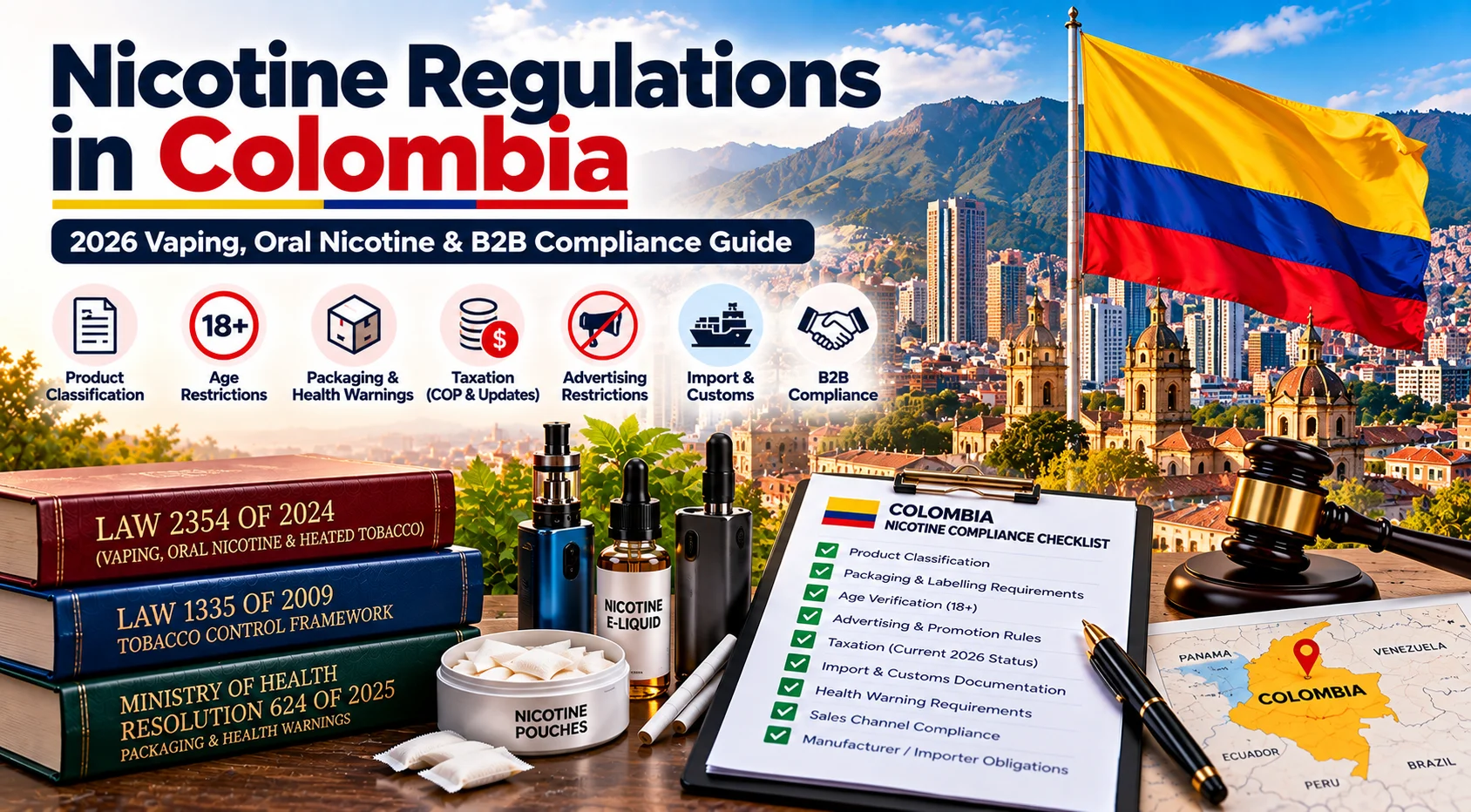
Nicotine Regulations in Colombia: 2026 Vaping, Oral Nicotine & B2B Compliance Guide
Understanding nicotine regulations in Colombia is increasingly important for manufacturers, importers, distributors, retailers and B2B buyers dealing with nicotine-containing products.
Colombia’s regulatory framework has expanded beyond traditional tobacco products. Law 2354 of 2024 brought electronic nicotine administration systems, nicotine-free electronic systems, heated tobacco products and oral nicotine products within the scope of Colombia’s tobacco-control framework.
For international businesses, the key point is that compliance depends on the product category, intended use, packaging, marketing, sales channel and destination-market requirements.
Important: This article provides general regulatory information for business and research purposes. It is not legal, tax or regulatory advice. Companies should verify the latest requirements with Colombian authorities and qualified local professionals before importing, manufacturing or selling nicotine products.
1. What Are the Nicotine Regulations in Colombia?
The principal framework comes from Law 1335 of 2009, which established controls relating to tobacco products, sales to minors, advertising, promotion, packaging, labelling and smoke-free environments.
Law 2354 of 2024 expanded the scope of these controls to include products and devices such as:
- Electronic Nicotine Administration Systems (SEAN)
- Similar Electronic Systems Without Nicotine (SSSN)
- Heated Tobacco Products (PTC)
- Oral Nicotine Products (PNO)
- Other tobacco substitutes, imitators and related devices
The law specifically states that the control measures established under Law 1335 apply to these additional categories.
This makes Colombia’s 2026 regulatory environment relevant not only to conventional tobacco manufacturers but also to businesses involved in vaping, oral nicotine and other emerging nicotine formats.
2. Colombia’s Main Regulatory Framework
The main legislation and regulatory resources include:
Law 1335 of 2009
Law 1335 established Colombia’s core tobacco-control rules, including restrictions on sales to minors, advertising and promotion, packaging and labelling requirements.
Law 2354 of 2024
Law 2354 expanded the regulatory scope to electronic nicotine systems, heated tobacco and oral nicotine products, among other products and devices.
Ministry of Health Requirements
Colombia’s Ministry of Health maintains current regulatory information and links to applicable rules, including Resolution 624 of 2025 and the official health-warning materials applicable for 2026–2027.
For manufacturers and importers, these official materials are particularly important because packaging and health-warning requirements can change according to product category.
3. Age Restriction for Nicotine and Tobacco Products
One of the central requirements under Colombia’s framework is protection of people under 18.
Law 1335 prohibits the direct or indirect sale of tobacco products and derivatives to persons under 18 years of age. Sellers are also required to display a clear notice at the point of sale indicating that sales to minors are prohibited.
Because Law 2354 extends the control framework to electronic nicotine systems, heated tobacco products and oral nicotine products, businesses should treat age-verification and responsible retail controls as important compliance requirements for covered products.
For B2B companies, this means downstream distributors and retailers should have appropriate procedures for age-restricted sales.
4. Vaping Products and Electronic Nicotine Systems
Colombia’s 2024 legislation expressly includes Sistemas Electrónicos de Administración de Nicotina (SEAN) within the regulatory framework.
This means electronic nicotine products are no longer outside the main tobacco-control framework simply because they do not contain conventional tobacco leaf. Law 2354 also covers similar electronic systems without nicotine.
Businesses supplying vaping products should therefore review:
- Product classification
- Nicotine content
- Product composition
- Packaging
- Labelling
- Health warnings
- Advertising and promotion
- Age restrictions
- Sales channels
- Import documentation
- Applicable taxation
- Destination-market requirements
The Colombian Ministry of Health currently publishes dedicated health-warning resources for electronic nicotine systems and liquids used in such systems.
5. Oral Nicotine Products in Colombia
Another important development is the inclusion of Productos de Nicotina Oral (PNO) in the regulatory framework.
Law 2354 specifically identifies oral nicotine products and applies the relevant control measures established under Law 1335.
This is important for manufacturers and suppliers dealing with products such as tobacco-free oral nicotine formats.
Businesses should not assume that a tobacco-free product automatically falls outside Colombia’s tobacco-control requirements.
Before entering the Colombian market, companies should determine:
- Whether the product qualifies as an oral nicotine product
- Whether it is a tobacco product, substitute or imitator
- What packaging requirements apply
- What health-warning requirements apply
- What sales restrictions apply
- What advertising restrictions apply
- Whether any registration or notification is required
- What customs and tax treatment applies
6. Packaging and Labelling Requirements
Packaging is an important part of nicotine regulations in Colombia.
Under Law 1335, tobacco-product packaging cannot be designed to target or particularly attract minors. Packaging also cannot make misleading claims suggesting that smoking provides athletic, professional, social or sexual benefits.
The legislation also establishes health-warning and pictogram requirements for covered tobacco products.
For products covered by the expanded 2024 framework, businesses should consult the current Ministry of Health materials rather than relying only on older tobacco packaging examples.
The Ministry currently provides official 2026–2027 warning resources for:
- Tobacco products
- Heated tobacco devices
- Heated tobacco products
- Electronic nicotine systems
- Electronic systems without nicotine
- E-liquids
- Oral nicotine products
What B2B Buyers Should Check
Before approving packaging for the Colombian market, buyers should verify:
- Product category
- Applicable warning format
- Language requirements
- Required health-warning placement
- Product information
- Manufacturer/importer information
- Batch information
- Ingredients or composition information
- Applicable country-of-origin information
- Current Ministry of Health requirements
7. Advertising and Promotion
Colombia’s tobacco-control framework includes restrictions on advertising and promotion.
Law 1335 prohibits forms of promotion of tobacco products and their derivatives, while Law 2354 extends the relevant control framework to electronic nicotine systems, heated tobacco products and oral nicotine products.
For manufacturers and distributors, this means marketing materials should be reviewed carefully before launch.
Businesses should pay particular attention to:
- Digital advertising
- Social-media promotion
- Influencer marketing
- Product claims
- Promotional campaigns
- Point-of-sale materials
- Youth-oriented imagery
- Health-related claims
- Product comparisons
A marketing strategy that may be permitted in another country should not automatically be assumed to be permitted in Colombia.
8. Smoke-Free and Aerosol-Free Environments
Colombia’s framework also addresses exposure to smoke and aerosols.
Law 2354 changed the understanding of “smoke-free” environments to include smoke and aerosols associated with covered substitutes and imitators.
This is particularly relevant to businesses dealing with vaping and electronic nicotine systems because workplace, hospitality and public-space compliance should not be assessed only on the basis of traditional cigarette smoke.
The Colombian Ministry of Health also provides official signage resources for smoke-free and aerosol-free environments.
9. Colombia Nicotine Tax and Excise Position in 2026
Taxation requires particular care when researching Colombia’s 2026 nicotine market.
At the end of 2025, Decree 1474 of 2025 introduced an expanded consumption-tax framework covering cigarettes, tobacco products and derivatives, substitutes or imitators, including electronic nicotine systems and vaping products.
The decree specified a COP 2,000 per millilitre specific component and a 30% ad valorem component for derivatives, substitutes or imitators.
However, this should not be presented as the current 2026 rate without qualification.
The Colombian Constitutional Court subsequently declared Decree 1474 of 2025 unconstitutional in Decision C-079 of 2026. DIAN states that the decree produced effects only during the period from 30 December 2025 through 28 January 2026, with the Court determining the relevant consequences for taxes and payments made during that period.
Therefore, manufacturers and importers should verify the currently applicable tax regime with DIAN and the relevant Colombian authorities before calculating landed cost, pricing or import economics.
This is especially important because tax treatment can differ depending on whether the product is:
- Conventional tobacco
- Heated tobacco
- Vaping liquid
- Electronic nicotine device
- Oral nicotine product
- Another nicotine-containing product
10. Importing Nicotine Products into Colombia
International suppliers entering Colombia should evaluate customs and regulatory requirements before shipment.
The compliance review should include:
- Correct product classification
- Customs tariff classification
- Commercial invoice
- Packing list
- Country of origin
- Product specifications
- Ingredient information
- Health-warning requirements
- Applicable import documentation
- Tax treatment
- Local importer requirements
- Product-specific regulatory requirements
For international shipments, destination-market compliance should be checked before dispatch.
McCoy NIC’s article on Cross-Border Shipping Rules for Nicotine Products provides additional information on how changing country-specific requirements can affect international nicotine shipments.
11. Raw Nicotine vs Finished Nicotine Products
An important distinction for B2B buyers is the difference between raw nicotine materials and finished consumer products.
Colombia’s tobacco-control framework is primarily structured around tobacco products, derivatives, substitutes, imitators and devices used with those products. Law 2354 specifically expands the consumer-product framework to categories such as SEAN, PTC and PNO.
A company purchasing nicotine as an industrial raw material should therefore determine:
- Intended application
- Final product category
- Import classification
- Required technical documents
- Product purity and specifications
- COA requirements
- Packaging requirements
- Transport requirements
- Local regulatory obligations
Raw material requirements should not automatically be assumed to be identical to finished consumer-product requirements.
For B2B buyers, McCoy NIC’s Nicotine Technical Support article provides additional information on specifications, COAs, quality documentation, packaging and international supply requirements.
12. Product Quality and Documentation
Regulatory compliance is only one part of international nicotine procurement.
Manufacturers may also need to evaluate:
- Nicotine concentration
- Purity
- Batch consistency
- Certificate of Analysis
- Product specifications
- Impurity profile
- Packaging
- Storage conditions
- Traceability
- Supplier documentation
For international procurement, documentation can become particularly important because buyers may need to demonstrate product identity and quality during internal quality-control processes.
McCoy NIC’s recent article on Nicotine Batch Traceability in Global Supply Chains discusses the role of batch information, COAs and traceability in B2B nicotine sourcing.
13. Colombia Compared With Other Markets
Nicotine regulations differ significantly from one country to another.
For example, Canada has its own regulatory framework for nicotine-containing products, while the United States applies FDA requirements to regulated tobacco products and nicotine products.
Businesses should therefore avoid assuming that a product approved or accepted in one market automatically satisfies Colombian requirements.
For international B2B manufacturers, a country-by-country compliance review is generally more appropriate.
Useful comparisons include:
- Nicotine Regulations in Canada
- Nicotine Regulations in the United States
- Nicotine Regulations in Switzerland
- Nicotine Regulations in the United Kingdom
These markets have different requirements, so the links are useful for comparison rather than as substitutes for Colombian requirements.
14. B2B Compliance Checklist for Colombia
Before supplying nicotine products to Colombia, manufacturers and importers should review:
Product
- Product category identified
- Nicotine concentration verified
- Ingredients documented
- Intended use established
- Finished product vs raw material distinguished
Packaging
- Current Colombian warning requirements checked
- Required product information included
- Packaging reviewed for youth appeal
- Labelling reviewed before production
Sales
- 18+ restrictions implemented
- Retail controls established
- Online sales reviewed
- Distributor compliance confirmed
Marketing
- Advertising restrictions reviewed
- Digital campaigns checked
- Product claims reviewed
- Promotional materials assessed
Import
- HS/customs classification confirmed
- Import documentation prepared
- Country-of-origin documentation available
- Local importer requirements checked
Quality
- COA available
- Product specification available
- Batch information maintained
- Traceability records maintained
- Storage and transport requirements documented
Tax
- Current DIAN tax position verified
- Applicable departmental requirements checked
- Product-specific tax treatment confirmed before shipment
15. What Manufacturers Should Monitor in 2026
Companies supplying Colombia should continue monitoring:
- New Ministry of Health regulations
- Updated health-warning materials
- Product-category interpretations
- Oral nicotine requirements
- Vaping requirements
- Packaging and labelling rules
- Advertising restrictions
- Tax and customs developments
- Import requirements
- Enforcement activity
The Colombian Ministry of Health’s current tobacco-control resource page provides links to applicable legislation and the warning materials for 2026–2027, making it an important source for businesses monitoring compliance.