Nicotine Regulations in South Africa: 2026 Vaping, Tobacco & B2B Compliance Guide
Understanding nicotine regulations in South Africa is important for nicotine manufacturers, tobacco companies, vaping businesses, importers, exporters, distributors and B2B buyers.
South Africa currently regulates tobacco products primarily through the Tobacco Products Control Act 83 of 1993, as amended. At the same time, electronic nicotine delivery systems and other newer nicotine products are subject to an evolving regulatory and taxation framework.
A major development in 2026 is the continued parliamentary consideration of the Tobacco Products and Electronic Delivery Systems Control Bill (B33-2022). The Bill proposes a broader framework covering tobacco products, electronic delivery systems, packaging, advertising, manufacturing, imports and sales. However, the Bill remains under parliamentary consideration and should not be treated as enacted law.
For B2B companies, the distinction between current law, excise requirements and proposed legislation is therefore particularly important.
1. Overview of Nicotine Regulations in South Africa
South Africa’s tobacco-control framework is based on the Tobacco Products Control Act and its amendments.
The existing legislation regulates areas including:
- Tobacco-product sales
- Advertising and promotion
- Packaging and labelling
- Smoking restrictions
- Sale to persons under 18
- Free distribution
- Vending-machine sales
- Manufacturing and related activities
The South African Government describes the Tobacco Products Control Act as legislation intended to regulate smoking, tobacco-product sales and advertising and information appearing on tobacco-product packages.
For international companies, however, nicotine regulation is broader than the traditional tobacco framework because vaping products are also subject to customs and excise requirements.
2. Tobacco Products and Nicotine Products
South Africa distinguishes between traditional tobacco products and newer nicotine-delivery products within its regulatory and tax framework.
Traditional tobacco products remain governed by the existing Tobacco Products Control Act and associated regulations.
Electronic nicotine delivery systems and vaping products have increasingly been brought into the taxation framework, while comprehensive health and sales regulation for these products is being addressed through the proposed Tobacco Products and Electronic Delivery Systems Control Bill.
This means that businesses should determine the exact product category before assessing compliance.
A practical classification review should consider:
- Whether the product contains tobacco
- Whether it contains nicotine
- Product format
- Intended use
- Whether it is an electronic delivery system
- Whether it is a finished consumer product or raw material
- Applicable customs classification
- Applicable excise category
3. Current Tobacco Control Law in South Africa
The Tobacco Products Control Act 83 of 1993, together with its amendments, remains an important part of the current legal framework.
The 2008 amendment, for example, expanded provisions relating to advertising, sponsorship, promotion, distribution and packaging and prohibited the sale of tobacco products to and by persons under 18.
For companies dealing in conventional tobacco products, current compliance therefore continues to involve requirements relating to:
- Packaging
- Labelling
- Advertising
- Promotion
- Distribution
- Age restrictions
- Smoking restrictions
- Sales practices
Companies should use the current legislation and regulations rather than relying solely on the text of proposed reforms.
4. Vaping Regulations in South Africa
Vaping is an important part of the current nicotine regulations in South Africa.
South Africa introduced an excise duty on vaping products in 2023. SARS states that vaping products are subject to excise duty when consumed within the Southern African Customs Union (SACU), and relevant local manufacturers must comply with SARS excise licensing requirements.
SARS also maintains specific guidance for vaping products covering:
- Licensing
- Registration
- Local manufacturing
- Importation
- Excise accounting
- Customs classification
- Vaping-liquid volumes
SARS’s vaping guidance was last updated on 19 August 2026, making it an important source for companies currently operating in the South African market.
5. 2026 Excise Duty on Vaping Products
Excise taxation is one of the most important practical considerations for vaping businesses.
South Africa’s 2026 tariff amendments increased the applicable vaping excise rate from R3.18/ml to R3.29/ml, effective under the relevant tariff amendment published on 30 April 2026.
The current tariff treatment includes relevant categories for vaping products and nicotine-containing products.
For B2B importers and manufacturers, the applicable rate must be determined using the correct tariff classification rather than simply applying a generic nicotine-product rate.
6. Excise Treatment of Nicotine-Containing Products
SARS’s 2026 tariff material includes specific classifications for products under heading 2404.
The 2026/27 tariff proposals include, among others:
- 2404.12 — other products containing nicotine: R3.29/ml
- 2404.19.10 — products containing nicotine substitutes: R3.29/ml
- 2404.19.20 — other products put up for retail sale in the form of sticks: R8.84 per 10 sticks
- 2404.11.91 — products put up for retail sale in the form of sticks: R8.84 per 10 sticks
Because customs classification can materially affect the tax treatment, importers should confirm the correct tariff heading before shipment.
7. Excise Licensing for Local Manufacturers
SARS states that relevant entities in South Africa must obtain the required excise licence before manufacturing or otherwise dealing in tobacco products on which applicable excise duty has not yet been paid.
For vaping products, SARS specifically explains that local manufacturers are subject to the relevant licensing and registration framework.
The excise process includes:
- Excise registration
- Licensing of manufacturing premises where required
- Warehouse requirements
- Monthly excise accounting
- eFiling
- Payment of applicable excise duty
- Record keeping
SARS states that applicable excise duty is self-assessed by licensed manufacturers through monthly excise accounts.
8. Importing Vaping Products into South Africa
Importers should distinguish between local manufacturing and importing finished vaping products.
SARS guidance states that importers must register as importers using the relevant registration process. SARS also identifies tariff headings applicable to imported vaping products.
Before importing, businesses should confirm:
- Product classification
- Customs tariff code
- Nicotine content
- Product volume
- Packaging format
- Excise duty
- Import registration
- Customs documentation
- Applicable labelling requirements
- Any additional regulatory requirements
The exact treatment depends on the product and its tariff classification.
9. Age Restrictions
South Africa’s existing Tobacco Products Control Amendment Act prohibits the sale of tobacco products to persons under 18 years of age.
This age restriction is an important compliance requirement for tobacco retailers and distributors.
The proposed Tobacco Products and Electronic Delivery Systems Control Bill would extend a specific prohibition on sales of tobacco products and electronic delivery systems to children. Parliament’s published Bill identifies a child as a person below 18 years.
Because the Bill is still being considered, businesses should distinguish the current legal position from the proposed future framework.
10. Advertising and Promotion
Advertising and promotion are important areas of South African tobacco regulation.
The existing Tobacco Products Control Act regulates tobacco-product advertising and related promotional activities.
The proposed Tobacco Products and Electronic Delivery Systems Control Bill would create a broader framework covering the advertising and promotion of tobacco products and electronic delivery systems.
For B2B companies, this makes it important to distinguish:
- Trade communication
- Consumer advertising
- Product promotion
- Sponsorship
- Free samples
- Retail promotion
- Digital marketing
Businesses should obtain country-specific regulatory advice before launching consumer-facing nicotine marketing campaigns.
11. Packaging and Labelling
Packaging is another important area of nicotine regulations in South Africa.
The existing Tobacco Products Control Act contains requirements concerning information reflected on tobacco-product packaging.
The proposed 2022 Bill would significantly expand packaging and labelling controls for tobacco products and electronic delivery systems, including standardised packaging provisions.
For companies preparing products for the South African market, packaging should therefore be reviewed against the currently applicable rules, while also monitoring the progress of proposed legislation.
A packaging compliance review should cover:
- Product name
- Manufacturer information
- Required warnings
- Product category
- Required health information
- Language requirements
- Packaging format
- Excise requirements
- Import information
12. Proposed Standardised Packaging Framework
The proposed Tobacco Products and Electronic Delivery Systems Control Bill includes standardised packaging and labelling requirements for tobacco products. It also proposes packaging and labelling requirements for electronic nicotine and non-nicotine delivery systems.
However, these provisions are part of the proposed Bill and should not be described as current enacted requirements.
This distinction is especially important for international manufacturers preparing packaging several months in advance.
Businesses should monitor the legislative process before committing to long production runs based on proposed packaging rules.
13. Vending Machines and Sales Restrictions
The proposed Tobacco Products and Electronic Delivery Systems Control Bill specifically includes restrictions on the sale of tobacco products and electronic delivery systems through vending machines.
The existing Tobacco Products Control Amendment Act also contains provisions concerning vending-machine sales of tobacco products.
Retailers should therefore review the rules applicable to the particular product category and sales channel.
14. 2026 Tobacco and Nicotine Regulatory Bill Update
The proposed Tobacco Products and Electronic Delivery Systems Control Bill (B33-2022) has been an important regulatory development during 2026.
In June 2026, Parliament’s Portfolio Committee on Health adopted a motion of desirability for the Bill. Parliament stated that this decision was a mandate to continue the legislative process rather than an endorsement of the Bill’s text as it then stood.
In August 2026, the committee began clause-by-clause deliberations. Parliament reported that the committee was examining definitions and had discussed differentiation between combustible and non-combustible products.
Therefore, as of the current 2026 legislative process, businesses should treat the Bill as proposed legislation, not as a replacement for the existing Tobacco Products Control Act.
15. Why the Proposed Bill Matters to B2B Suppliers
Although it is not yet enacted, the Bill is important for companies planning long-term business in South Africa.
The proposed framework addresses:
- Tobacco products
- Electronic delivery systems
- Packaging
- Labelling
- Manufacturing
- Importing
- Exporting
- Advertising
- Sales
- Product standards
- Age restrictions
- Vending machines
- Free distribution
The Bill’s published objectives explicitly include regulation of the manufacturing and export of tobacco products and electronic delivery systems.
International suppliers should therefore monitor the legislative process before finalising long-term South African market strategies.
16. Nicotine Pouches and Tobacco-Free Nicotine Products
Nicotine pouches and other tobacco-free nicotine products require particular attention because South Africa’s comprehensive future framework is still developing.
The proposed Bill contains provisions concerning non-nicotine and nicotine-containing products and seeks to establish a broader regulatory framework for newer products.
At the same time, excise classifications under the Customs and Excise framework already cover certain products containing nicotine and products intended for nicotine intake.
Therefore, businesses dealing with nicotine pouches should separately assess:
- Product classification
- Whether tobacco is present
- Customs tariff heading
- Excise treatment
- Packaging
- Intended use
- Import requirements
- Current tobacco-control requirements
- Status of proposed legislation
This distinction is important because tax classification and health-regulation classification do not necessarily operate in exactly the same way.
17. B2B Nicotine Raw Material Supply
Companies supplying bulk nicotine raw materials to South African manufacturers should distinguish raw-material supply from finished consumer nicotine products.
A B2B raw-material transaction may require a different customs, tax and documentation analysis from a finished vape liquid, nicotine pouch or tobacco product.
Buyers should consider maintaining:
- Certificate of Analysis (CoA)
- Safety Data Sheet (SDS)
- Purity specification
- Batch number
- Manufacturing information
- Product specification
- Packaging specification
- Intended-use information
- Traceability records
- Transport documentation
For additional information, see our guide on Factors That Affect Bulk Nicotine Procurement: A B2B Buyer’s Guide.
McCoy NIC also provides Nicotine Technical Support for Buyers for businesses reviewing technical and procurement requirements.
18. Customs Classification and Import Compliance
Correct customs classification is one of the most important parts of importing nicotine products into South Africa.
A product may fall under different tariff treatment depending on:
- Whether it contains nicotine
- Whether it contains tobacco
- Product form
- Whether it is intended for inhalation
- Whether it is intended for oral nicotine intake
- Whether it is a vaping liquid
- Whether it is a finished retail product
SARS’s 2026 customs tariff schedule contains specific classifications for products intended for nicotine intake and products intended for inhalation without combustion.
Importers should therefore confirm the tariff classification before calculating landed cost.
19. Cross-Border Shipping to South Africa
International nicotine suppliers should also review shipping and customs requirements before sending products to South Africa.
The practical process should include:
- Confirm product classification.
- Confirm HS/tariff code.
- Check excise duty.
- Check import registration.
- Verify packaging.
- Prepare commercial invoice.
- Prepare packing list.
- Prepare product specification.
- Prepare CoA and SDS where appropriate.
- Confirm customs requirements.
- Verify destination-country restrictions.
- Check whether additional permits or approvals apply.
For broader international shipping guidance, see:
Cross-Border Shipping Rules for Nicotine Products
20. South Africa Compared With Other Nicotine Markets
Nicotine regulation differs considerably between countries.
South Africa’s current framework combines an existing tobacco-control law with a separate excise framework for vaping and ongoing legislative development for electronic delivery systems.
For comparison, readers can also review:
Nicotine Regulations in Serbia
Nicotine Regulations in Romania
Nicotine Regulations in Georgia
Nicotine Regulations in Czech Republic
Nicotine Regulations in Slovakia
These country-specific guides are useful for B2B buyers because a product compliant in one jurisdiction may require different packaging, tax treatment or documentation in another.
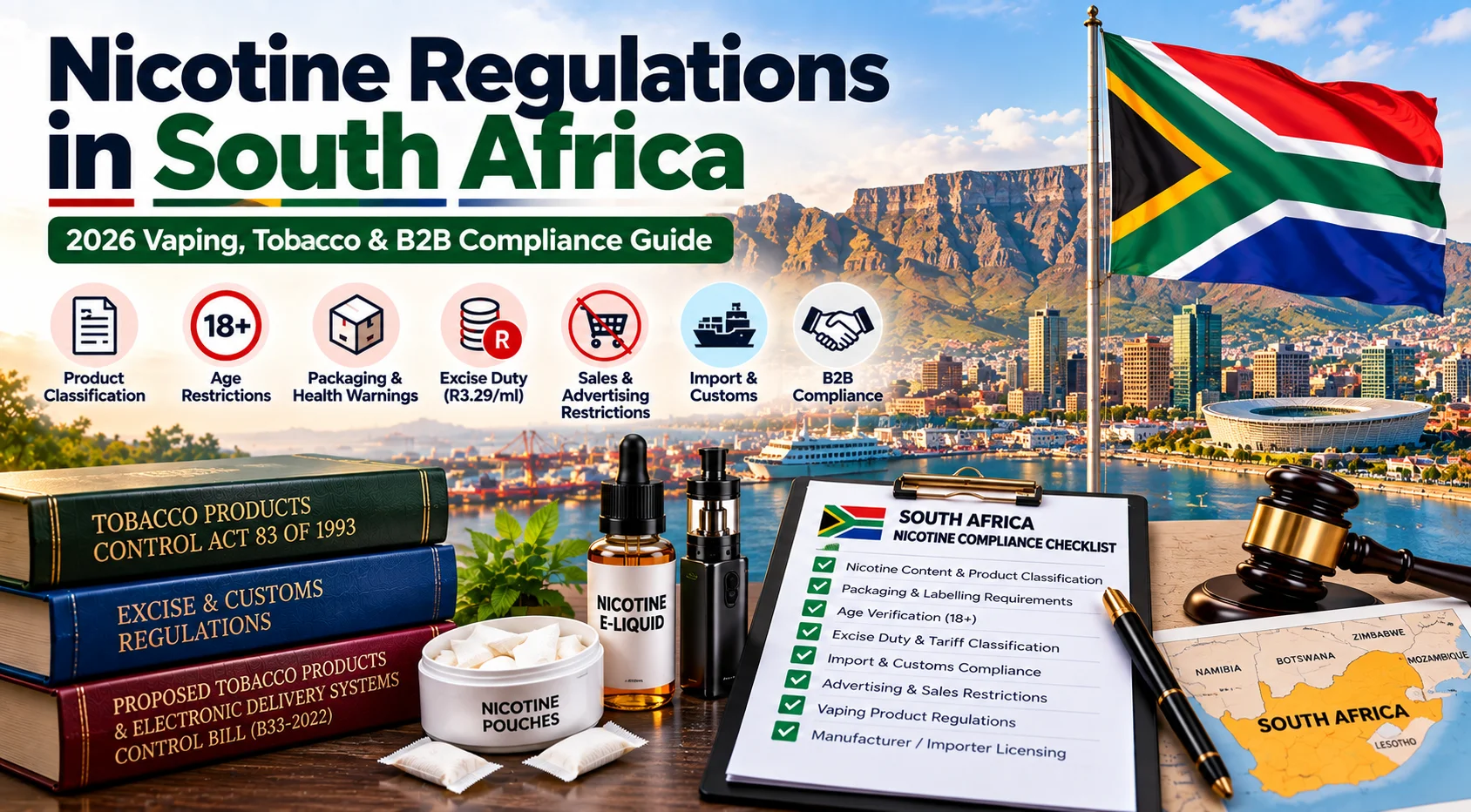
21. South Africa Nicotine Compliance Checklist
Before supplying nicotine products to South Africa, businesses should review the following areas.
Product
- Product category confirmed
- Tobacco/tobacco-free status confirmed
- Nicotine concentration verified
- Intended use documented
- Product specification available
Packaging
- Current packaging requirements reviewed
- Applicable health warnings checked
- Product information verified
- Labelling reviewed
- Proposed future requirements monitored
Tax
- Customs tariff code confirmed
- Excise classification confirmed
- Current excise rate verified
- Excise licence requirement checked
- Importer registration checked
Sales
- Age restrictions reviewed
- Advertising restrictions reviewed
- Promotional restrictions checked
- Vending-machine rules reviewed
- Consumer sales channels assessed
Documentation
- Commercial invoice
- Packing list
- Certificate of Analysis
- Safety Data Sheet
- Product specification
- Batch information
- Customs documentation
- Importer information
22. What Manufacturers Should Monitor in 2026
For businesses planning long-term operations in South Africa, three areas deserve particular attention.
1. Excise Changes
SARS has already updated the vaping excise framework in 2026, including the increase to R3.29/ml for the relevant vaping tariff item.
2. Legislative Development
The Tobacco Products and Electronic Delivery Systems Control Bill is progressing through Parliament. Clause-by-clause deliberations began in August 2026.
3. Product Classification
New nicotine formats require careful classification because customs, excise and tobacco-control requirements may not operate identically.
Companies should therefore review product specifications before shipment rather than relying on the treatment of older tobacco products.