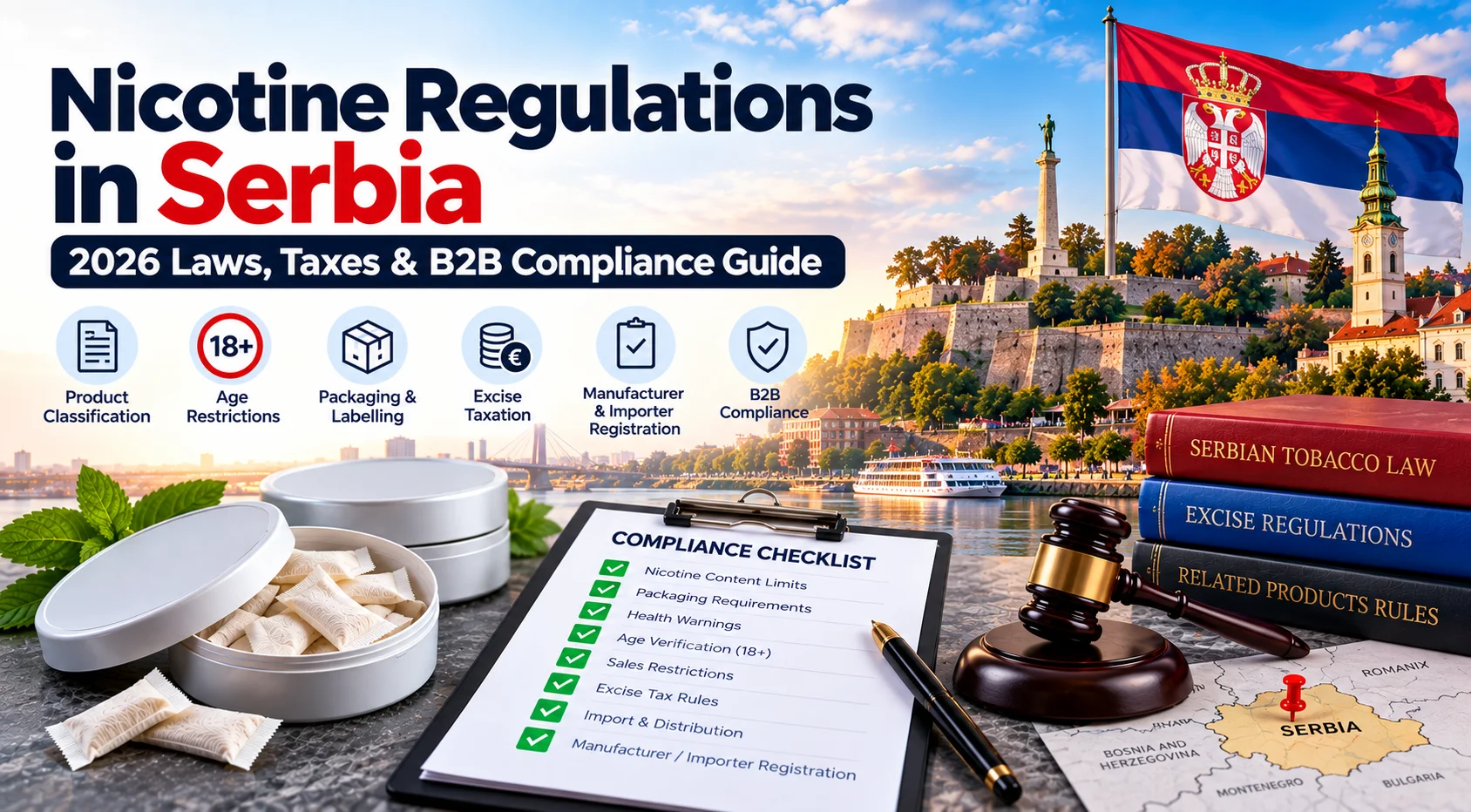
Nicotine Regulations in Serbia: 2026 Laws, Taxes & B2B Compliance Guide
Understanding nicotine regulations in Serbia is important for manufacturers, importers, distributors, exporters and B2B buyers involved in nicotine-containing products.
Serbia regulates nicotine pouches, electronic cigarettes and other related products through its national tobacco legislation and excise-tax framework. The Serbian Tobacco Law specifically defines nicotine pouches as a category of related products and establishes requirements covering product composition, packaging, sales, manufacturer and importer registration, and health warnings. Serbia’s Ministry of Finance currently publishes the Tobacco Law consolidated with amendments through 2026.
For companies entering the Serbian market, compliance should therefore be assessed according to the specific product, intended use and role of the business in the supply chain.
1. Overview of Nicotine Regulations in Serbia
The Serbian Tobacco Law distinguishes between tobacco products and related products.
Related products include products with or without nicotine that do not consist of tobacco but correspond to tobacco products according to specified criteria. The category includes electronic-cigarette refill liquids, herbal products for smoking or heating, nicotine pouches and waterpipe products.
A nicotine pouch is defined under Serbian law as a single-use product containing nicotine or nicotine compounds and other ingredients, packed in a pouch or porous pouch and intended exclusively for oral use.
For B2B companies, this product classification is important because registration, packaging, sales and tax requirements can depend on the category.
For comparison with another nearby market, see our Nicotine Regulations in Romania article.
2. Nicotine Pouch Regulations in Serbia
Nicotine pouches without tobacco are specifically regulated in Serbia.
The Serbian framework establishes requirements concerning:
- Nicotine content
- Number of pouches per package
- Ingredients
- Packaging information
- Health warnings
- Manufacturer and importer responsibilities
- Retail sales
- Age restrictions
- Excise taxation
The law also establishes separate registers for manufacturers and importers of related products.
This means that businesses supplying nicotine pouches to Serbia should review both product-level compliance and company-level registration requirements.
3. Maximum Nicotine Content in Serbian Nicotine Pouches
One of the most important requirements under nicotine regulations in Serbia concerns nicotine concentration.
Serbian legislation provides that:
- An individual package of nicotine pouches may contain a maximum of 20 pouches.
- One nicotine pouch may contain a maximum of 17 mg of nicotine.
- Nicotine used in related products must meet standards equivalent to those applicable to nicotine used in pharmaceutical products.
- Other ingredients used in nicotine pouches must meet standards equivalent to those applicable to food products.
Manufacturers should therefore verify nicotine concentration and ingredient specifications before supplying finished products to the Serbian market.
For comparison, our Nicotine Regulations in Slovakia article covers a different national framework for nicotine pouches.
4. Manufacturer and Importer Registration
Serbia has specific registration requirements for businesses manufacturing or importing related products.
The Tobacco Law establishes:
- Register of manufacturers of related products
- Register of importers of related products
A business manufacturing related products must be registered in the relevant manufacturer register, while an importer must be registered in the importer register.
The registration decisions are issued for a defined period, with renewal procedures provided by the law.
This is particularly important for international B2B companies because simply having a compliant product does not necessarily satisfy the requirements for conducting regulated manufacturing or import activities in Serbia.
5. Registration Fees for Related-Product Businesses
The Serbian Tobacco Law also provides registration-related fees for manufacturers and importers of related products.
The current consolidated provisions state a registration fee of 5,215,000 Serbian dinars, subject to annual adjustment according to the consumer-price index. The registration can be paid in five equal annual instalments under the conditions established by the law.
Because these amounts can be updated, companies should verify the current fee with the Serbian Tobacco Administration before submitting an application.
6. Age Restrictions on Nicotine Products
Serbian law prohibits the sale of tobacco and related products to minors.
The law also prohibits:
- Sale of tobacco and related products to minors
- Retail self-service sales of tobacco and related products
- Retail sales through vending machines
- Remote sales using one or more means of distance communication
- Personal solicitation of tobacco and related products
- Sale of nicotine pouches individually rather than as packaged products
For retailers and distributors, age-control procedures are therefore an important part of compliance.
Businesses should also ensure that their sales staff understand the applicable restrictions.
7. Restrictions on Individual Nicotine-Pouch Sales
Serbian legislation specifically prohibits selling nicotine pouches individually.
This means that nicotine pouches must remain within the legally compliant package format rather than being sold as individual loose units.
For retailers, wholesalers and distributors, inventory and sales procedures should be structured accordingly.
8. Packaging and Labelling Requirements
Packaging and labelling are important elements of nicotine regulations in Serbia.
The Serbian Tobacco Law requires individual and group packaging of related products placed on the Serbian market to carry a health warning.
For related products containing nicotine, the required warning states that the product contains nicotine that causes strong addiction. The warning must be placed on at least one of the largest surfaces and cover at least 30% of the surface on which it is printed. It must also be presented in Serbian using the specified formatting requirements.
For nicotine pouches, packaging must also include information concerning:
- Product ingredients
- Nicotine content
- Net mass
- Manufacturing date or expiry information
- Manufacturer or importer contact details
- Instructions for use and storage
Manufacturers should therefore review packaging artwork specifically for Serbia.
9. Packaging Design and Youth Protection
Serbian law contains restrictions on the presentation of certain related products.
It prohibits the sale of nicotine pouches and certain other related products where the packaging contains writing, illustrations or elements referring to sweets, candies, desserts, toys, cartoon characters or similar youth-oriented elements.
This means that packaging compliance is not limited to technical information and health warnings.
Branding and visual presentation should also be reviewed before products are placed on the Serbian market.
10. Electronic Cigarettes and Nicotine E-Liquids
Serbia also establishes specific requirements for electronic-cigarette refill liquids.
The law provides that nicotine-containing refill liquid may be sold to consumers in:
- Refillable containers of up to 10 ml
- Disposable electronic-cigarette tanks of up to 2 ml
- Disposable cartridges of up to 2 ml
The maximum nicotine concentration for electronic-cigarette refill liquid is 20 mg/ml.
These requirements should be assessed separately from the rules applicable to nicotine pouches.
11. Excise Tax on Nicotine Pouches in Serbia
Excise taxation is an important part of Serbia’s nicotine-product framework.
The Serbian Excise Law provides a specific excise category for nicotine pouches.
The excise is calculated on the net weight of nicotine pouches, and the current provision reflected in the consolidated legislation lists an amount of 5,186.57 Serbian dinars per kilogram.
Manufacturers, importers and distributors should verify the current applicable excise amount before calculating product costs, pricing or import economics.
12. Excise Compliance for B2B Suppliers
For businesses importing or distributing nicotine products, excise compliance should be considered alongside product compliance.
Companies should review:
- Product classification
- Customs classification
- Excise category
- Applicable excise rate
- Import documentation
- Tax reporting
- Packaging and marking requirements
- Distribution records
The Serbian Ministry of Finance maintains the relevant tobacco and excise legislation, including amendments applicable in 2026.
13. B2B Nicotine Raw Materials
Companies supplying nicotine raw materials to Serbian manufacturers should distinguish raw-material supply from finished consumer nicotine products.
For B2B procurement, buyers should review:
- Intended application
- Product classification
- Nicotine concentration
- Purity
- Certificate of Analysis
- Safety Data Sheet
- Batch number
- Manufacturing details
- Packaging specifications
- Transport documentation
- Traceability information
A finished nicotine pouch and a nicotine raw material used in manufacturing should not automatically be treated as the same regulatory category.
For additional procurement information, see our guide on Factors That Affect Bulk Nicotine Procurement: A B2B Buyer’s Guide.
14. Importing Nicotine Products into Serbia
International companies planning to export nicotine products to Serbia should complete a Serbia-specific compliance review before shipment.
A practical checklist includes:
- Confirm the product category.
- Confirm intended use.
- Verify nicotine concentration.
- Check package quantity.
- Review ingredients.
- Confirm manufacturer/importer registration requirements.
- Review packaging and health warnings.
- Check Serbian-language requirements.
- Confirm age and sales restrictions.
- Verify excise classification.
- Prepare customs documentation.
- Maintain batch and quality documentation.
The Serbian Tobacco Administration plays an important role in maintaining the relevant registers and regulating activities involving tobacco and related products.
15. Serbia and European Nicotine Regulations
Serbia is not an EU Member State, so its national regulatory framework should be considered separately from EU Member State requirements.
However, businesses supplying both Serbia and the EU may need to manage multiple regulatory frameworks.
For example, our Nicotine Regulations in Romania article covers Romanian requirements, while our Nicotine Regulations in Bulgaria guide covers another neighbouring European market.
Comparing country-specific requirements is useful when planning regional distribution.
16. Serbia Compared With Other Nicotine Markets
Nicotine regulations vary considerably between countries.
For example:
- Serbia regulates nicotine pouches as related products.
- Serbia establishes a 17 mg maximum nicotine content per pouch.
- A package may contain a maximum of 20 pouches.
- Manufacturer and importer registers apply to related products.
- A specific health warning is required on nicotine-containing related products.
- Nicotine pouches are subject to an excise duty based on net weight.
For regional comparison, readers can also review:
Nicotine Regulations in Romania — Romania’s nicotine-pouch, sales and excise framework.
Nicotine Regulations in Slovakia — Slovakia’s product notification, nicotine-limit and taxation requirements.
Nicotine Regulations in Czech Republic — Czech requirements for nicotine pouches, packaging and taxation.
Nicotine Regulations in Poland — Poland’s regulatory framework for nicotine products.
Nicotine Regulations in Sweden — Sweden’s nicotine-product notification and compliance framework.
17. B2B Compliance Checklist for Serbia
Before supplying nicotine products to Serbia, businesses should review the following areas.
Product
- Product category confirmed
- Nicotine concentration verified
- Maximum 17 mg nicotine per pouch checked
- Maximum 20 pouches per package checked
- Ingredients reviewed
- Intended use confirmed
Registration
- Manufacturer registration checked
- Importer registration checked
- Applicable Tobacco Administration requirements reviewed
- Registration validity confirmed
Packaging
- Serbian-language warning checked
- Nicotine warning included
- Ingredients listed
- Nicotine content stated
- Net mass provided
- Manufacturing/expiry information provided
- Manufacturer/importer details included
- Instructions for use and storage included
Sales
- 18+ sales restriction implemented
- No self-service retail sales
- No vending-machine sales
- No prohibited remote sales
- No individual nicotine-pouch sales
- Youth-oriented packaging avoided
Tax
- Excise classification confirmed
- Current excise amount verified
- Customs documentation prepared
- Tax obligations reviewed
Quality
- Certificate of Analysis available
- Safety Data Sheet available
- Batch traceability maintained
- Purity information verified
- Product specification documented
18. Why Serbia Compliance Matters for International Nicotine Suppliers
For manufacturers, exporters and B2B buyers, Serbian compliance should be assessed before production, importation and distribution.
The country’s regulatory framework contains specific requirements for nicotine pouches, including nicotine limits, package quantity, health warnings, packaging information, manufacturer/importer registration and sales restrictions.
Excise taxation is another important consideration because nicotine pouches are subject to a weight-based excise duty.
Maintaining accurate product specifications, batch records and regulatory documentation can help businesses manage their Serbian supply chain more effectively.