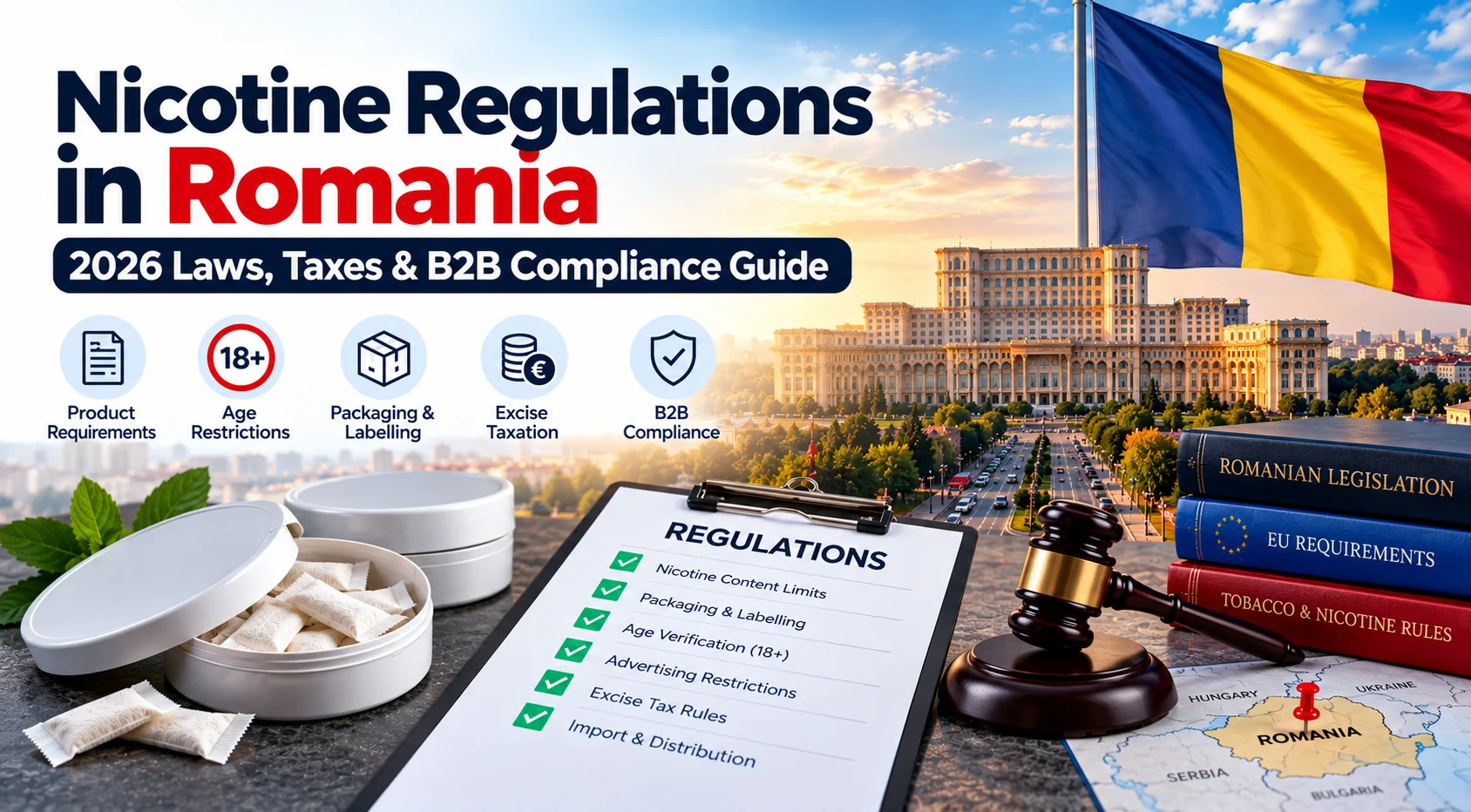
Nicotine Regulations in Romania: 2026 Laws, Taxes & B2B Compliance Guide
Understanding nicotine regulations in Romania is important for manufacturers, importers, distributors, exporters and B2B buyers dealing with nicotine-containing products.
Romania regulates tobacco products, electronic cigarettes, refill liquids, nicotine pouches and other related products through national legislation together with applicable European Union requirements.
For companies planning to enter the Romanian market, compliance can involve product formulation, nicotine concentration, packaging, labelling, age restrictions, advertising, sales channels, excise taxation and import requirements.
1. Overview of Nicotine Regulations in Romania
Romanian legislation establishes requirements for tobacco products and products related to tobacco, including electronic cigarettes, refill containers and tobacco-free nicotine pouches.
The legal framework specifically defines a nicotine pouch as a tobacco-free product containing nicotine intended for oral consumption. Romania introduced specific provisions for these products through amendments to its tobacco-product legislation.
For manufacturers and importers, the first step should be to identify the exact product category and intended use.
The applicable requirements can differ between:
- Nicotine pouches
- Electronic cigarettes
- Nicotine-containing e-liquids
- Tobacco products
- Heated products
- Other nicotine-containing products
- Nicotine raw materials intended for manufacturing
Businesses supplying several European countries should therefore conduct a country-specific compliance review rather than assuming that one EU market’s rules automatically apply in Romania.
For comparison, see our guide on Nicotine Regulations in Czech Republic, another Central European market with its own national requirements.
2. Nicotine Pouch Regulations in Romania
Romania specifically regulates nicotine pouches without tobacco.
Under Romanian legislation, placing non-compliant nicotine pouches on the market is prohibited. The law also establishes a maximum nicotine level of 20 mg per pouch.
Manufacturers and importers should therefore verify:
- Nicotine concentration
- Nicotine per pouch
- Ingredients
- Product formulation
- Batch specifications
- Product documentation
- Certificate of Analysis
A reliable product specification and batch-level Certificate of Analysis can help B2B buyers verify the declared nicotine concentration and quality.
3. Maximum Nicotine Content
One of the most important points under nicotine regulations in Romania is the maximum nicotine content for tobacco-free nicotine pouches.
Romanian legislation establishes a maximum of 20 mg of nicotine per pouch.
Manufacturers supplying finished nicotine pouches to Romania should therefore check product specifications before production and shipment.
This is particularly important for international suppliers because a formulation designed for another European market may have to be adjusted if it does not meet the Romanian limit.
4. Nicotine Products and 18+ Sales Restrictions
Romania prohibits the sale of covered tobacco and nicotine-related products to persons under 18.
The legislation specifically includes nicotine pouches, electronic cigarettes, refill containers and other covered nicotine products. Sellers may request an identity document to verify the buyer’s age.
For retailers and distributors, age verification should therefore be integrated into sales procedures.
Businesses should also train employees and maintain clear procedures for refusing sales to underage customers.
5. Restrictions on Sales Through Lockers and Easybox Systems
Romanian legislation contains specific restrictions concerning sales through automated locker systems.
The sale through easybox/locker-type devices of covered tobacco and nicotine products is prohibited. Products supplied through courier services must also carry the required package warning concerning tobacco and/or nicotine products and age verification.
This is an important consideration for businesses operating an e-commerce or direct-to-consumer distribution model in Romania.
Companies should therefore assess their fulfilment method in addition to the product itself.
6. Packaging and Labelling Requirements
Packaging and consumer information are important components of Romanian nicotine compliance.
For regulated nicotine products, businesses should review the applicable requirements concerning:
- Product information
- Nicotine content
- Ingredients
- Health warnings
- Consumer safety information
- Manufacturer/importer information
- Batch identification
- Romanian-language warnings where applicable
Romanian legislation also contains requirements concerning warnings and information for nicotine-related products.
Manufacturers should review packaging artwork specifically for the Romanian market before commercial production.
7. Advertising and Marketing Restrictions
Advertising is another important consideration in Romania.
Romania amended its advertising legislation in 2024 to expressly cover nicotine pouches alongside tobacco products, electronic cigarettes and certain other nicotine-related products.
Explicit advertising for these products is prohibited, while additional restrictions apply to advertising in and around educational and healthcare facilities and in communications directed primarily at minors.
For businesses marketing nicotine-related products in Romania, regulatory review should therefore cover not only packaging and sales but also promotional content.
8. Electronic Cigarettes and Nicotine E-Liquids
Electronic cigarettes and refill liquids containing nicotine are subject to specific Romanian requirements.
The Romanian framework includes requirements concerning:
- Nicotine concentration
- Refill-container volume
- Ingredients
- Product design
- Packaging
- Labelling
- Safety information
- Child protection
- Product information
- Sales restrictions
For nicotine-containing liquids, the legislation provides a maximum nicotine concentration of 20 mg/ml and limits refill bottles to a maximum volume of 10 ml, while cartridges and tanks have a maximum volume of 2 ml.
Businesses should assess these requirements separately from those applicable to nicotine pouches.
9. Excise Tax on Nicotine Products in Romania
Excise taxation is an important consideration for manufacturers, importers and distributors.
Romania classifies tobacco-free oral nicotine products among products subject to excise taxation.
For 2026, the applicable Romanian excise table lists the rate for products containing nicotine, without tobacco, intended for oral consumption at 126 lei per kilogram.
For electronic-cigarette liquids, the 2026 rate listed in the same legislation is 1.31 lei per millilitre.
Businesses should verify the applicable rate at the time of manufacture, import or release for consumption because Romanian tax legislation can be amended.
10. Excise Authorisation for Manufacturers and Importers
Romanian tax legislation also establishes authorisation requirements for economic operators dealing with certain excise products.
The relevant provisions require operators that manufacture, acquire from other EU Member States or import certain products subject to excise duty to obtain the appropriate authorisation from the competent authority.
For companies entering the Romanian market, it is therefore important to determine whether their specific business activity requires:
- Excise authorisation
- Import registration
- Customs procedures
- Tax registration
- Additional product documentation
The exact requirements depend on the product and the company’s role in the supply chain.
11. Cross-Border Distance Sales
Romania has specific restrictions concerning cross-border distance sales of certain tobacco and nicotine-related products.
Romanian legislation prohibits cross-border distance sales to consumers in Romania of tobacco products, electronic cigarettes and refill containers. The Romanian Customs Authority cooperates with authorities in other countries to prevent prohibited cross-border distance sales.
Businesses selling nicotine-related products online should therefore review the exact product category and sales model before serving Romanian consumers from another country.
12. Nicotine Raw Materials for B2B Manufacturing
The regulatory treatment of nicotine raw materials can differ from the requirements applicable to finished consumer products.
A company purchasing nicotine for manufacturing should establish the intended use and legal classification before determining the applicable Romanian requirements.
For B2B procurement, buyers should maintain documentation such as:
- Certificate of Analysis
- Safety Data Sheet
- Product specification
- Nicotine concentration
- Purity information
- Batch number
- Manufacturing information
- Packaging details
- Transport documentation
- Traceability records
Clear documentation can help manufacturers verify incoming material and maintain consistent quality-control processes.
13. Importing Nicotine Products into Romania
International manufacturers and exporters should complete a Romania-specific compliance review before shipping nicotine products.
A practical checklist includes:
- Confirm the product category
- Confirm intended use
- Verify nicotine concentration
- Review ingredients
- Check applicable product requirements
- Review packaging and labelling
- Check Romanian-language information where required
- Confirm age restrictions
- Review advertising restrictions
- Confirm excise classification
- Check customs requirements
- Verify authorisation requirements
- Maintain batch documentation
A product compliant in another European country should not automatically be assumed to meet every Romanian requirement.
14. Romania and EU Nicotine Regulations
Romania is an EU Member State, so businesses must consider both EU-level requirements and Romanian national legislation.
EU rules provide a wider framework for certain tobacco and nicotine-related products, while Romanian law establishes additional national requirements concerning areas such as nicotine pouches, sales, advertising, packaging and taxation.
For this reason, manufacturers should perform a Romania-specific assessment before placing products on the market.
Businesses expanding across Europe can compare the Romanian framework with our country-specific guides for [Poland], [Czech Republic], [Slovakia], [Hungary] and other European markets.
15. Romania Compared With Other European Nicotine Markets
Nicotine regulations can differ significantly from one European market to another.
Romania, for example, has established a 20 mg-per-pouch limit for nicotine pouches and a 2026 excise rate of 126 lei/kg for tobacco-free oral nicotine products.
For comparison, our Nicotine Regulations in Slovakia guide covers a different national framework for nicotine pouches, while our Nicotine Regulations in Czech Republic article provides another Central European comparison.
Businesses can also compare Romania with:
- Poland
- Sweden
- Denmark
- Ireland
- Portugal
- Estonia
- United Kingdom
Country-specific comparisons can help manufacturers identify differences in nicotine limits, packaging, taxation, sales restrictions and market-entry requirements.
16. B2B Compliance Checklist for Romania
Before supplying nicotine products to Romania, manufacturers, exporters and B2B buyers should review the following areas.
Product Compliance
- Product category confirmed
- Intended use confirmed
- Nicotine concentration verified
- Ingredients reviewed
- Applicable nicotine limits checked
- Product specification available
Packaging and Labelling
- Ingredient information checked
- Nicotine content verified
- Required warnings reviewed
- Romanian-language requirements checked
- Batch information maintained
- Manufacturer/importer information available
Sales Compliance
- 18+ verification implemented
- Retail sales procedures reviewed
- Online sales model reviewed
- Locker/easybox restrictions checked
- Courier requirements reviewed
Marketing Compliance
- Advertising restrictions reviewed
- Promotional materials checked
- Content directed at minors avoided
- Restricted locations reviewed
Tax and Customs
- Excise classification confirmed
- 2026 excise rate checked
- Authorisation requirements reviewed
- Customs documentation prepared
- Import obligations confirmed
Quality Documentation
- Certificate of Analysis available
- Safety Data Sheet available
- Batch traceability maintained
- Purity information verified
- Product specifications documented
17. Why Compliance Matters for International Nicotine Suppliers
For international suppliers, compliance should be considered before manufacturing, packaging, shipment and market distribution.
Romania has introduced specific requirements for nicotine pouches, including a maximum nicotine level of 20 mg per pouch, age restrictions and rules concerning sales and advertising. Excise taxation also needs to be considered when calculating the commercial cost of products entering the Romanian market.
Maintaining accurate product specifications, batch records and regulatory documentation can help B2B buyers and manufacturers manage the supply chain more effectively.
Businesses should also monitor Romanian legislative updates because product, tax and market-access requirements can change.