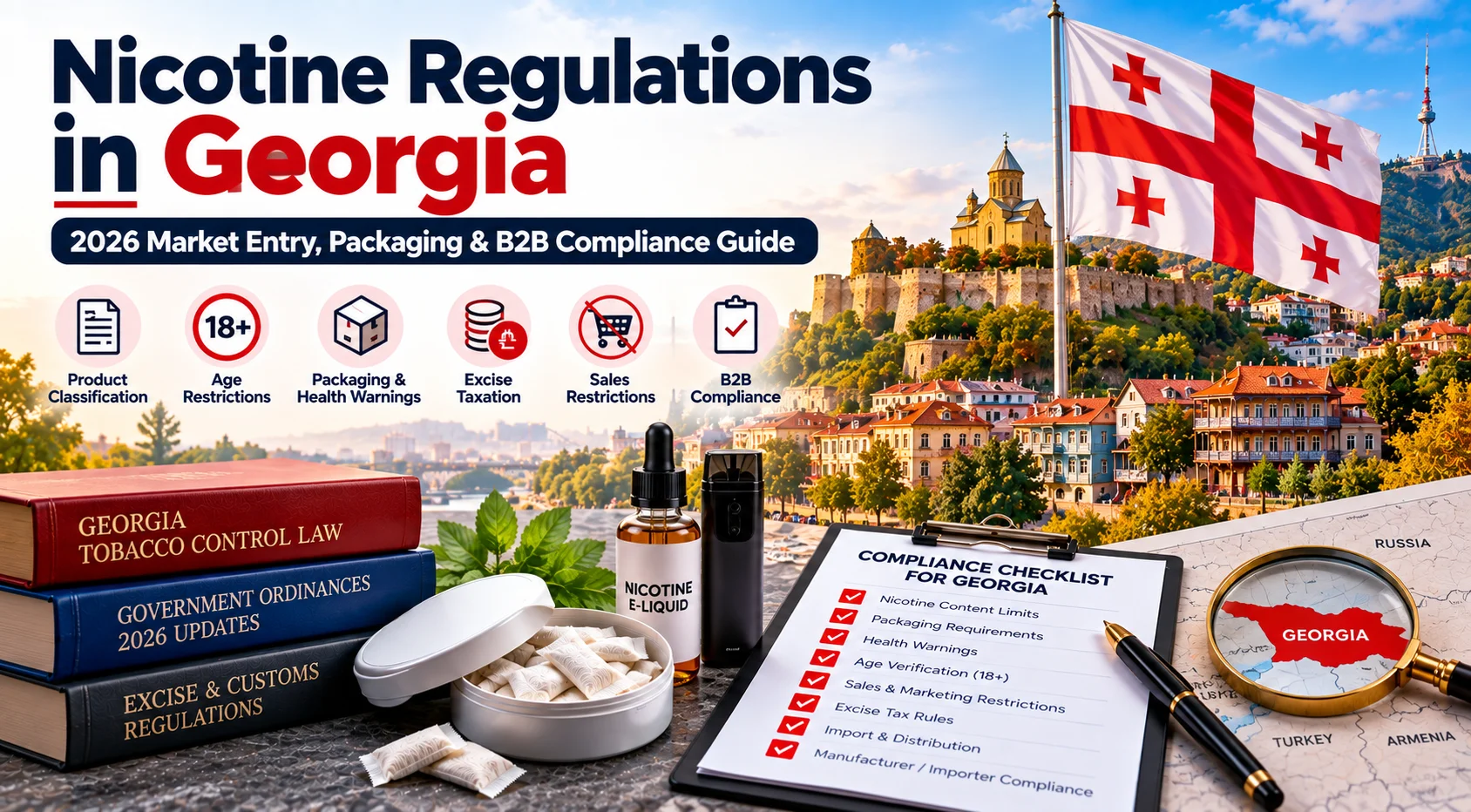
Nicotine Regulations in Georgia: 2026 Market Entry, Packaging & B2B Compliance Guide
Understanding nicotine regulations in Georgia is important for manufacturers, importers, exporters, distributors and B2B buyers dealing with nicotine-containing products.
Georgia regulates tobacco products and related nicotine products through its national tobacco-control legislation, supported by government regulations covering product standards, nicotine-containing electronic-cigarette materials, packaging, health warnings, sales channels and taxation.
The Georgian framework also specifically recognises certain nicotine-containing products without tobacco intended for human nicotine consumption, making the country relevant for businesses working with newer nicotine formats.
For companies planning to enter the Georgian market in 2026, the main compliance areas include product classification, packaging, health warnings, age restrictions, retail sales, online-sales restrictions, excise taxation and import documentation.
1. Overview of Nicotine Regulations in Georgia
Georgia’s Law on Tobacco Control establishes the country’s main tobacco-control framework.
The law covers tobacco products as well as nicotine-containing materials used in electronic cigarettes and similar devices. It also recognises tobacco-free nicotine products intended to deliver nicotine to the human body.
This makes product classification an important first step for international B2B suppliers.
Depending on the product, companies may need to review:
- Product category
- Nicotine content
- Product composition
- Packaging
- Health warnings
- Sales restrictions
- Age restrictions
- Excise classification
- Import requirements
- Documentation
Businesses should therefore avoid assuming that the rules applicable to cigarettes, e-liquids, nicotine pouches and bulk nicotine raw materials are identical.
For comparison with another nearby non-EU market, see our Nicotine Regulations in Serbia article.
2. Tobacco-Free Nicotine Products in Georgia
Georgia’s tobacco-control legislation includes a specific definition for a product without tobacco containing nicotine and intended for nicotine intake by humans.
This category is relevant to modern nicotine formats, including certain tobacco-free nicotine products.
For manufacturers and importers, the following information should be confirmed before shipment:
- Whether the product contains tobacco
- Whether it contains nicotine
- Intended use
- Product format
- Nicotine concentration
- Packaging type
- Applicable warning requirements
- Customs classification
- Excise treatment
A finished nicotine consumer product should also be distinguished from a nicotine raw material supplied to another manufacturer.
3. 2026 Updates to Nicotine Regulations in Georgia
One of the important developments for nicotine regulations in Georgia during 2026 is the series of amendments to Government Ordinance No. 150.
The official Georgian Legislative Herald records amendments dated 16 April 2026, 6 July 2026 and 14 August 2026. The July amendment is identified as Government Ordinance No. 305, while the August amendment is Government Ordinance No. 387.
These amendments concern, among other things:
- Nicotine-containing materials for electronic cigarettes
- Cartridges and capsules
- Containers
- Permitted nicotine-content requirements
- Packaging
- Medical/health warnings
- Product-sale requirements
Because the rules have been amended during 2026, companies should use the latest consolidated requirements rather than relying on older packaging or product specifications.
4. Packaging and Health Warning Requirements
Packaging is an important part of Georgia’s nicotine compliance framework.
The Tobacco Control Law requires approved health warnings on applicable tobacco-product packaging. These warnings can include a major warning, additional warning, pictogram and required contact information, according to the applicable product category.
The law also prohibits misleading packaging information that could create the impression that a tobacco product is less harmful than another product.
Certain expressions and descriptions suggesting reduced harm are restricted under the packaging provisions.
Manufacturers preparing packaging for Georgia should therefore review:
- Warning text
- Warning format
- Pictograms
- Warning placement
- Required language
- Packaging design
- Product information
- Country-specific artwork
A package designed for another market should not automatically be assumed to comply with Georgian requirements.
5. 2026 Packaging Compliance: What Manufacturers Should Check
Because Georgia updated the relevant government regulations during 2026, manufacturers should review packaging artwork before printing new production batches.
A practical packaging review should include:
- Product classification.
- Applicable health warning.
- Warning size and placement.
- Required pictogram.
- Required textual information.
- Product identification.
- Manufacturer/importer information.
- Applicable language requirements.
- Excise-stamp requirements where applicable.
- Current transition provisions.
The official Georgian Legislative Herald currently lists the 2026 amendments to Government Ordinance No. 150, so companies should check the latest applicable version before production.
6. Electronic Cigarettes and Nicotine-Containing Materials
Georgia regulates nicotine-containing materials, cartridges, capsules and containers used with electronic cigarettes and similar devices.
The Government of Georgia has established regulatory requirements concerning the volume of nicotine-containing material and maximum permissible nicotine content for electronic cigarettes and similar devices.
For B2B suppliers of e-liquids and vaping materials, product specifications should clearly identify:
- Nicotine concentration
- Liquid volume
- Container type
- Cartridge or capsule format
- Product composition
- Batch number
- Manufacturing information
- Packaging specification
The exact regulatory treatment should be checked against the current Georgian technical rules applicable to the product.
7. Age Restrictions for Nicotine Products
Georgia prohibits the sale of tobacco products to people under 18 years of age.
The Tobacco Control Law also prohibits engaging persons under 18 in the tobacco industry. Sellers must request an identification document when they cannot establish that the buyer has reached the age of 18.
This is important for:
- Retailers
- Distributors
- Importers
- Wholesalers
- Consumer-facing sales channels
B2B suppliers should ensure that their Georgian distribution partners understand the applicable age-verification requirements.
8. Internet and Mail Sales Restrictions
Georgia’s tobacco-control framework restricts retail sales of tobacco products through the Internet or by mail, with a statutory exception for certain tobacco accessories or devices that do not display tobacco-industry trademarks or trade names.
For international suppliers, this means that an online sales strategy must be reviewed specifically for the Georgian market.
A sales method permitted in another country should not automatically be used for Georgia.
For a broader discussion of international nicotine shipments, see:
Cross-Border Shipping Rules for Nicotine Products
9. Vending Machine and Retail Sales Restrictions
Georgia also prohibits sales through electronic or mechanical vending machines for products covered by its tobacco-control sales restrictions.
The law also restricts tobacco-product sales and placement in specified locations, including:
- Educational institutions and nearby areas
- Public institutions
- Medical institutions
- Sports institutions
- Cultural institutions
- Certain areas selling children’s products, food or toys
- Early-learning and preschool institutions and nearby areas
Retail placement and visibility are also regulated.
For distributors, retail partners should therefore be assessed for compliance before products are placed on the Georgian market.
10. Restrictions on Individual Sales and Packaging
Georgia establishes specific requirements for the packaging and sale of tobacco products.
For cigarettes, the law prohibits sale by individual pieces or in packs containing fewer or more than 20 cigarettes. It also prohibits sale without appropriate packaging.
Because packaging rules vary according to product category, manufacturers should confirm the specific requirement applicable to their nicotine product rather than applying the cigarette rule automatically to all nicotine formats.
11. Tobacco Advertising and Promotion Restrictions
Georgia has extensive restrictions on tobacco-product promotion.
The Tobacco Control Law restricts activities including:
- Free product offers
- Gifts
- Product trials intended to promote sales
- Loyalty schemes
- Coupons
- Network marketing
- Direct promotional communication
- Telemarketing
- Certain promotional materials
- Retailer incentives
- Sponsorship or financial contributions intended to popularise tobacco products
The law also restricts promotional activities involving toys, sweets or other products that imitate tobacco products.
Businesses should therefore review marketing and promotional plans separately from their ordinary B2B sales communications.
12. Point-of-Sale Requirements
Georgia also establishes information requirements at tobacco-product points of sale.
The Tobacco Control Law requires approved health-warning information, a consultation telephone number for people wishing to stop tobacco consumption and information that sales to persons under 18 are prohibited. The information must be displayed at least in A4 format.
Retail partners should therefore review both:
- Product packaging
- Point-of-sale information
before commercial distribution.
13. Standardised Packaging
Georgia has standardised-packaging requirements for applicable tobacco products.
The Tobacco Control Law provides that sale or placement of applicable tobacco products without standardised packaging is prohibited, subject to the statutory exceptions.
This is particularly important for manufacturers supplying several countries.
A single international packaging design may require modification for Georgia because packaging standards can differ from those in neighbouring markets.
For example, manufacturers supplying Serbia should separately review the Nicotine Regulations in Serbia requirements rather than applying Georgia’s packaging rules to Serbia.
14. Excise Tax on Nicotine Products
Excise taxation is an important component of nicotine regulations in Georgia.
Georgia’s Tax Code includes excise taxation for:
- Tobacco products
- Raw tobacco and tobacco waste
- Liquids containing nicotine intended for electronic cigarettes
- Certain liquids without nicotine intended for electronic cigarettes
The current Tax Code also provides specific excise treatment for products under relevant commodity codes.
For example, the current excise table lists GEL 1.2 per ml for CN code 2404 12 000 00, described as products containing nicotine.
The exact tax treatment should always be confirmed against the correct commodity classification for the product being imported.
15. Excise Stamps
Georgia’s Tax Code also contains specific requirements concerning excise stamps.
For goods under CN codes 2404 12 000 00 and 2404 19 900 00, the Tax Code provides that the procedure for mandatory affixing of excise stamps by the importer is determined by an order of the Minister of Finance.
Therefore, importers should verify:
- Correct commodity code
- Excise classification
- Applicable excise rate
- Excise-stamp requirement
- Customs documentation
- Import declaration
- Applicable tax obligations
This should be checked before calculating the final landed cost of a nicotine product.
16. B2B Nicotine Raw Material Supply
Companies supplying nicotine raw materials to Georgian manufacturers should distinguish raw-material supply from finished consumer nicotine products.
A bulk nicotine ingredient supplied as a manufacturing input may require a different regulatory and customs assessment from a finished nicotine pouch or e-liquid.
B2B buyers should maintain:
- Certificate of Analysis
- Safety Data Sheet
- Purity specification
- Batch number
- Manufacturing details
- Product specification
- Packaging details
- Intended-use information
- Traceability documents
- Transport documentation
For buyers looking for technical information, McCoy NIC also covers Nicotine Technical Support for Buyers.
17. Importing Nicotine Products into Georgia
International manufacturers and exporters should complete a Georgia-specific compliance review before shipment.
A practical checklist includes:
- Confirm the exact product category.
- Determine whether tobacco is present.
- Confirm nicotine concentration.
- Verify product volume and package format.
- Review applicable health warnings.
- Check current 2026 packaging requirements.
- Confirm standardised-packaging requirements.
- Verify age restrictions.
- Review Internet and mail-sale restrictions.
- Check vending-machine restrictions.
- Review retail-location requirements.
- Confirm commodity classification.
- Verify excise tax.
- Check excise-stamp requirements.
- Prepare customs documentation.
- Maintain CoA and SDS documentation.
- Confirm the latest Georgian requirements before shipment.
18. Georgia and Serbia: Different National Frameworks
Georgia and Serbia are both important markets for companies expanding nicotine-product distribution across the wider European and Eurasian region, but their national rules are different.
For example, Serbia’s framework specifically regulates nicotine pouches as related products and establishes its own nicotine-content, packaging, registration and excise requirements.
Read the dedicated country article:
Nicotine Regulations in Serbia
This is a useful internal link for readers comparing non-EU European nicotine markets.
19. Georgia and Romania: Country-Specific Rules
Romania also has its own national framework for nicotine pouches, taxation, packaging and sales.
Readers researching both markets can compare the Georgian framework with:
Nicotine Regulations in Romania
The comparison is useful for B2B buyers because a nicotine product compliant in Romania is not automatically compliant in Georgia.
20. More Country-Specific Nicotine Regulation Guides
McCoy NIC News is building a country-by-country regulatory content cluster for nicotine manufacturers, exporters, importers and B2B buyers.
Relevant country guides include:
Nicotine Regulations in Czech Republic
Nicotine Regulations in Slovakia
Nicotine Regulations in Poland
Nicotine Regulations in Sweden
Nicotine Regulations in Bulgaria
Nicotine Regulations in Croatia
These internal links help B2B readers move between relevant country-specific regulatory guides.
21. B2B Compliance Checklist for Georgia
Before supplying nicotine products to Georgia, businesses should review five major areas.
Product
- Product classification confirmed
- Tobacco/tobacco-free status confirmed
- Nicotine concentration verified
- Intended use documented
- Product specification available
Packaging
- Current health-warning requirement checked
- 2026 amendments reviewed
- Packaging artwork approved
- Standardised packaging assessed where applicable
- Required product information included
Sales
- 18+ requirement implemented
- Age verification available
- Internet-sale restrictions checked
- Mail-sale restrictions checked
- Vending-machine restrictions checked
- Retail-location requirements reviewed
Tax and Import
- Commodity code confirmed
- Excise category confirmed
- Excise rate verified
- Excise-stamp requirement checked
- Customs documents prepared
Quality
- CoA available
- SDS available
- Batch records maintained
- Purity specification documented
- Product traceability maintained
22. What Manufacturers Should Check Before Entering Georgia
For manufacturers and exporters, compliance should begin before production rather than after the goods arrive in Georgia.
The most important checks are:
Product classification: Determine exactly how Georgian law treats the product.
Nicotine content: Confirm the applicable technical requirement for the product category.
Packaging: Review the latest Georgian health-warning and packaging rules.
Sales channel: Check Internet, mail, vending-machine and retail restrictions.
Tax: Confirm the correct commodity code and excise treatment.
Documentation: Maintain consistent product specifications, CoA, SDS and batch information.
Local distribution: Ensure the Georgian importer or distributor understands the applicable requirements.
The official Georgian legislation portal records multiple 2026 amendments to the rules governing nicotine-containing materials and packaging, so older compliance information should be rechecked before a new shipment.