Rules & Regulations of Nicotine in Croatia 2026: Latest Laws, Taxes & Compliance
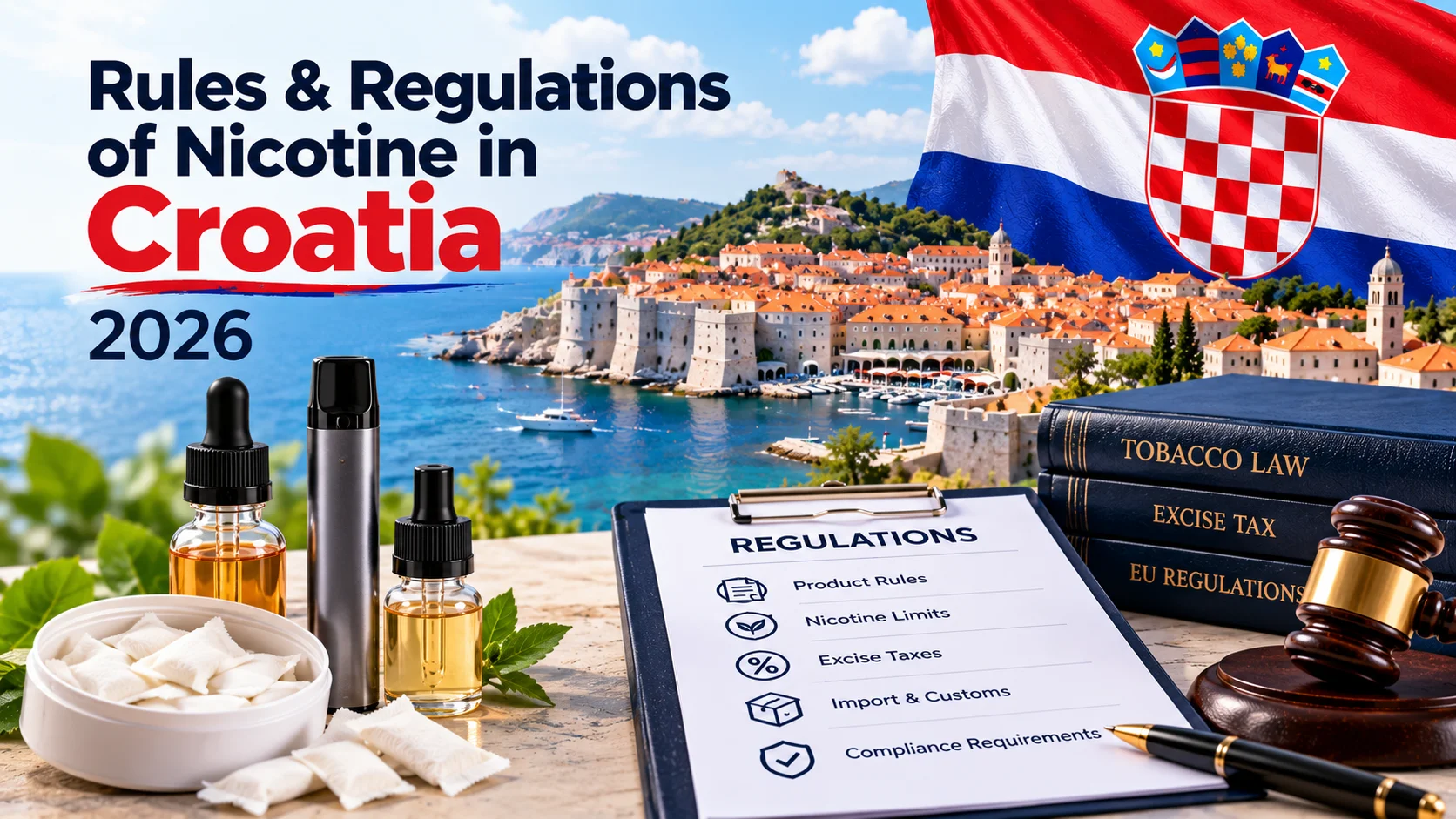
Understanding the Rules & Regulations of Nicotine in Croatia is important for nicotine manufacturers, importers, exporters, distributors and B2B buyers. Croatia applies national tobacco and related-product legislation together with European Union requirements, while excise taxation applies to several tobacco and related products.
In 2026, Croatia has updated excise rates for tobacco products and related products, including e-liquids, heated tobacco products and new tobacco products.
Rules & Regulations of Nicotine in Croatia: 2026 Overview
Croatia regulates tobacco products and related products through national legislation covering areas such as electronic cigarettes, refill containers, tobacco products and other products subject to excise taxation.
For businesses supplying nicotine products to Croatia, the exact product category and intended use should be established before shipment because different regulatory and tax requirements can apply to different products.
Nicotine and E-Liquid Regulations in Croatia
Croatia has specific requirements for nicotine-containing liquids used in electronic cigarettes.
According to the Croatian Ministry of Health:
- Nicotine-containing liquid must be supplied in refill containers with a maximum capacity of 10 ml.
- Cartridges and tanks must not exceed 2 ml.
- Nicotine concentration must not exceed 20 mg/ml.
- Electronic cigarettes and refill containers must have appropriate safety features, including protection against leakage and child-resistant characteristics.
- Certain ingredients and additives are restricted.
These requirements are particularly relevant for manufacturers and importers of finished electronic-cigarette products.
Product Notification Requirements
Manufacturers and importers of electronic cigarettes and refill containers intended for the Croatian market are required to notify the Croatian Ministry of Health about their products.
Businesses should therefore prepare appropriate product information before placing covered products on the Croatian market.
Depending on the product, documentation may include:
- Product composition
- Nicotine concentration
- Ingredients
- Product specifications
- Packaging information
- Safety information
- Manufacturing details
- Batch information
- Required product notification data
Croatia Nicotine Excise Tax 2026
Excise taxation is an important part of the Rules & Regulations of Nicotine in Croatia 2026.
Croatia’s new excise regulation entered into force on 1 January 2026. The Croatian Customs Administration lists the following rates:
| Product | 2026 Excise Rate |
|---|---|
| E-liquids | €0.25 per ml |
| Heated tobacco products | €211.30 per kg |
| New tobacco products | €126.90 per kg |
| Fine-cut tobacco | €126.90 per kg |
| Other smoking tobacco | €126.90 per kg |
| Cigars and cigarillos | €126.90 per 1,000 pieces |
| Cigarettes | €59.10 per 1,000 pieces + 34% proportional duty |
The minimum excise duty on cigarettes is €130.60 per 1,000 pieces.
Businesses should confirm the applicable product classification and current excise treatment before importing or distributing products in Croatia.
Does Croatia Tax E-Liquid Without Nicotine?
Croatia’s Customs Administration states that liquid intended for consumption in an electronic cigarette is subject to excise taxation whether or not it contains nicotine.
This distinction is important for companies dealing with e-liquid because excise treatment is not necessarily determined solely by the presence of nicotine.
Cross-Border Sales of Nicotine Products
Businesses selling excise goods to consumers across EU borders should pay particular attention to Croatian distance-selling requirements.
The Croatian Customs Administration states that cross-border distance selling of tobacco and related products, including smokeless tobacco products, is prohibited in Croatia under the applicable tobacco legislation. The stated prohibition does not apply to e-cigarettes, refill containers and single-use cartridges.
For broader international shipping considerations, see:
Cross-Border Shipping Rules for Nicotine Products: What Exporters Need to Know
This McCoy NIC article covers market-specific requirements involving nicotine levels, product legality, packaging, documentation and cross-border shipping.
Croatia Customs Enforcement and Vape Products
Croatian Customs has also reported enforcement activity involving vape products.
In July 2026, the Croatian Customs Administration reported an operation involving postal shipments arriving from another EU Member State. Authorities identified shipments containing vape products and took measures concerning their entry and further distribution in Croatia.
For international suppliers, this highlights the importance of checking excise, customs and market-placement requirements before dispatch.
What Nicotine Exporters Should Check Before Shipping to Croatia
Before supplying nicotine-related products to Croatia, businesses should verify:
- Product classification
- Intended use
- Nicotine concentration
- Product composition
- Applicable excise category
- Current excise rate
- Packaging and labelling
- Product notification requirements
- Customs documentation
- Cross-border sales restrictions
- Batch and traceability documentation
- Certificate of Analysis where applicable
The exact requirements can vary according to the final product and its intended use.
Quality Documentation for B2B Nicotine Buyers
Regulatory compliance is only one part of international nicotine procurement.
B2B buyers may also require technical information such as:
- Product specification
- Certificate of Analysis (COA)
- Batch information
- Purity information
- Analytical testing information
- Packaging specifications
- Traceability documentation
For additional information about nicotine quality and analytical considerations, read:
New Research Examines Synthetic and Tobacco-Derived Nicotine Impurities
The article discusses impurity profiles, analytical testing and quality considerations relevant to nicotine buyers.
Nicotine Batch Traceability
Batch traceability is also relevant to international nicotine procurement.
A traceable batch record can connect the supplied material with its specification, testing information and quality documentation.
Read more:
Why Batch Traceability Is Becoming More Important in the Global Nicotine Supply Chain
This provides additional information about documentation and supply-chain transparency for international nicotine buyers.
Technical Support for Nicotine Buyers
Companies sourcing nicotine internationally may also require technical information before qualifying a supplier.
McCoy NIC has published:
McCoy NIC Strengthens Technical Support for Nicotine Buyers
The article discusses technical information, product specifications, quality documentation and support for qualified B2B buyers.
Croatia and the European Nicotine Market
Croatia’s nicotine regulatory environment operates alongside broader European Union developments.
Individual European markets can introduce additional national requirements, so exporters should not assume that a product permitted in one European country automatically meets all Croatian requirements.
For this reason, destination-market compliance should be checked before each commercial shipment.
Readers can also explore other country-specific regulatory articles on the McCoy NIC News platform, including coverage of nicotine regulations in Poland, Portugal, Ireland, Estonia and Denmark.
Key Takeaways
The Rules & Regulations of Nicotine in Croatia 2026 include several important considerations for manufacturers, exporters and B2B buyers:
- Nicotine-containing e-liquids are subject to product-specific requirements.
- Nicotine concentration in covered e-liquids cannot exceed 20 mg/ml.
- Refill containers are limited to 10 ml, while cartridges and tanks are limited to 2 ml.
- Croatia’s 2026 excise rate for e-liquids is €0.25/ml.
- Croatia also applies excise duties to certain other tobacco and related products.
- E-liquid intended for electronic-cigarette consumption can be subject to excise duty even when it contains no nicotine.
- Cross-border sales rules differ according to product category.
- Product classification, documentation and customs compliance should be verified before shipment.