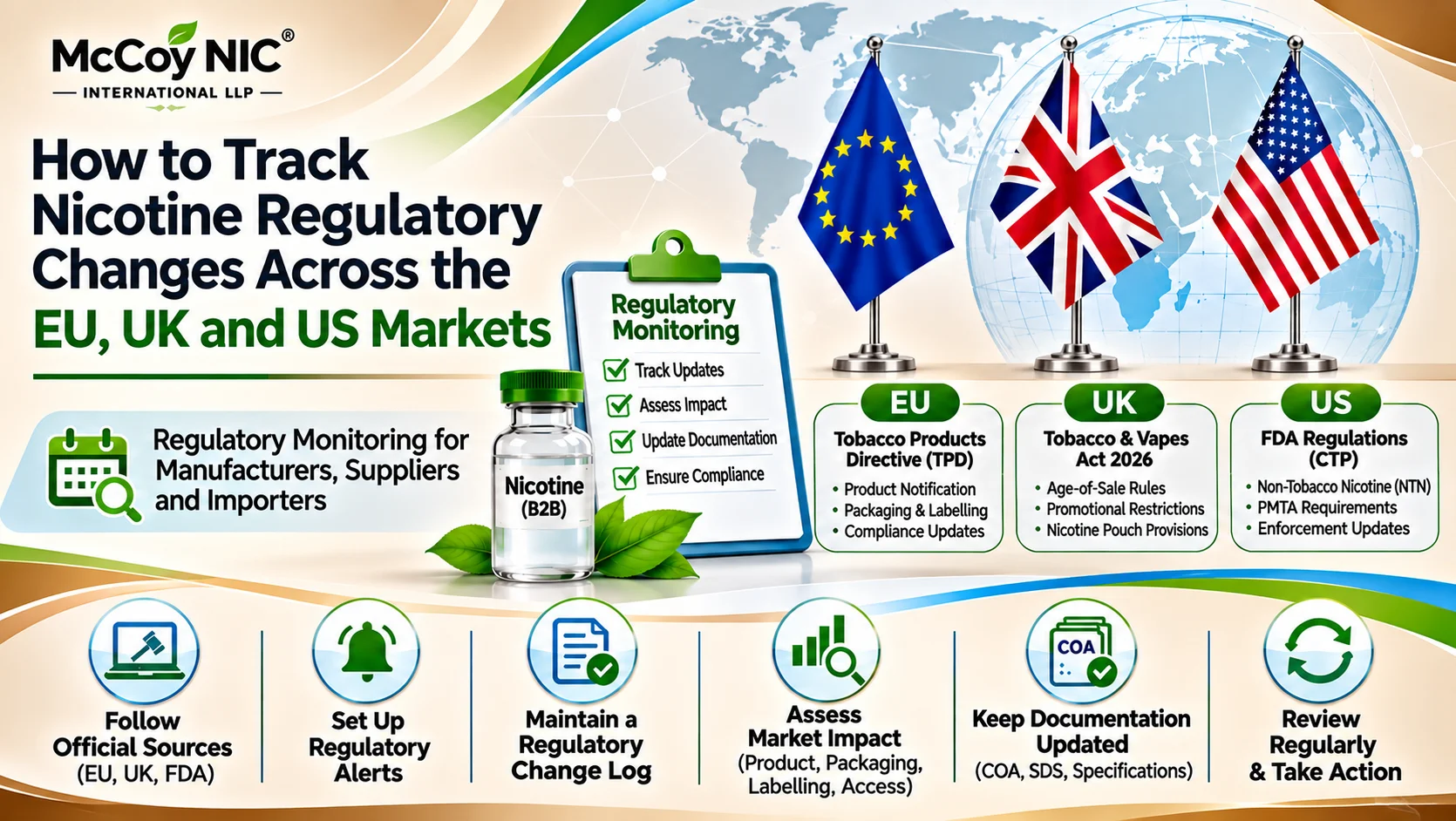
How to Track Nicotine Regulatory Changes Across the EU, UK and US Markets
Nicotine regulatory changes are an important consideration for nicotine manufacturers, suppliers, importers and businesses operating across international markets. Regulations can differ significantly between the European Union (EU), the United Kingdom (UK) and the United States (US), particularly for tobacco-derived nicotine, synthetic nicotine, e-cigarette products and nicotine pouches.
For businesses involved in pure nicotine, tobacco-derived nicotine and synthetic nicotine, tracking regulatory developments is essential for understanding market requirements, maintaining product documentation and preparing for potential compliance changes.
A structured regulatory monitoring process helps businesses identify new legislation, review official guidance, assess product-specific requirements and communicate relevant updates to their customers.
1. Why Tracking Nicotine Regulatory Changes Matters
Nicotine regulations are not identical across international markets. A product that can be marketed under one country’s rules may face different requirements in another jurisdiction.
Regulatory developments can affect:
- Product classification and market eligibility.
- Nicotine source and product composition requirements.
- Product notification and premarket authorization.
- Packaging, labelling and health warnings.
- Age restrictions, advertising and promotional activities.
- Quality specifications and analytical documentation.
- Import, distribution and record-keeping requirements.
Manufacturers and suppliers should therefore monitor regulations according to the destination market and the specific category of nicotine-containing product.
2. Monitoring Nicotine Regulations in the European Union
The EU regulatory framework includes the Tobacco Products Directive (TPD), Directive 2014/40/EU, which establishes requirements for tobacco products and specified related products.
The European Commission explains that the Directive covers areas such as product ingredients, reporting, packaging, labelling, electronic cigarettes and novel tobacco products.
Official source: European Commission – Tobacco Product Regulation
Businesses should monitor the following areas:
A. Tobacco Products Directive (TPD)
The TPD provides a common regulatory framework for specified tobacco and related products. Its requirements include ingredient reporting, packaging, health warnings and product-specific notification obligations.
It is important not to assume that every nicotine-containing product automatically falls within the same TPD requirements. Product classification and applicable national legislation must be reviewed separately.
Reference: EUR-Lex – Directive 2014/40/EU
B. National Regulations and Nicotine Pouches
Nicotine pouch requirements can differ between EU member states. Businesses should monitor national legislation, proposed restrictions and product-specific rules instead of relying only on the EU-wide TPD framework.
For example, the European Commission’s regulatory information system publishes notifications of proposed national technical regulations.
Reference: European Commission – TRIS Database
C. Upcoming EU Policy Developments
Businesses should also follow European Commission evaluations, consultations and legislative proposals concerning tobacco and novel nicotine products.
A policy evaluation or proposed amendment does not automatically mean that a new legal requirement is already in force. Companies should distinguish between consultations, draft legislation, adopted legislation and effective dates.
Reference: European Commission – TPD Implementation and Developments
3. Monitoring Nicotine Regulations in the United Kingdom
The UK has its own regulatory framework and publishes guidance for manufacturers, importers and retailers of nicotine products.
One important development is the Tobacco and Vapes Act 2026, which became law on 29 April 2026.
According to UK Government guidance, several restrictions covering vaping and nicotine products came into force on 29 October 2026.
These include:
- Age-of-sale restrictions covering nicotine and vaping products.
- Restrictions on promotional free distribution.
- Restrictions on substantial promotional discounts.
- Restrictions on vending-machine sales of relevant products.
The guidance includes nicotine pouches and synthetic nicotine within the scope of the relevant nicotine-product restrictions, while medicinal products are treated separately.
Official sources:
What Should Manufacturers and Suppliers Monitor?
Businesses supplying nicotine-related products to the UK should review:
- Product classification and intended use.
- Applicable product and safety requirements.
- Packaging and labelling requirements.
- Restrictions relevant to the product category.
- Importer and distributor responsibilities.
- Changes to official government guidance.
Do not assume that requirements for consumer nicotine products are identical to requirements for pharmaceutical or medicinal products.
4. Monitoring Nicotine Regulations in the United States
The US regulatory framework is administered by the Food and Drug Administration (FDA), particularly its Center for Tobacco Products (CTP), for products falling within its tobacco-product jurisdiction.
A major consideration is the regulation of non-tobacco nicotine (NTN), including synthetic nicotine.
In 2022, federal legislation clarified FDA’s authority over products containing nicotine from any source, including synthetic nicotine.
Manufacturers seeking to market products covered by the applicable tobacco-product requirements generally need to obtain the required FDA premarket authorization.
Official source: FDA – Regulation and Enforcement of Non-Tobacco Nicotine Products
A. Premarket Tobacco Product Applications (PMTA)
Businesses should monitor FDA updates concerning PMTA submissions, application reviews, authorization decisions and enforcement actions.
A submitted or accepted application should not be confused with marketing authorization. Companies must verify the regulatory status of the specific product before making market-access claims.
B. FDA Enforcement Updates
On 8 May 2026, FDA announced enforcement priorities concerning certain unauthorized electronic nicotine delivery systems and nicotine pouch products.
The guidance discusses enforcement priorities for products marketed without the required premarket authorization.
Businesses should review the actual guidance and its scope rather than interpreting an enforcement announcement as a general approval or exemption.
Official sources:
- FDA – May 2026 Enforcement Priorities Announcement
- FDA – May 2026 Final Guidance
- FDA – Tobacco Product Guidance Documents
5. Build a Regulatory Monitoring System
Checking regulatory websites occasionally is not enough for companies dealing with multiple international markets. A structured monitoring system can help teams identify important updates and assign follow-up actions.
A practical process can include the following steps.
Step 1: Identify Official Regulatory Sources
Create a list of official government and regulatory websites for each destination market.
| Market | Regulatory source | What to monitor |
|---|---|---|
| EU | European Commission | TPD, policy evaluations and product regulation |
| EU Member States | TRIS and national authorities | National legislation and proposed rules |
| UK | GOV.UK and legislation.gov.uk | Nicotine product guidance and legal changes |
| US | FDA Center for Tobacco Products | PMTA, NTN and enforcement updates |
Step 2: Set Up Regulatory Alerts
Use official email subscriptions, government announcement pages and regulatory newsletters wherever available.
Useful search terms include:
- Nicotine product regulation
- Synthetic nicotine legislation
- Tobacco-derived nicotine requirements
- Nicotine pouch restrictions
- PMTA regulatory updates
- Tobacco Products Directive amendments
- Nicotine product notification
- Nicotine impurity and quality standards
Step 3: Maintain a Regulatory Change Log
Every relevant update should be recorded in a central spreadsheet or compliance database.
| Field | Information to record |
|---|---|
| Market | EU, UK or US |
| Product category | Nicotine, nicotine pouch, e-liquid or medicinal product |
| Regulatory authority | Issuing authority |
| Update date | Date published |
| Effective date | Date the requirement becomes applicable |
| Update type | Proposal, guidance, amendment or final rule |
| Business impact | Products or operations affected |
| Responsible person | Assigned team member |
| Action status | Pending, under review or completed |
Step 4: Assess the Business Impact
Not every regulatory announcement requires an immediate change to product specifications or business operations.
The compliance team should determine:
- Whether the update applies to the company’s product category.
- Whether it applies to the intended destination market.
- Whether it is legally binding or guidance.
- Whether an effective date has been announced.
- Whether product documentation or operating procedures need revision.
Step 5: Review Product Documentation
Regulatory monitoring should be connected with product-quality documentation.
Depending on product type and customer requirements, relevant documents may include:
- Certificate of Analysis (COA).
- Safety Data Sheet (SDS).
- Product specifications.
- Impurity profile and analytical test reports.
- Nicotine source and composition information.
- Batch traceability and manufacturing records.
- Stability and storage information.
For further information, businesses can review the McCoy NIC Certificates and Documentation page.
6. Why Product Quality and Regulatory Monitoring Should Work Together
Regulatory compliance is not limited to reading new legislation. Businesses should also understand how regulatory requirements relate to product quality, analytical testing and documentation.
For example, a customer evaluating nicotine for a particular application may request information about purity, secondary alkaloids, impurities, analytical methods and batch consistency.
Manufacturers and suppliers should maintain suitable technical documentation and ensure that product claims are supported by appropriate evidence.
Related technical reading:
- USP vs EP Nicotine Impurity Limits: Anatabine and Anabasine
- Chiral HPLC Testing in Synthetic Nicotine
- FDA Non-Tobacco Nicotine PMTA: Chiral Isomer Testing
These topics help explain how analytical testing and technical documentation can support product-quality evaluation. They do not replace market-specific legal advice or regulatory authorization.
7. Common Mistakes When Tracking Nicotine Regulations
Businesses should avoid the following mistakes:
Relying on unofficial news alone: News reports can help identify developments, but legal requirements should be checked against official publications.
Treating proposals as final laws: A consultation or draft regulation is not automatically an enforceable requirement.
Using one compliance checklist for every country: EU, UK and US requirements differ and should be reviewed independently.
Ignoring product classification: Nicotine ingredients, consumer nicotine products, e-cigarettes and medicinal products may fall under different regulatory frameworks.
Overlooking effective dates: A regulation may be adopted on one date and become applicable on another.
Failing to update documentation: Regulatory changes may require updates to internal specifications, customer information or compliance procedures.
8. Practical Regulatory Monitoring Checklist
Companies can use this checklist as part of their monthly compliance review:
-
Review European Commission tobacco and nicotine product updates.
-
Check EU member-state regulatory notifications.
-
Review new UK nicotine product guidance and legislation.
-
Monitor FDA PMTA and NTN announcements.
-
Check enforcement announcements and product authorization status.
-
Record publication and effective dates.
-
Assess the impact on each relevant product category.
-
Review COA, SDS and technical documentation where necessary.
-
Assign responsibility for required compliance actions.
-
Keep a record of completed reviews and decisions.
Conclusion
Tracking nicotine regulatory changes across the EU, UK and US markets requires a consistent process based on official sources, product classification and documented compliance reviews.
For manufacturers, importers and suppliers, monitoring legislation alongside product specifications, analytical testing and technical documentation can help identify regulatory risks and prepare for market-specific requirements.
McCoy NIC International LLP supports B2B nicotine sourcing and technical information requirements across product categories including pure nicotine, tobacco-derived nicotine and synthetic nicotine. Businesses should always verify applicable legal requirements with the relevant regulatory authority before placing products on a market.