Non-Tobacco Nicotine: Regulatory Definitions and Market-Specific Compliance Questions
Non-Tobacco Nicotine Regulations are becoming increasingly important across the global nicotine industry as manufacturers, suppliers and product developers explore synthetic nicotine and alternative nicotine sources. However, regulatory definitions and compliance requirements differ across international markets. A product described as tobacco-free or synthetic nicotine may still fall under specific national nicotine, tobacco, vaping, pharmaceutical or consumer product regulations.
For international manufacturers and buyers, understanding these differences is essential before sourcing, manufacturing, importing or distributing nicotine-containing products.
What Is Non-Tobacco Nicotine?
Non-tobacco nicotine refers to nicotine that is not obtained from a tobacco plant. It includes synthetic nicotine, which is manufactured through chemical processes.
The US Food and Drug Administration (FDA) describes non-tobacco nicotine as nicotine that did not come from a tobacco plant. The agency also confirms that synthetic nicotine has a similar molecular structure to naturally occurring nicotine.
The main categories are:
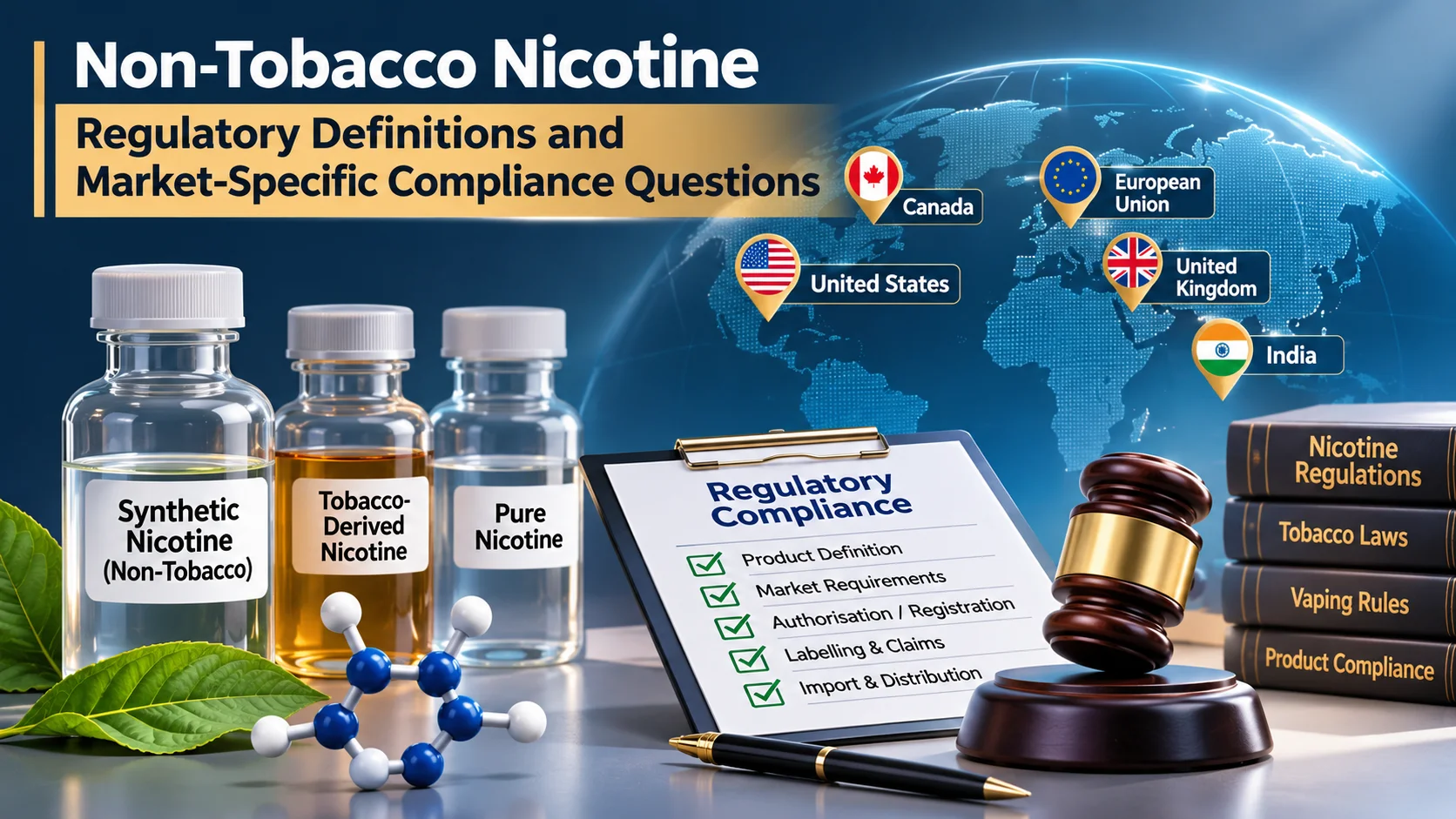
- Tobacco-derived nicotine: Extracted from tobacco plant material.
- Synthetic nicotine: Produced through chemical synthesis rather than tobacco extraction.
- Non-tobacco nicotine: A broader term covering nicotine that does not originate from tobacco plants.
The distinction is important for product identification and regulatory assessment. However, the source of nicotine alone does not determine whether a finished product is legally permitted in a particular market.
The FDA explains these definitions in its official guidance: Regulation and Enforcement of Non-Tobacco Nicotine Products.
Why Are Non-Tobacco Nicotine Regulations Different Across Markets?
Regulators generally assess products according to their composition, intended use, presentation and legal classification. A synthetic nicotine ingredient, a nicotine pouch, an e-liquid and a pharmaceutical nicotine product may be subject to different requirements.
For businesses, the key questions include:
- Is the product classified as a tobacco product or a nicotine-containing product?
- Does the product require premarket authorisation?
- Are product notifications or registrations necessary?
- Are there restrictions on nicotine concentration, packaging or labelling?
- Does the product fall under pharmaceutical or medicinal product legislation?
- Are there import restrictions in the destination country?
These questions should be reviewed separately for each market.
United States: FDA Authority Covers Nicotine From Any Source
The United States expanded the FDA’s authority in 2022 to include tobacco products containing nicotine from any source, including synthetic nicotine.
The change took effect on April 14, 2022, under the federal legislation amending the definition of a tobacco product. Consequently, covered non-tobacco nicotine products are subject to applicable FDA requirements.
Manufacturers seeking to market covered products must obtain the required FDA marketing authorisation. The FDA also applies relevant requirements relating to manufacturing, distribution, marketing and youth access.
Compliance question: Does synthetic nicotine avoid FDA regulation?
No. Using synthetic nicotine instead of tobacco-derived nicotine does not automatically exempt a covered product from FDA requirements.
Official source: FDA – Regulation and Enforcement of Non-Tobacco Nicotine Products.
European Union: Product Classification and National Rules Matter
The European Union’s Tobacco Products Directive 2014/40/EU establishes requirements for tobacco products, electronic cigarettes and related product categories. It includes provisions covering product safety, quality, labelling and notification requirements for electronic cigarettes.
However, not every nicotine-containing product automatically falls within the same category under the Directive. Businesses must assess the product’s legal definition and any additional national requirements in the Member State where it will be marketed.
Nicotine pouches are a particularly important example. Their regulatory treatment has developed through national measures, and requirements can differ between EU countries.
For example, Poland introduced nicotine pouch notification requirements from July 5, 2025, requiring manufacturers and importers to provide ingredient information to the relevant authority.
Compliance question: Does one EU regulatory assessment cover every Member State?
Not necessarily. Businesses should review EU-level requirements together with the national legislation applicable in the destination country.
Official sources:
United Kingdom: Synthetic Nicotine Is Included in Relevant Restrictions
The UK government guidance on selling vaping and nicotine products explicitly includes synthetic nicotine within the scope of relevant restrictions.
The guidance covers vaping products and other nicotine products, including nicotine pouches, strips and pearls. From October 29, 2026, the age-of-sale restriction for covered vaping and nicotine products is 18 and over across the UK.
The updated framework also includes restrictions on free distribution and substantial promotional discounts for covered products.
Compliance question: Can synthetic nicotine products avoid UK restrictions because they are not tobacco-derived?
No. The UK guidance expressly includes synthetic nicotine in the relevant product restrictions. Businesses should assess the product category and applicable requirements before entering the market.
Official source: UK Government – Selling Vaping and Nicotine Products.
India: Nicotine Product Classification Requires Careful Review
India applies different legal frameworks to tobacco products, electronic cigarettes, food products and pharmaceutical products containing nicotine.
The Prohibition of Electronic Cigarettes Act, 2019 prohibits activities including the production, manufacture, import, export, transport, sale, distribution, storage and advertisement of electronic cigarettes as defined under the Act.
India also restricts the use of nicotine and tobacco as ingredients in food products under the Food Safety and Standards regulations.
In September 2026, Reuters reported that India’s Health Ministry had directed states to take action against nicotine pouches, citing health risks and the products’ unapproved status. This development highlights the importance of checking current enforcement and product-specific legal requirements rather than assuming that a tobacco-free description makes a product permissible.
Compliance question: Does non-tobacco or synthetic nicotine automatically make a product legal in India?
No. Businesses must evaluate the product’s composition, intended use, classification and applicable Indian laws before importing, manufacturing or distributing it.
Official and supporting sources:
- National Tobacco Control Programme – Acts, Rules and Regulations
- Reuters – India orders crackdown on nicotine pouches, September 2026
Canada: Vaping and Tobacco Definitions Must Be Examined Separately
Canada’s Tobacco and Vaping Products Act establishes separate legal definitions for tobacco products and vaping products.
A product containing nicotine that is not derived from tobacco may still fall within the vaping product framework depending on its composition and intended use. Products making therapeutic claims may also require assessment under Canada’s Food and Drugs Act and applicable Health Canada requirements.
Compliance question: Is synthetic nicotine automatically outside Canadian vaping regulations?
No. The product’s intended use, design and legal classification determine which requirements may apply.
Official sources:
What Documentation Should Buyers and Suppliers Review?
International buyers and suppliers should maintain accurate technical and product documentation to support product assessment and procurement decisions.
Important documents include:
- Certificate of Analysis (COA), including batch-specific assay and purity results.
- Safety Data Sheet (SDS), covering hazards, handling and storage.
- Product specification with chemical identity and grade.
- Declaration identifying the nicotine source.
- Manufacturing and quality-control information.
- Intended-use declaration.
- Relevant import and export documentation.
- Market-specific regulatory assessment.
A COA or SDS supports technical evaluation but does not, by itself, establish regulatory approval or permission to sell a product in a particular country.
Businesses evaluating different nicotine sources can also review McCoy NIC’s product information on Pure Nicotine, Tobacco-Derived Nicotine and Synthetic Nicotine.