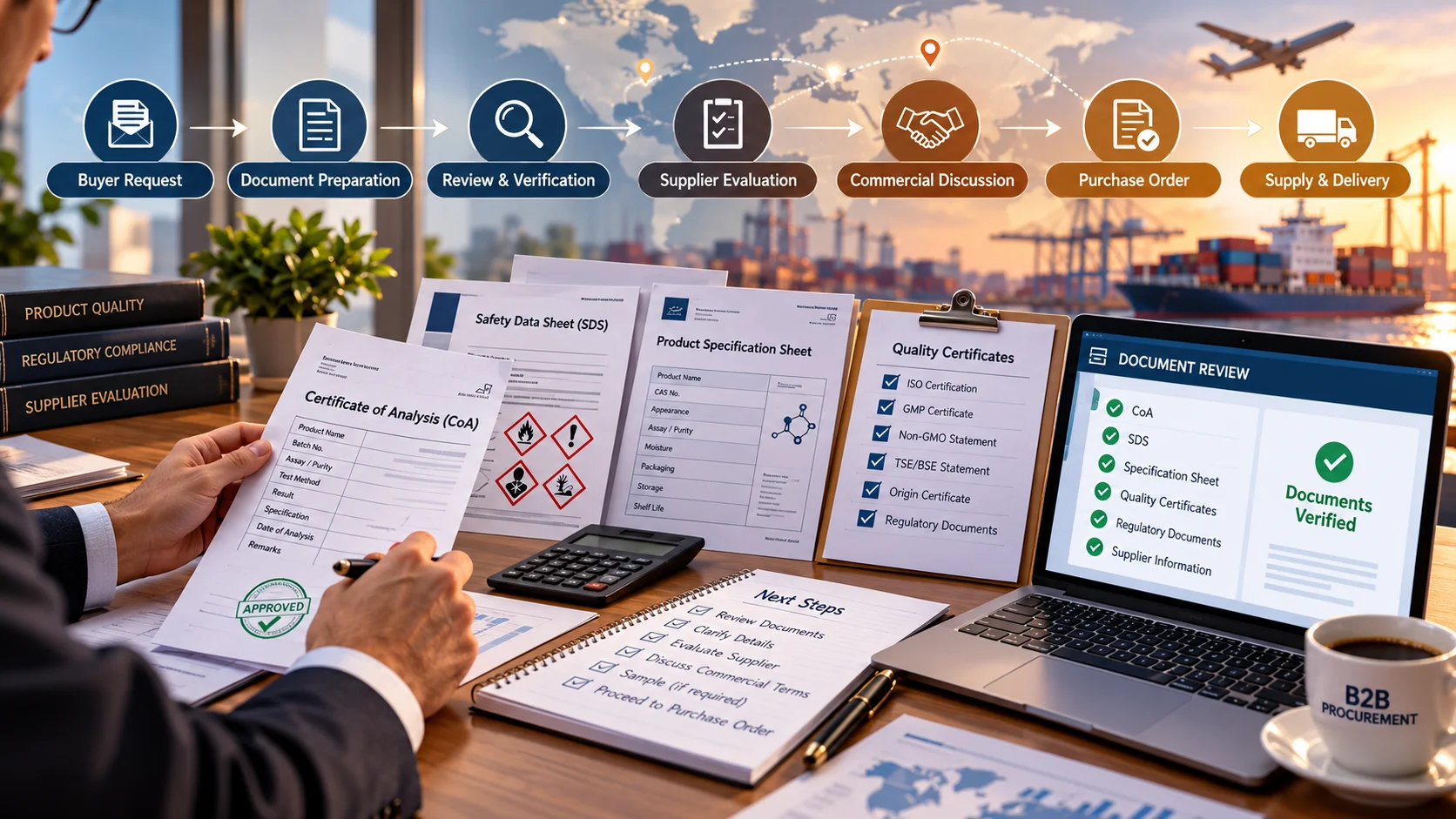
What Happens After a Buyer Requests Product Documentation?
In international B2B trade, requesting product documentation is an important step before moving forward with a potential purchase. When a buyer contacts a supplier and asks for technical documents, certificates or product specifications, it usually indicates that the purchasing process has moved beyond the initial enquiry stage.
However, receiving a documentation request does not automatically mean that an order is confirmed. Buyers generally need to review the available information, compare product specifications, evaluate supplier capabilities and determine whether the material meets their technical and commercial requirements.
For manufacturers, distributors and suppliers dealing in specialised ingredients, pharmaceutical materials and industrial chemicals, responding to documentation requests efficiently can help establish transparency and build confidence during the procurement process.
Understanding what happens after a buyer requests product documentation can help both buyers and suppliers manage enquiries more effectively and avoid unnecessary delays.
1. The Supplier Reviews the Buyer’s Documentation Request
The first step begins when a supplier receives a request for product-related documents.
The buyer may request information about a specific product, grade, purity level, packaging format or intended application. In some cases, the buyer may also specify the documents required for internal quality approval or regulatory assessment.
Common documentation requests include:
- Certificate of Analysis (CoA).
- Safety Data Sheet (SDS).
- Product Specification Sheet.
- Technical Data Sheet (TDS), where applicable.
- Relevant quality certificates.
- Product origin and traceability information.
- Available regulatory or compliance documentation.
The supplier should first understand the buyer’s requirements and identify which documents are available.
If any requested information is unclear, the supplier may contact the buyer for clarification before preparing the documentation package.
2. The Required Product Documents Are Collected
Once the request is understood, the supplier collects the relevant documents from its quality, technical, regulatory or manufacturing departments.
Each document serves a different purpose in the purchasing and evaluation process.
Certificate of Analysis (CoA)
A Certificate of Analysis provides analytical results for an identified sample or product batch.
Depending on the material, it may include:
- Product identification.
- Batch or lot number.
- Assay or purity results.
- Relevant impurity results.
- Testing methods.
- Specification limits.
- Testing date and laboratory information.
Buyers should check whether the CoA corresponds to the actual batch being offered or supplied. A general product specification sheet should not be treated as a substitute for a batch-specific CoA.
Safety Data Sheet (SDS)
A Safety Data Sheet provides information about chemical hazards, safe handling, storage, exposure controls, emergency measures and disposal considerations.
For chemical products, the SDS helps buyers and their safety teams understand the precautions associated with handling and using the material.
Depending on the applicable regulatory framework and product classification, an SDS may be required as part of the supply process.
Product Specification Sheet
A product specification sheet describes the technical characteristics and agreed quality parameters of a product.
It may include:
- Product name and grade.
- Appearance and physical characteristics.
- Assay or purity requirements.
- Applicable testing parameters.
- Storage recommendations.
- Packaging information.
This document allows buyers to compare the offered material against their technical requirements.
Quality and Compliance Certificates
Buyers may also request company-level quality certificates, manufacturing-related credentials or other applicable compliance documents.
These documents help buyers understand the supplier’s quality management framework and relevant business credentials.
However, company-level certificates and product-specific analytical documents serve different purposes and should be evaluated separately.
3. The Buyer Reviews and Verifies the Documents
After receiving the documents, the buyer’s procurement, quality assurance and regulatory teams may review the information.
The objective is to establish whether the submitted documents are relevant, complete and consistent with the requirements of the intended purchase.
Important verification points include:
- Whether the product name and grade match the enquiry.
- Whether the reported specifications meet the buyer’s requirements.
- Whether the CoA identifies the relevant batch.
- Whether the SDS contains appropriate safety information.
- Whether document dates and revision details are clear.
- Whether the supplier’s information is consistent across documents.
For specialised ingredients, buyers may also request clarification regarding analytical methods, impurity limits, traceability and other technical parameters.
According to the European Chemicals Agency (ECHA), Safety Data Sheets play an important role in communicating chemical hazards and safe-use information throughout the supply chain.
This makes document accuracy and proper communication important considerations during supplier evaluation.
4. Additional Information May Be Requested
During the verification process, buyers may identify missing information or require clarification.
For example, a buyer may request an updated specification sheet, additional analytical details, a batch-specific CoA or clarification regarding packaging and storage conditions.
This is a normal part of technical and commercial evaluation.
Suppliers should respond to additional questions clearly and provide supporting information where available.
If a particular document is not available, the supplier should communicate this transparently rather than provide an incomplete or misleading document.
For businesses dealing with regulated ingredients, the buyer may also need to confirm whether the available documentation is suitable for the destination market and intended application.
5. Supplier Qualification and Internal Approval Begin
Once the initial documentation review is completed, buyers may begin or continue their supplier qualification process.
Supplier qualification is an important stage in B2B procurement because purchasing decisions involve more than product availability and pricing.
Companies may evaluate:
- Supplier business credentials.
- Manufacturing or sourcing capabilities.
- Quality management arrangements.
- Product consistency and specifications.
- Relevant certificates and documentation.
- Regulatory and export-related requirements.
- Communication and supply reliability.
In pharmaceutical and specialised chemical markets, the buyer may involve multiple departments before approving a supplier.
The quality team may review product specifications, the procurement team may compare commercial terms, and the regulatory team may assess applicable compliance requirements.
Read our related article: Nicotine Supplier Evaluation: 9 Documents Buyers Need.
6. Commercial Discussions Move Forward
If the documentation review is satisfactory, the buyer may proceed with further commercial discussions.
This stage may involve requesting or confirming:
- Product quotation.
- Minimum Order Quantity (MOQ).
- Available quantity.
- Packaging options.
- Estimated lead time.
- Shipping arrangements.
- Payment terms.
- Delivery conditions.
Buyers should compare quotations against the same product specifications and documentation requirements to avoid differences in the final purchasing decision.
For additional insights, read our article on Why Supplier Quotation Comparison Matters to Buyers.
It is important to remember that receiving product documents does not guarantee an order. Commercial approval, internal qualification and other purchasing requirements may still be pending.
7. Samples or Further Technical Evaluation May Follow
In certain transactions, buyers may request product samples after reviewing the initial documentation.
Samples may be required to conduct independent laboratory testing, application trials or internal quality assessments.
Before arranging samples, both parties should clarify:
- Sample quantity.
- Product identification and grade.
- Available analytical documentation.
- Packaging and handling requirements.
- Transportation arrangements.
- Applicable regulatory requirements.
For chemical and specialised ingredient products, sample shipments must follow the relevant safety, packaging, transport and destination-country requirements.
A satisfactory sample evaluation may support the next stage of procurement, although final approval remains subject to the buyer’s internal procedures.
8. Purchase Order and Supply Coordination
Once the supplier has passed the buyer’s relevant evaluation stages and commercial terms have been agreed, the purchasing process may move towards a Purchase Order (PO).
Before accepting the order, both parties should confirm:
- Product identity and agreed specifications.
- Confirmed quantity and packaging.
- Applicable batch and quality documentation requirements.
- Price and payment conditions.
- Delivery schedule and shipping arrangements.
- Required export and import documentation.
After order confirmation, the supplier coordinates production or material allocation, quality checks, documentation preparation and dispatch planning as applicable.
The buyer should also understand which documents will be supplied before shipment and which will accompany the final delivery.
Why Is Proper Documentation Handling Important?
Product documentation is not simply an administrative requirement. It supports communication between suppliers, buyers, quality teams and regulatory professionals.
A well-organised documentation process can help businesses:
- Reduce unnecessary communication delays.
- Improve transparency during supplier evaluation.
- Identify specification differences earlier.
- Support internal quality approval.
- Maintain better product traceability.
- Improve coordination before purchase order confirmation.
For companies operating in international markets, accurate documentation also helps buyers understand the information available for assessing a product and its suitability for their requirements.
How This Process Applies to Nicotine and Specialised Ingredient Procurement
In the nicotine and pharmaceutical ingredient sectors, documentation requests can involve additional technical and regulatory considerations.
Buyers sourcing pure nicotine, tobacco-derived nicotine, synthetic nicotine, nicotine salts or other specialised ingredients may request product-specific analytical information, safety documentation and relevant quality credentials.
The exact documents depend on the product, intended application, buyer requirements and applicable regulations in the destination market.
A typical procurement discussion may involve:
- Product identity and technical specifications.
- Assay or purity requirements.
- Batch-specific Certificate of Analysis.
- Safety Data Sheet.
- Packaging and storage requirements.
- Origin and traceability information.
- Relevant regulatory and export documentation.
Businesses should verify that the documentation corresponds to the actual product and transaction rather than relying on generic certificates or unrelated documents.
For more information, explore our guide on Nicotine Import Documentation: A B2B Buyer’s Guide.
You can also read How McCoy NIC Organizes Public Product Information to understand the role of product information and documentation in buyer enquiries.