Importing Nicotine Ingredients: Documentation and Customs Readiness Across Markets
Importing nicotine ingredients requires careful preparation of technical documents, customs declarations and market-specific regulatory information. For manufacturers, pharmaceutical businesses, chemical distributors and international suppliers, incomplete documentation or incorrect product classification can result in customs delays, additional inspections or shipment refusal.
Nicotine ingredients may be supplied as tobacco-derived nicotine, synthetic nicotine, nicotine salts or other specified chemical forms. However, the documentation and regulatory requirements depend on the product’s identity, intended use, destination country and whether the shipment contains a raw ingredient or a finished consumer product.
For international buyers and suppliers, customs readiness should begin before the shipment leaves the exporting country.
1. Why Is Documentation Important When Importing Nicotine Ingredients?
Import documentation helps customs authorities and relevant regulatory agencies identify the imported material, verify its declared value and origin, understand its intended use and determine whether additional controls apply.
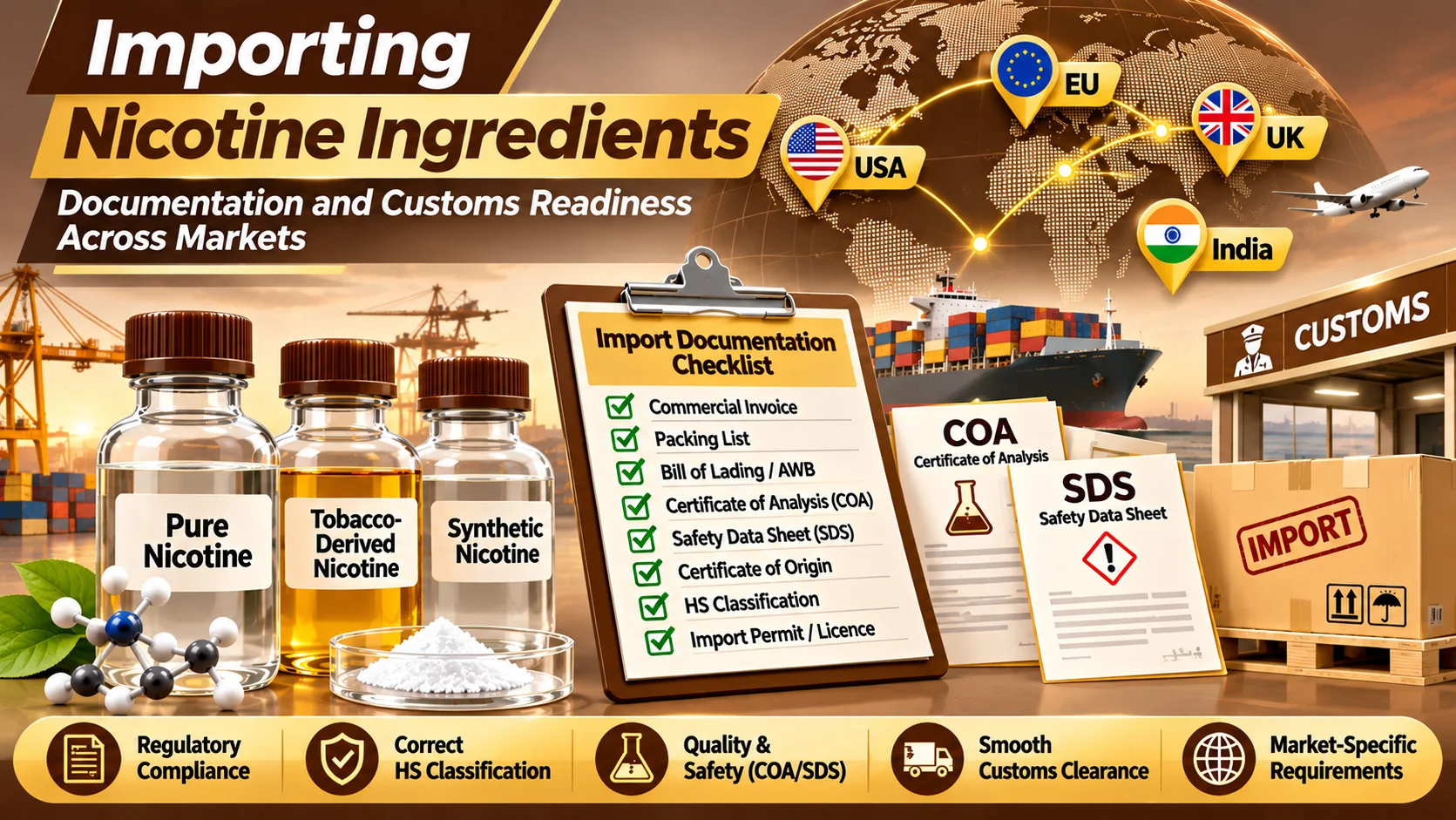
A typical international shipment may require:
- Commercial invoice.
- Packing list.
- Bill of Lading (B/L) or Air Waybill (AWB).
- Certificate of Origin, where required.
- Certificate of Analysis (COA).
- Safety Data Sheet (SDS).
- Product specification.
- Customs tariff classification and HS code.
- Import licence, permit or regulatory approval, where applicable.
Not every document is mandatory for every shipment. Requirements depend on the destination country, product classification, intended use and applicable customs procedures.
The European Commission’s Access2Markets customs clearance guidance explains the role of commercial invoices, proof of origin and transport documents in international import clearance.
2. Commercial Invoice: Establishing the Shipment Details
The commercial invoice is one of the principal documents used in international trade. It records the transaction between the exporter and importer and provides information required for customs valuation and clearance.
For nicotine ingredient shipments, the invoice should clearly identify:
- Exporter and importer details.
- Product or chemical name.
- Product grade and specification, where relevant.
- Quantity and unit of measurement.
- Unit price and total shipment value.
- Currency.
- Country of origin.
- Country of export.
- Applicable HS code, subject to customs verification.
- Incoterms and agreed delivery terms.
Product descriptions should be specific and consistent with the technical documents. For example, describing a shipment only as “chemical material” may create avoidable questions during customs assessment.
The declared product description should accurately represent the material being shipped. Businesses should not use misleading descriptions to avoid regulatory scrutiny or customs duties.
3. Certificate of Analysis (COA): Supporting Nicotine Quality Information
A Certificate of Analysis provides batch-specific information about the tested material. It is particularly useful for buyers evaluating nicotine raw materials and checking whether a shipment meets the agreed product specification.
A COA may include:
- Product identification and batch number.
- Assay or nicotine content.
- Purity results.
- Relevant impurity test results.
- Appearance and other specified parameters.
- Testing methods.
- Specification limits and actual results.
- Date of testing and authorised approval.
For example, a buyer importing synthetic nicotine may require additional information to verify chemical identity and relevant quality characteristics.
Similarly, pharmaceutical-grade or other specialised nicotine materials may require additional testing and documentation according to the buyer’s quality system and applicable regulatory framework.
Businesses sourcing different nicotine categories can review McCoy NIC’s information on Pure Nicotine, Tobacco-Derived Nicotine and Synthetic Nicotine.
A COA supports technical evaluation, but it does not independently establish that a product is authorised for import or sale in a destination country.
4. Safety Data Sheet (SDS): Chemical Handling and Transport Information
An SDS communicates important safety information about a chemical substance or mixture. It helps importers, transport companies, warehouse operators and downstream users understand potential hazards and appropriate handling precautions.
For nicotine ingredients, an SDS should be reviewed for:
- Chemical identification and composition.
- Hazard identification.
- First-aid measures.
- Firefighting measures.
- Accidental release procedures.
- Handling and storage precautions.
- Exposure controls and personal protective equipment.
- Physical and chemical properties.
- Toxicological information.
- Transport information.
- Regulatory information.
Importers should verify that the SDS corresponds to the actual material being shipped and is appropriate for the destination market.
In the European Economic Area, hazardous chemicals must be classified, labelled and packaged in accordance with applicable CLP requirements. The EU’s official Classification, Labelling and Packaging guidance explains the obligations for companies supplying hazardous substances and mixtures.
The SDS should also be consistent with the product specification, chemical identity and hazard classification.
5. United States: FDA and Customs Requirements
Importing nicotine-containing materials into the United States requires careful distinction between raw ingredients and finished tobacco products.
The FDA’s import requirements explain that products meeting the federal definition of a tobacco product may be subject to applicable tobacco product requirements. The definition includes products containing nicotine from any source when intended for human consumption, while excluding certain raw materials other than tobacco used in manufacturing a component, part or accessory of a tobacco product.
This distinction is important: a raw nicotine ingredient should not automatically be treated as a finished tobacco product, and its regulatory position should be assessed according to its actual classification and intended use.
For products regulated by the FDA, importers may need to provide accurate information through the Automated Commercial Environment (ACE), including:
- Country of production.
- FDA product code.
- Intended use code.
- Importer-of-record contact information.
- Brand information, where applicable.
The FDA also explains that applicable product authorisation, labelling and other requirements may be verified at importation for regulated tobacco products.
Key compliance question: Does every shipment containing nicotine require the same FDA import approval?
No. Requirements depend on whether the shipment is a raw ingredient, a component or a finished product and on the applicable statutory and regulatory framework.
Official references:
6. European Union: Customs, EORI, REACH and CLP Considerations
Importing nicotine ingredients into the European Union requires attention to customs procedures as well as applicable chemical regulations.
An EU importer generally needs an Economic Operators Registration and Identification (EORI) number for customs activities. The customs documentation may include a commercial invoice, proof of origin, transport documents and the applicable import declaration.
For chemical substances, additional assessment may be necessary under REACH and CLP.
Important considerations include:
- Whether the imported material is a substance or mixture.
- Whether REACH registration obligations apply.
- Whether the importer is responsible for classification and labelling.
- Whether a compliant SDS is required.
- Whether any applicable restriction or authorisation applies.
Under REACH, importers bringing a substance into the EU at one tonne or more per year may have registration obligations, subject to applicable exemptions and specific legal provisions. CLP classification obligations may apply independently of tonnage.
The European Chemicals Agency and national authorities provide guidance on these responsibilities. Businesses can review the EU guidance on chemical classification and labelling and the Irish Health and Safety Authority’s chemical importer guidance.
For finished electronic cigarettes and related products, separate product notification requirements may also apply. The European Commission explains that manufacturers and importers of products covered by the Tobacco Products Directive must submit relevant product information to the competent authorities in the Member States where they intend to market those products.
See the European Commission’s EU-CEG guidance.
7. United Kingdom: Import Documentation and Vaping Product Rules
The United Kingdom maintains separate customs, chemical safety and nicotine product requirements.
Importers should identify whether the shipment is a raw chemical ingredient, a medicinal product, a vaping product or another regulated product category.
For chemical ingredients, relevant safety and classification obligations should be reviewed. For finished vaping products, additional requirements may apply depending on product category and intended market.
A significant development is the UK’s Vaping Products Duty and Vaping Duty Stamps Scheme. Government guidance updated on July 9, 2026 explains that businesses importing vaping products into the UK must pay the applicable duty through their customs declaration. Vaping duty stamps must also be attached before arrival unless the products enter an approved duty-suspension arrangement.
These requirements concern vaping products and should not automatically be applied to every shipment of raw nicotine ingredient.
Importers can review the official UK Government guidance on Vaping Products Duty and the Duty Stamps Scheme.
Key compliance question: Are raw nicotine ingredients automatically subject to vaping product duty?
No. Businesses should establish whether the shipment falls within the legal definition of a vaping product covered by the duty framework.
8. India: Import Classification and Product-Specific Restrictions
Importing nicotine ingredients into India requires careful review of customs classification, intended use and the applicable regulatory framework.
Businesses should distinguish between raw nicotine materials, pharmaceutical ingredients, food-related applications and finished electronic nicotine delivery systems.
India’s Prohibition of Electronic Cigarettes Act, 2019 prohibits activities including the production, manufacture, import, export, transport, sale, distribution, storage and advertisement of electronic cigarettes as defined under the Act.
However, the legal treatment of a raw nicotine chemical ingredient should not automatically be equated with that of a prohibited finished electronic cigarette. Importers must assess the specific material, intended application and applicable laws before arranging a shipment.
Depending on the product and intended use, businesses may need to examine:
- Correct customs tariff classification.
- Import policy under the applicable DGFT provisions.
- Chemical safety and transport documentation.
- Applicable drug or pharmaceutical requirements.
- Product-specific restrictions and permissions.
- Customs valuation and country-of-origin information.
The Directorate General of Foreign Trade provides the relevant framework through the Indian Foreign Trade Policy and ITC(HS) information.
India’s Ministry of Finance also reported a major enforcement operation in May 2026 involving the seizure of prohibited electronic cigarettes and vapes imported through mis-declared consignments. This demonstrates the importance of accurate declarations and compliance with the applicable import restrictions.
Official source: Press Information Bureau – DRI Action Against E-Cigarette Smuggling, May 21, 2026.
9. HS Code and Customs Classification: Why Accuracy Matters
The Harmonized System (HS) is used internationally to classify traded goods for customs purposes. However, the correct tariff classification depends on the product’s chemical identity, composition, form, intended use and the importing country’s tariff schedule.
Businesses should not assume that all nicotine ingredients share one universal HS code.
Before shipping, importers should confirm:
- The correct chemical or product description.
- Applicable HS classification.
- Country-specific tariff extensions.
- Customs duty and applicable taxes.
- Import policy conditions.
- Any additional permits or declarations.
An incorrect HS code can result in reassessment, additional duties, penalties or shipment delays.
Where classification is uncertain, importers should consult a qualified customs broker or seek an advance or binding tariff classification decision from the relevant customs authority, where available.
10. Pre-Shipment Documentation Checklist for Nicotine Ingredients
Before dispatching a nicotine ingredient shipment, exporters and importers should review the following documentation.
| Document | Main purpose |
|---|---|
| Commercial Invoice | Transaction value and shipment details |
| Packing List | Package count, weight and contents |
| Bill of Lading / Air Waybill | Transport and shipment reference |
| Certificate of Origin | Country-of-origin evidence, where required |
| Certificate of Analysis | Batch-specific quality results |
| Safety Data Sheet | Chemical hazards and handling information |
| Product Specification | Identity, grade and technical parameters |
| HS Classification | Customs tariff identification |
| Import Permit / Licence | Where required by destination rules |
| Regulatory Declaration | Product-specific compliance information, where applicable |
A pre-shipment review should confirm that product names, quantities, batch references, country of origin and other relevant details are consistent across the documents.
The importer should also share the technical documentation with its customs broker before dispatch, allowing potential classification or regulatory issues to be identified early.
11. How Suppliers and Buyers Can Improve Customs Readiness
International nicotine procurement involves coordination between suppliers, buyers, logistics providers and customs representatives.
Suppliers can improve shipment readiness by preparing accurate product specifications, batch-specific COAs, SDS documents and consistent commercial documentation.
Buyers can support the process by confirming the intended application, destination-country requirements, acceptable product grade, packaging conditions and required documentation before placing an order.
A practical procurement process should include:
- Confirming the exact nicotine ingredient and chemical form.
- Identifying the intended application and destination market.
- Checking customs classification and import policy.
- Reviewing the COA and SDS before shipment.
- Confirming any required permits or registrations.
- Checking packaging, transport and storage requirements.
- Sharing shipment documents with the customs broker in advance.
- Retaining complete records for traceability and future audits.
For businesses sourcing nicotine ingredients internationally, clear communication and accurate documentation can reduce avoidable customs delays and improve supply-chain coordination.
Conclusion: Customs Readiness Starts Before Shipment Dispatch
Importing nicotine ingredients requires more than a commercial invoice and transport document. Buyers and suppliers should establish the product’s chemical identity, intended use, customs classification and destination-market requirements before arranging shipment.
The United States, European Union, United Kingdom and India apply different customs and regulatory frameworks. In addition, raw nicotine ingredients should be distinguished from finished consumer products because their legal treatment may differ.
Maintaining accurate COAs, SDS documents, product specifications, origin information and customs declarations can help businesses prepare more effectively for international shipments.
For manufacturers, importers and distributors, a structured pre-shipment documentation review is an important part of responsible nicotine supply-chain management.