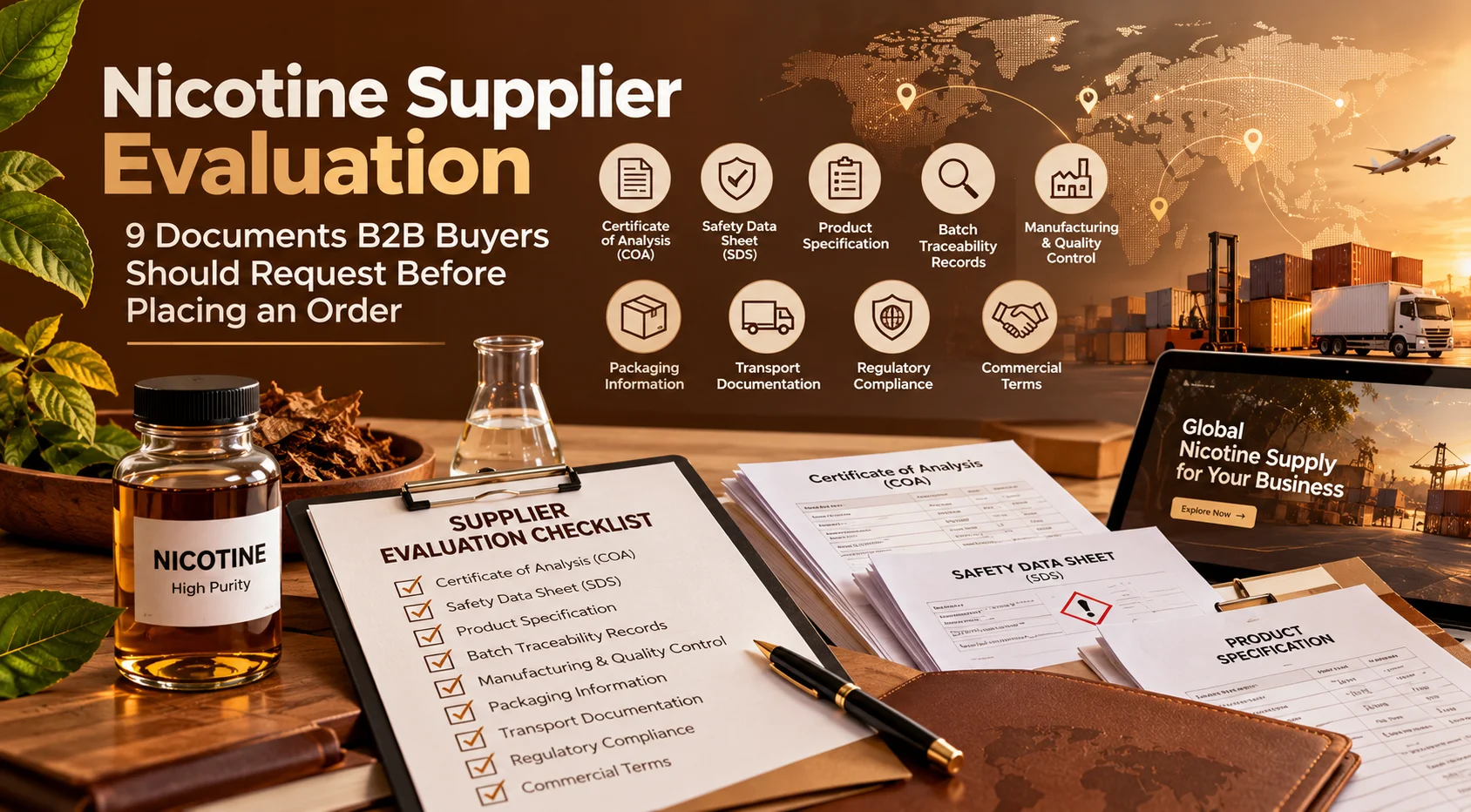
Nicotine Supplier Evaluation: 9 Documents B2B Buyers Should Request Before Placing an Order
Selecting a nicotine supplier involves more than comparing prices and delivery estimates. For manufacturers, procurement teams and international B2B buyers, reviewing technical documentation before placing an order can help clarify product specifications, quality requirements, safety information and import responsibilities.
A structured nicotine supplier evaluation process can also help buyers identify missing information before commercial agreements are finalised.
Why Nicotine Supplier Evaluation Matters
When purchasing nicotine as an industrial or manufacturing raw material, buyers need to establish whether the proposed material meets their intended application and internal specifications.
A supplier quotation may include product type, quantity, packaging and price, but these details do not necessarily provide all the technical information required for supplier qualification.
Buyers should therefore review the relevant documentation with their quality, procurement and regulatory teams before approving a supplier.
9 Documents to Request During Nicotine Supplier Evaluation
1. Certificate of Analysis (COA)
A Certificate of Analysis provides analytical information about a specific product or batch. Buyers should check that the document identifies the material tested and reports relevant results against clearly stated specifications.
Depending on the product, review:
- Product name and grade
- Batch or lot number
- Reported assay or purity
- Test methods, where provided
- Acceptance criteria and units
- Testing date and laboratory details
The document should correspond to the actual batch being supplied. Buyers should clarify any missing information before accepting the material.
2. Safety Data Sheet (SDS)
A Safety Data Sheet communicates relevant chemical hazards, handling precautions, storage requirements, emergency measures and other safety information.
Procurement teams should request the SDS applicable to the exact material and confirm that employees responsible for handling, storage and transport can access the appropriate safety guidance.
The required documentation and classification should be checked against the rules applicable to the material and destination market.
3. Product Specification Sheet
A product specification sheet describes the technical parameters against which the material is supplied.
Depending on the grade and intended application, it may identify chemical identity, assay, appearance, relevant impurity limits, storage conditions and packaging information.
Buyers should compare the supplier’s specification with their own approved requirements instead of relying on a general product description.
4. Batch Identification and Traceability Records
Batch identification helps connect a supplied material with its relevant production and quality records.
Buyers should establish how the supplier identifies individual batches and how discrepancies or quality concerns can be investigated.
For manufacturers, keeping the supplier’s batch identifier linked to incoming inspection records and internal inventory records can improve documentation and investigation processes.
5. Manufacturing and Quality-Control Information
Depending on the supplier-qualification requirements, buyers may request relevant information about manufacturing controls, quality assurance procedures, testing arrangements and batch-release processes.
The purpose is to understand how the supplier evaluates material against agreed specifications.
Any quality-system certification or manufacturing claim should be verified for its scope, validity and relevance to the supplied product.
6. Packaging and Storage Information
Packaging requirements depend on the material, concentration, quantity, transport conditions and destination regulations.
Buyers should confirm the proposed packaging configuration, compatibility, closure requirements, storage conditions and any applicable handling precautions.
The packaging information should be consistent with the product specification and the requirements of the receiving facility.
7. Transport and Dangerous-Goods Information
Before shipment, the parties should determine the transport classification and documentation requirements applicable to the exact material and mode of transport.
Depending on the shipment, this may involve carrier requirements, appropriate packaging, transport documentation and handling instructions.
Buyers should not assume that every nicotine product has the same transport classification. The relevant classification must be verified for the material being shipped.
8. Regulatory and Import Documentation
International shipments may require additional documents depending on the chemical, intended use, destination country and importing organization.
Before confirming an order, buyers should identify the relevant import permits, customs information, chemical registration obligations and other applicable requirements.
For European markets, for example, REACH and CLP obligations may need to be assessed according to the substance, use and supply-chain role. Requirements for a raw material should not automatically be confused with requirements for a finished consumer product.
9. Commercial and Supply Agreement Details
Technical qualification should be accompanied by clear commercial terms.
Before placing an order, buyers should confirm:
- Product grade and agreed specification
- Quantity and minimum order quantity
- Price and quotation validity
- Packaging configuration
- Lead time and delivery terms
- Payment terms
- Required documents
- Procedure for handling non-conforming material
- Responsibilities for shipping and import compliance
Written confirmation helps both parties understand the agreed requirements before dispatch.
How to Compare Nicotine Suppliers More Consistently
A practical evaluation process can use the same criteria for each supplier.
First, confirm that the proposed material matches the required specification. Next, review the COA, SDS and relevant quality documentation. Then assess packaging, logistics, regulatory responsibilities and commercial terms.
If information is missing, record the gap and request clarification rather than assuming that the requirement has been met.
A simple supplier evaluation record can include the supplier name, product grade, documents received, unresolved questions, quality review status and final approval decision.
Questions Buyers Should Ask Before Approving a Supplier
Procurement teams can ask suppliers:
- Does the COA identify the specific batch being offered?
- Are the product specifications aligned with the buyer’s requirements?
- Is an applicable SDS available?
- How are batch records and quality documents maintained?
- What packaging and storage conditions are required?
- Which transport documents are applicable?
- What import or regulatory requirements must the buyer fulfil?
- What is the expected lead time?
- How are quality discrepancies and rejected material handled?
The answers should be assessed against the buyer’s technical, quality and regulatory requirements.
Digital B2B Sourcing and Supplier Discovery
Online B2B platforms can help companies discover potential business contacts and communicate preliminary product requirements. However, a listing or supplier profile alone does not establish product quality, regulatory compliance or suitability for a particular application.
Buyers exploring digital sourcing options can visit TradeNicotine.com to review the platform and its available supplier and buyer information.
Before proceeding with any transaction, users should independently verify the counterparty, product documentation, applicable regulations and commercial terms.
For additional information about nicotine raw-material supply, buyers can also visit McCoy NIC International LLP and review its relevant product and procurement information.
Conclusion
A structured nicotine supplier evaluation process helps B2B buyers examine product specifications, analytical documentation, safety information, batch records, packaging, transport requirements and commercial terms before placing an order.
The appropriate documents depend on the material, intended application, destination market and the buyer’s internal requirements. No single document should be treated as proof of every aspect of quality or regulatory compliance.
By identifying documentation gaps early and maintaining clear written specifications, procurement teams can make supplier comparisons more consistent and support better-informed purchasing decisions.
Frequently Asked Questions
What documents should a nicotine supplier provide?
Depending on the material and transaction, buyers may request a COA, SDS, product specification, batch identification records, packaging information and applicable transport, regulatory and import documentation.
Why is a COA important when purchasing nicotine?
A COA reports analytical results for an identified material or batch. Buyers can compare those results with agreed specifications and clarify any discrepancies before accepting the material.
Is a COA sufficient for supplier approval?
Not necessarily. Supplier approval may also require an SDS, technical specifications, quality-system information, traceability records and relevant regulatory checks.
What should international buyers verify before importing nicotine?
Buyers should confirm the product classification, intended use, applicable import requirements, customs documentation, transport classification and any relevant chemical regulatory obligations in the destination market.
Can a B2B marketplace replace supplier verification?
No. A marketplace can support supplier discovery and initial communication, but buyers must independently evaluate supplier identity, product documentation, quality requirements and legal compliance.


4 thoughts on “Nicotine Supplier Evaluation: 9 Documents B2B Buyers Should Request Before Placing an Order”