Understanding the Role of Specifications in Industrial Nicotine Procurement
Category: Industry Insights
Industrial procurement decisions depend on accurate product information, clearly defined quality requirements and reliable documentation. In the nicotine industry, product specifications help buyers and suppliers establish a common understanding of the material being discussed before a commercial transaction moves forward.
Understanding industrial nicotine specifications can help procurement teams compare product information, evaluate supplier documentation and identify technical details that require clarification. A structured specification review also supports communication between purchasing, quality assurance and regulatory teams.
What Are Industrial Nicotine Specifications?
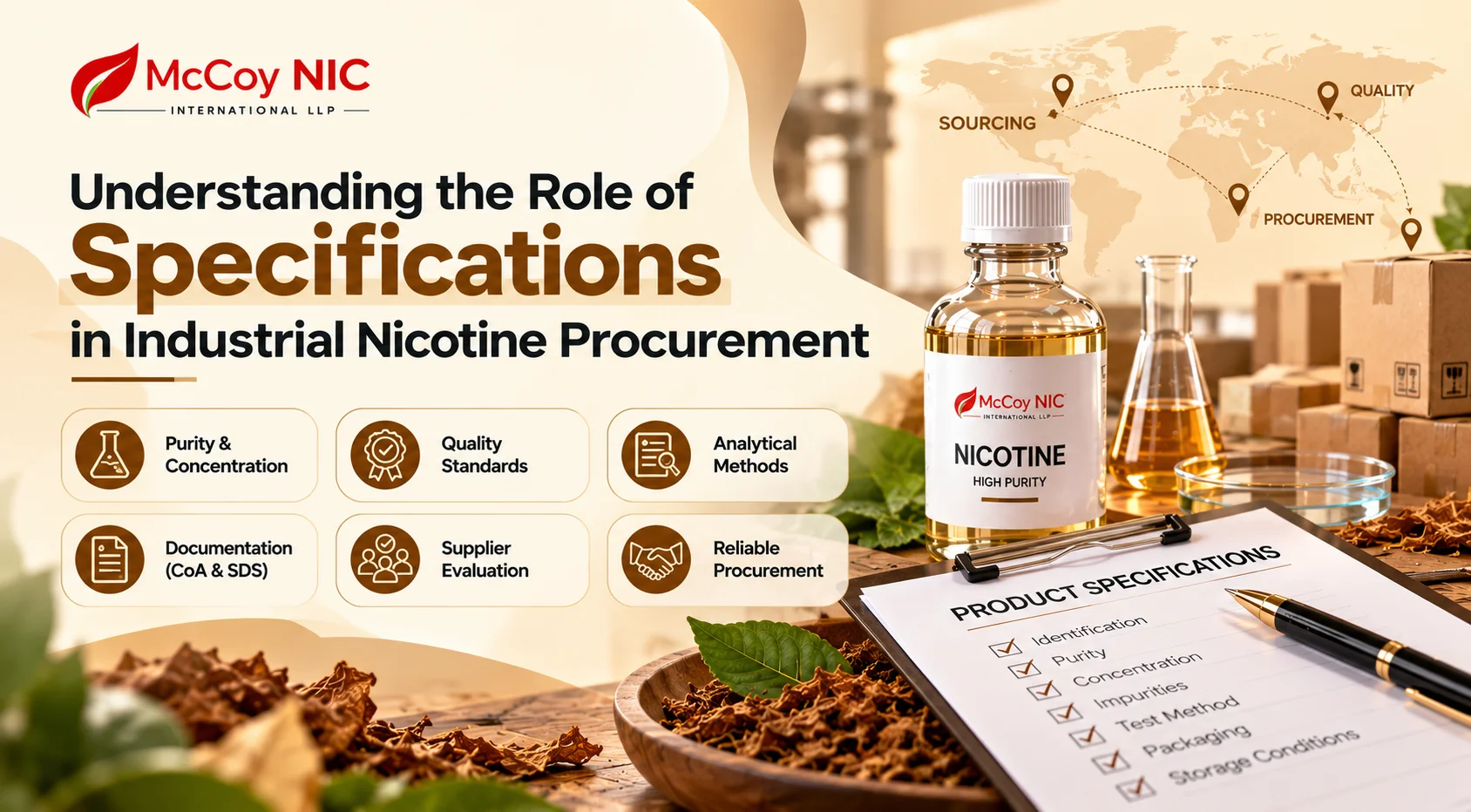
Product specifications describe the defined characteristics and acceptance requirements of a material. Depending on the product, these may include chemical identity, purity, concentration, relevant impurities, analytical methods, storage conditions and applicable quality limits.
For industrial nicotine procurement, buyers should identify which specifications are essential for their intended application and confirm that the supplier’s documentation addresses those requirements.
Specifications should be product-specific, clearly documented and agreed upon by the relevant parties. General marketing descriptions alone are not a substitute for technical documentation.
1. Understanding Purity and Concentration
Purity and concentration are related but different concepts.
Purity generally describes the proportion of the intended substance relative to impurities or other components, while concentration describes the amount of a substance present in a particular mixture or solution.
Buyers should confirm how each value is defined, the units used and the analytical method supporting the reported result. Comparing figures without checking their basis can lead to misunderstandings.
India’s official ChemIndia chemical inventory FAQ provides general information on chemical identity, purity and concentration.
2. Reviewing the Certificate of Analysis
A Certificate of Analysis (CoA) records analytical results for a specified material or batch. It can help procurement and quality teams assess whether the reported results meet agreed specifications.
When reviewing a CoA, buyers should check:
- Product name and identification details.
- Batch or lot number, where applicable.
- Test parameters and reported results.
- Units of measurement and acceptance limits.
- Analytical methods, where specified.
- Testing date and document traceability.
Any missing, unclear or inconsistent information should be discussed with the supplier before the material is accepted.
A CoA should be evaluated within its actual scope and does not automatically establish every aspect of a product’s quality, regulatory status or suitability.
3. Understanding Safety Data Sheets
A Safety Data Sheet (SDS) provides information about a chemical’s hazards, safe handling, storage, exposure controls, transport considerations and emergency measures.
Buyers should ensure that the SDS corresponds to the relevant product and is appropriate for the destination market and intended workplace use.
The UK Health and Safety Executive explains the role of chemical safety data sheets in understanding chemical hazards and supporting workplace risk assessments.
An SDS and a CoA serve different purposes: one communicates safety information, while the other reports analytical results.
4. Checking Product Identity and Documentation Consistency
Product identification is an essential part of procurement review. Buyers should check that the product description, relevant identifiers, specification sheet, CoA and SDS refer to the same material, as applicable.
If documents contain conflicting product names, units, batch identifiers or specification limits, the discrepancy should be resolved before proceeding.
For international transactions, procurement teams should also verify the documentation required by the destination country and applicable transport or import rules.
The European Chemicals Agency provides guidance on chemical safety and supply-chain communication, including the importance of communicating reliable safety information.
5. Comparing Supplier Specifications
When comparing potential suppliers, buyers should use a consistent set of technical and commercial criteria.
These may include:
- Conformity with the agreed product specification.
- Availability and relevance of quality documentation.
- Traceability of analytical results.
- Packaging and storage requirements.
- Lead time and supply arrangements.
- Applicable regulatory and import requirements.
A lower quoted price should not be treated as evidence of equivalent quality. Buyers should compare products on a like-for-like basis and resolve differences in specifications before making a purchasing decision.
6. Defining Acceptance Criteria Before Procurement
Clear acceptance criteria help both parties understand which requirements must be met. Procurement teams should document the required specifications, testing expectations, applicable tolerances and the process for resolving discrepancies.
Where independent testing or additional verification is appropriate, the parties should agree on the process and responsibilities in advance.
Documented requirements can reduce ambiguity during supplier evaluation, goods receipt and quality review.
7. How McCoy NIC Supports Procurement Discussions
For B2B buyers evaluating nicotine raw materials, access to product information and clear supplier communication can help establish the technical requirements of an enquiry.
McCoy NIC International LLP provides a point of contact for business enquiries regarding nicotine products and related sourcing requirements. Buyers can visit the McCoy NIC website to review company information and discuss the specifications and documentation relevant to their requirements.
Buyers should confirm product availability, applicable specifications, quality documents, commercial terms and destination-specific requirements directly with the supplier before placing an order.
Businesses exploring supplier discovery can also visit TradeNicotine.com.