Why Intended Use Matters in Regulatory Reviews
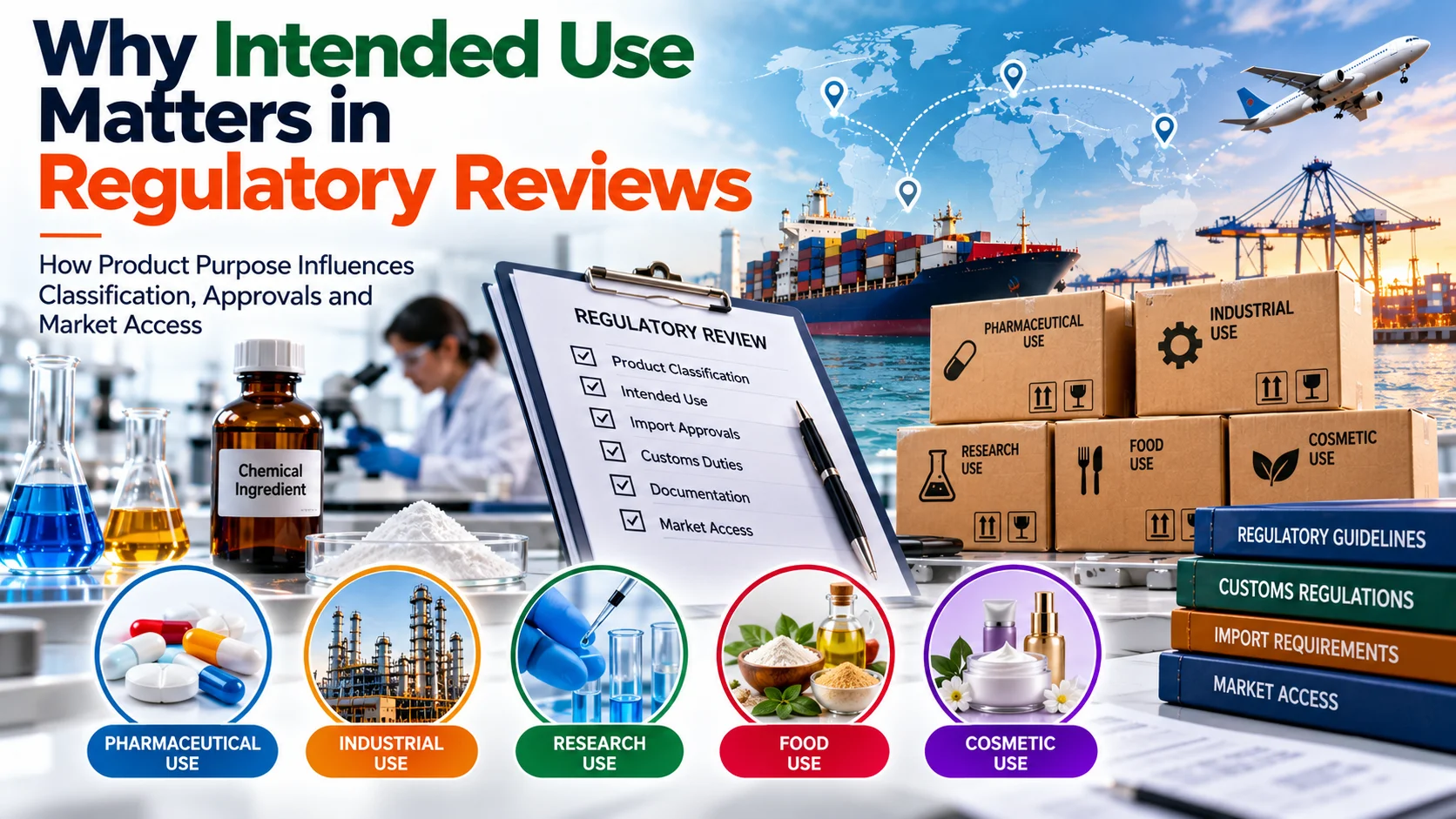
Intended Use in Regulatory Reviews is an important factor in determining how chemical ingredients, pharmaceutical raw materials and other regulated products are assessed by customs authorities and regulatory agencies. The purpose for which a material is manufactured, imported, supplied or used can influence its product classification, regulatory requirements, import permissions, documentation and market access.
In international ingredient trade, the same chemical substance may be considered under different regulatory frameworks depending on its composition, presentation, application and the laws of the destination country. For example, a material supplied as an industrial chemical may require a different regulatory assessment from a finished medicinal product containing an active pharmaceutical ingredient.
However, declaring a particular intended use does not automatically change a product’s legal classification. Authorities may also examine its objective characteristics, composition, manufacturing process, labelling and applicable legal definitions.
What Does Intended Use Mean in Regulatory Compliance?
Intended use refers to the purpose for which a product or material is designed, manufactured, marketed, imported or supplied.
In regulated industries, this information helps authorities and businesses understand the context in which a product will be used.
Depending on the product and jurisdiction, intended-use information may help distinguish between:
- Industrial chemical applications.
- Pharmaceutical and medicinal applications.
- Laboratory research and analytical applications.
- Food ingredient applications.
- Cosmetic and personal-care applications.
- Agricultural and other specialised uses.
The regulatory significance of intended use varies across product categories. It may be an important factor in one regulation or tariff entry but have a limited role in another.
Why Does Intended Use Matter in Regulatory Reviews?
1. Product Classification and Customs Assessment
Product classification is one of the areas where intended use may become relevant.
Customs authorities assess goods using the applicable tariff schedule, product descriptions, composition, technical characteristics and legal notes. Some tariff headings specifically refer to the use or application of a product.
In such cases, the intended use may help determine the appropriate classification, provided it satisfies the conditions of the relevant tariff provision.
For example, two materials with similar chemical names may have different commercial presentations or applications. Their classification should therefore be assessed using the applicable tariff rules rather than relying only on their product names.
Businesses should obtain professional classification advice when a product’s tariff treatment is uncertain.
2. Pharmaceutical and Active Ingredient Regulations
The intended application of a substance can be relevant when assessing whether it falls within pharmaceutical or medicinal product regulations.
For example, an active pharmaceutical ingredient (API) supplied for manufacturing a medicinal product may be subject to specific quality, registration, licensing and import requirements.
In India, the Central Drugs Standard Control Organisation (CDSCO) regulates the import and registration of drugs under the Drugs and Cosmetics Act, 1940 and associated rules. Its import framework also covers substances intended for use as components of drugs.
In the United States, the Food and Drug Administration (FDA) considers product information, declared intended-use codes and other entry information when reviewing imported human drugs.
This makes it important for importers to provide accurate product descriptions and supporting information.
3. Import Licences and Regulatory Approvals
Certain materials may require specific permissions, registrations, licences or notifications depending on their regulatory category and intended application.
For example, requirements for a pharmaceutical ingredient may differ from those applicable to an industrial chemical or a laboratory reagent.
Before arranging an international shipment, businesses should establish:
- Whether the material is subject to product-specific import controls.
- Whether an import licence or registration is required.
- Whether the receiving company is authorised to import or handle the material.
- Whether end-use declarations or additional approvals apply.
- Whether any destination-specific restrictions or conditions exist.
The applicable requirements should be confirmed with the relevant regulatory authority or qualified compliance professional.
4. Customs Duties and End-Use Conditions
In certain customs and trade arrangements, a duty exemption, concessional rate or exclusion may depend on the declared end use of an imported product.
Where such a benefit is conditional, importers may need to provide an end-use declaration, maintain supporting records and ensure that the material is used only for the permitted purpose.
For example, an imported chemical may qualify for a specific customs treatment only when supplied for an eligible industrial or manufacturing application.
If the material is subsequently diverted to an ineligible purpose, the importer may face additional duty, interest or other consequences under the applicable rules.
Therefore, end-use conditions should be reviewed before claiming a customs benefit.
5. Product Labelling and Technical Documentation
Intended-use information should be consistent across the relevant technical and commercial documents.
Depending on the product, these may include:
- Product specification sheet.
- Safety Data Sheet (SDS).
- Certificate of Analysis (CoA).
- Technical data sheet.
- Commercial invoice.
- Import or end-use declaration.
- Product label and packaging information.
- Applicable licences and regulatory approvals.
For example, if a product is described as a pharmaceutical ingredient in one document but as an industrial chemical in another, the difference may require clarification during a regulatory or customs review.
Accurate and consistent documentation helps businesses explain the product’s identity, application and compliance status.
How Authorities Evaluate Intended Use
A declared purpose is not necessarily sufficient by itself to establish the regulatory treatment of a product.
Depending on the relevant law, authorities may consider several factors:
Composition: The chemical identity, ingredients, concentration and formulation of the material.
Physical form and presentation: Whether the product is supplied as a raw material, mixture, preparation, finished dosage form or another presentation.
Technical characteristics: The product’s properties, functions and suitability for a particular application.
Manufacturing process: The operations performed during production, processing or formulation.
Labelling and product claims: Descriptions, instructions, packaging and claims made by the manufacturer or supplier.
Supporting documentation: Specifications, certificates, technical records, import declarations and other relevant evidence.
The weight given to each factor depends on the applicable regulation, tariff heading and jurisdiction.
Important Indian Legal Development: Intended Use and Customs Classification
In January 2026, the Supreme Court of India delivered its judgment in Commissioner of Customs (Import) v. M/s Welkin Foods.
The judgment discusses when intended use can be considered in customs classification. It explains that an importer cannot automatically rely on actual use to classify goods. Intended use may be considered where the relevant tariff entry allows it, and the claimed use must be consistent with the entry and supported by the objective characteristics and properties of the goods.
This is an important consideration for businesses importing chemicals, ingredients and other products where tariff classification may involve a use-based criterion.
The judgment also makes clear that classification depends on the wording of the relevant tariff entry and the specific facts of the product. It should not be treated as a universal rule that intended use determines the classification of every imported product.
Practical Example: Industrial Chemical vs Pharmaceutical Application
Consider a company importing a chemically defined substance for use in manufacturing.
The same substance may be discussed in different commercial contexts:
Scenario A – Industrial application: The material is purchased as an input for a permitted industrial manufacturing process.
Scenario B – Pharmaceutical application: The material is purchased as an ingredient for producing a medicinal product.
Scenario C – Laboratory application: The material is purchased for research, testing or analytical activities.
Although the chemical identity may be similar, the regulatory assessment may differ depending on the product’s form, intended application, tariff provisions and destination-country legislation.
The importer should not assume that changing the description on an invoice is enough to change the legal status of the material. The actual product and applicable regulatory criteria must support the declared use.
What Ingredient Buyers and Suppliers Should Verify Before Shipment
Businesses involved in international chemical and pharmaceutical ingredient trade can reduce compliance risks by reviewing intended-use information before confirming an order.
For suppliers and manufacturers:
- Provide an accurate product description and chemical identity.
- Clearly state the product’s grade, composition and intended application.
- Maintain current technical specifications and safety documentation.
- Ensure that labels and commercial descriptions are consistent.
- Clarify any known restrictions or special handling requirements.
- Provide relevant supporting documents when requested and legally permitted.
For importers and buyers:
- Define the intended application before placing an order.
- Verify the product’s tariff classification with a qualified customs professional.
- Check whether the intended use triggers special import permissions or registrations.
- Confirm whether end-use declarations or post-import conditions apply.
- Review the consistency of the invoice, SDS, CoA and technical specification.
- Check destination-country regulations before dispatch.
- Maintain records supporting the declared application and compliance decisions.
For a related pre-shipment checklist, see our guide to Regulatory Document Checklist for Nicotine Shipments.
The Importance of Intended Use in Global Ingredient Sourcing
As international ingredient supply chains become more complex, intended-use verification is becoming an important part of procurement and regulatory planning.
Manufacturers and buyers often source materials from multiple countries for different industrial, pharmaceutical and research applications. Without clear information about the product and its intended purpose, businesses may face classification questions, documentation gaps, import delays or unexpected compliance obligations.
A well-defined procurement process should therefore include product identification, intended-use verification, supplier documentation review and destination-specific regulatory checks.
Businesses should also review applicable rules whenever a product’s application, formulation, packaging or destination market changes.