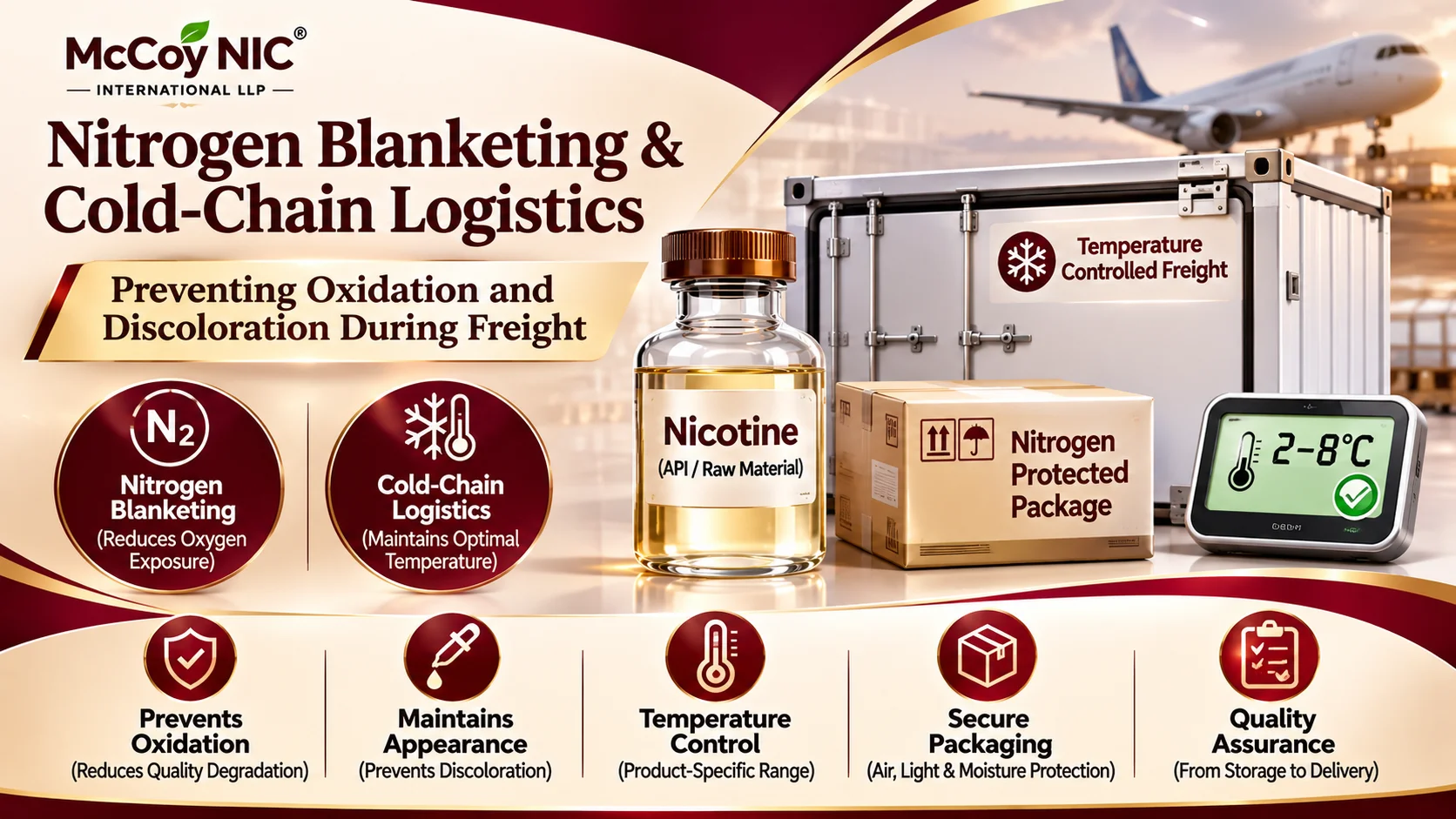
Nitrogen Blanketing and Cold-Chain Logistics: Preventing Nicotine Oxidation and Discoloration During Freight
Nitrogen blanketing and cold-chain logistics are important considerations for protecting nicotine quality during storage, handling and international transportation. Exposure to air, light, moisture and unsuitable temperatures can affect nicotine’s appearance and chemical stability. For manufacturers, exporters and pharmaceutical raw-material suppliers, appropriate packaging and transport controls can help reduce the risk of product deterioration during freight.
Nicotine is sensitive to environmental exposure, and prolonged contact with air and light can cause discoloration. Businesses handling pure nicotine products should therefore evaluate oxygen exposure, container compatibility, storage conditions and transportation procedures as part of their quality-management programme.
1. Why Nicotine Oxidation and Discoloration Matter
Nicotine is a hygroscopic and light-sensitive chemical. According to the CDC’s National Institute for Occupational Safety and Health (NIOSH), nicotine can gradually turn brown when exposed to air or light.
Discoloration may indicate changes in the material’s condition, although appearance alone cannot establish the identity or concentration of degradation products.
Potential environmental factors that deserve attention include:
- Oxygen exposure during filling and packaging.
- Direct or prolonged exposure to light.
- Moisture entering the primary container.
- Temperature conditions outside the established storage range.
- Inadequate container closure or damaged packaging.
- Extended storage or transportation delays.
For manufacturers and buyers, visual inspection should be supported by appropriate analytical testing, including nicotine assay and relevant impurity profiling.
Reference: CDC/NIOSH – Nicotine: Systemic Agent
2. What Is Nitrogen Blanketing?
Nitrogen blanketing is a packaging and storage technique in which an inert nitrogen atmosphere is introduced into a container or vessel to reduce the amount of oxygen in contact with the product.
Nitrogen is commonly selected because it is relatively inert under normal storage and handling conditions.
For nicotine handling, a properly designed nitrogen-blanketing process may help reduce oxygen exposure in the container headspace.
Potential applications include:
- Storage tanks and process vessels.
- Bulk material holding containers.
- Suitable filling and packaging operations.
- Headspace management in compatible sealed containers.
The effectiveness of nitrogen blanketing depends on equipment design, sealing integrity, gas purity, operating procedures and verification of the intended atmosphere.
Nitrogen blanketing should not be treated as a substitute for appropriate packaging, light protection, moisture control or stability testing.
3. How Nitrogen Blanketing Can Help Protect Nicotine Quality
When a compatible container is properly sealed, nitrogen blanketing can reduce the oxygen available in its headspace.
A controlled packaging process may include:
- Inspection and preparation of compatible containers.
- Verification that the container is clean and suitable for the product.
- Nitrogen purging or blanketing using a validated procedure.
- Filling under controlled conditions.
- Appropriate closure and sealing.
- Verification of packaging integrity and applicable process parameters.
- Batch documentation and traceability.
The process should be designed around the product’s physical and chemical characteristics. Nitrogen flow rates, purge cycles and acceptable residual oxygen levels should be established through process qualification rather than assumed to be universal.
Important safety consideration: Nitrogen can displace oxygen in the surrounding atmosphere and create an asphyxiation hazard. Appropriate ventilation, gas monitoring, operating procedures and personnel training are essential.
4. Cold-Chain Logistics: Why Temperature Control Matters
Cold-chain logistics refers to the controlled storage and transportation of products within defined temperature conditions.
For pharmaceutical materials, transport conditions should be based on the product’s labelled storage requirements and supporting stability data.
Not every nicotine raw material automatically requires refrigerated or frozen transportation. Some materials may have controlled room-temperature storage requirements, while others may require different conditions based on their formulation, packaging and stability characteristics.
Before arranging transportation, companies should establish:
- Approved storage temperature range.
- Maximum permitted transportation duration.
- Packaging and container requirements.
- Expected seasonal and route temperature conditions.
- Monitoring and alarm requirements, where applicable.
- Procedures for delays and temperature excursions.
The World Health Organization’s guidance on time- and temperature-sensitive pharmaceutical products provides a framework for assessing storage and distribution requirements.
5. Nitrogen Blanketing vs Cold-Chain Logistics
Both methods can contribute to product-quality protection, but they address different risks.
| Parameter | Nitrogen Blanketing | Cold-Chain Logistics |
|---|---|---|
| Primary purpose | Reduce oxygen exposure | Maintain defined temperature conditions |
| Main control | Inert gas atmosphere | Temperature-controlled environment |
| Quality concern | Oxidation risk | Temperature-related degradation risk |
| Application | Storage and packaging | Warehousing and transportation |
| Monitoring | Applicable gas and packaging parameters | Temperature records and excursion monitoring |
| Key requirement | Suitable equipment and sealing | Qualified packaging and transport conditions |
Using both approaches may be appropriate where supported by product-specific risk assessment and stability data.
6. Packaging Requirements for International Nicotine Freight
Packaging selection is an important part of protecting nicotine during international transportation.
The packaging system should be compatible with the product and capable of maintaining its required storage conditions throughout the expected shipping period.
Important considerations include:
Primary packaging
- Chemical compatibility with nicotine.
- Appropriate closure and sealing.
- Protection against moisture and unwanted environmental exposure.
- Suitability for the intended storage conditions.
Secondary packaging
- Physical protection against handling damage.
- Appropriate cushioning and containment.
- Clear batch identification and handling instructions.
Transport packaging
- Suitable protection against expected temperature conditions.
- Protection from direct sunlight and excessive environmental exposure.
- Secure handling during loading and unloading.
- Appropriate documentation and shipment traceability.
Packaging compatibility should be established through suitable testing and qualification rather than relying only on the container’s appearance or material description.
7. Temperature Monitoring During International Freight
Long-distance transportation can expose materials to changing environmental conditions, particularly during airport handling, customs clearance, warehouse transfers and seasonal temperature extremes.
Temperature monitoring can help manufacturers and logistics providers identify whether the shipment remained within its defined transport conditions.
Recommended controls include:
- Calibrated temperature-monitoring devices where required.
- Qualified shipping containers and thermal packaging.
- Documented loading and dispatch checks.
- Temperature records during transportation.
- Defined procedures for delays and unexpected excursions.
- Review of monitoring data before accepting affected shipments.
Health Canada’s guidance on temperature control during pharmaceutical storage and transportation explains the importance of temperature mapping, qualified shipping containers and documented excursion assessments.
8. What Happens When Nicotine Is Exposed to Air and Light?
Nicotine can undergo chemical changes when exposed to environmental conditions. NIOSH specifically identifies its sensitivity to air and light and notes that it can gradually turn brown.
Scientific research has also investigated nicotine oxidation pathways.
A 2022 study published in the Journal of Physical Chemistry A examined gas-phase nicotine oxidation initiated by hydroxyl radicals and ozone. The study described reaction pathways involving nicotine-derived radicals and oxygen.
A separate 2026 study in the Journal of Hazardous Materials investigated radical-mediated nicotine oxidation at aerosol interfaces under ambient conditions.
These studies provide scientific context for nicotine oxidation, but their experimental systems should not be treated as direct evidence of the oxidation rate inside sealed commercial shipping containers.
Scientific references:
- Rapid Gas-Phase Autoxidation of Nicotine in the Atmosphere – ACS, 2022
- Spontaneous Radical-Mediated Oxidation of Nicotine at Nanometer Aerosol Interfaces – Journal of Hazardous Materials, 2026
9. Quality Checks Before Dispatching Nicotine Shipments
Manufacturers and exporters should establish a documented pre-dispatch inspection process.
A practical checklist may include:
- Verify product identity and batch number.
- Review the batch-specific Certificate of Analysis (COA).
- Confirm the approved storage and transportation conditions.
- Inspect primary container integrity and closure.
- Verify packaging compatibility.
- Confirm nitrogen-blanketing records, where applicable.
- Check external packaging and protective materials.
- Confirm required shipment labels and handling instructions.
- Review temperature-monitoring arrangements, where required.
- Maintain dispatch, transportation and receiving records.
Buyers should also review the applicable McCoy NIC certification and documentation information and request the actual batch-specific COA and relevant safety documentation for the material being purchased.
10. How Suppliers Can Improve Nicotine Freight Management
Suppliers can strengthen their quality-management systems by integrating packaging controls, storage procedures and transportation planning.
A practical approach includes:
- Establishing product-specific storage specifications.
- Assessing whether nitrogen blanketing is appropriate.
- Qualifying packaging and container-closure systems.
- Using suitable protective packaging.
- Selecting logistics partners experienced in chemical or pharmaceutical freight.
- Establishing temperature-excursion procedures.
- Maintaining batch traceability.
- Reviewing customer feedback and transportation incidents.
Companies handling tobacco-derived nicotine and synthetic nicotine should assess the stability and packaging requirements of each material separately instead of assuming that identical storage and transport conditions apply to every product.
Conclusion
Nitrogen blanketing and cold-chain logistics address two different but complementary aspects of nicotine quality protection. Nitrogen blanketing can reduce oxygen exposure in suitable storage and packaging systems, while temperature-controlled transportation helps maintain product-specific storage conditions during freight.
For manufacturers, exporters and pharmaceutical raw-material suppliers, the most effective strategy combines compatible packaging, controlled environmental exposure, suitable transport conditions, analytical quality checks and complete shipment documentation.
By establishing these controls according to product-specific stability data and risk assessments, businesses can better manage oxidation risks, discoloration concerns and transportation-related quality issues.