Nicotine Pouch Dissolution Study: New Research Compares Commercial Products
A new nicotine pouch dissolution study published in Scientific Reports has compared seven commercially available oral nicotine pouch products, examining both nicotine release and a wide range of physical and chemical characteristics.
The study, published on January 6, 2026, analyzed on!, Zyn, Velo, Dryft, Rogue, Volt and Loop using laboratory methods designed to characterize nicotine content, dissolution, particle size, density, solubility, moisture, pH, water activity, crystallinity and viscosity.
The researchers said that understanding these properties can provide insight into formulation and product-performance factors that may influence nicotine release.
Study Examines Seven Commercial Nicotine Pouches
The research included seven commercially available nicotine pouch products representing different product types and formulations.
The products examined were:
- on!
- Zyn
- Velo
- Dryft
- Rogue
- Volt
- Loop
The researchers included both dry and wet pouch types in the analysis. The study used a broad characterization approach rather than evaluating nicotine concentration alone.
This distinction is important because a nicotine pouch is a complex formulation containing nicotine together with filler materials and other components that can influence its physical and chemical properties.
What Did the Nicotine Pouch Dissolution Study Measure?
The researchers evaluated several characteristics of the commercial products.
These included:
- Nicotine content
- Nicotine dissolution and release
- Particle-size distribution
- Filler morphology
- Bulk density
- True density
- Solubility
- Moisture content
- pH
- Water activity
- Crystallinity
- Extract viscosity
Dissolution testing was performed using a USP-4 flow-through cell apparatus, with nicotine measured using ultra-performance liquid chromatography with photodiode-array detection. Physical characterization included dynamic image analysis, microscopy and differential scanning calorimetry.
Nicotine Release Profiles Differed Between Products
One of the study’s notable findings was that nicotine dissolution profiles varied between the commercial products.
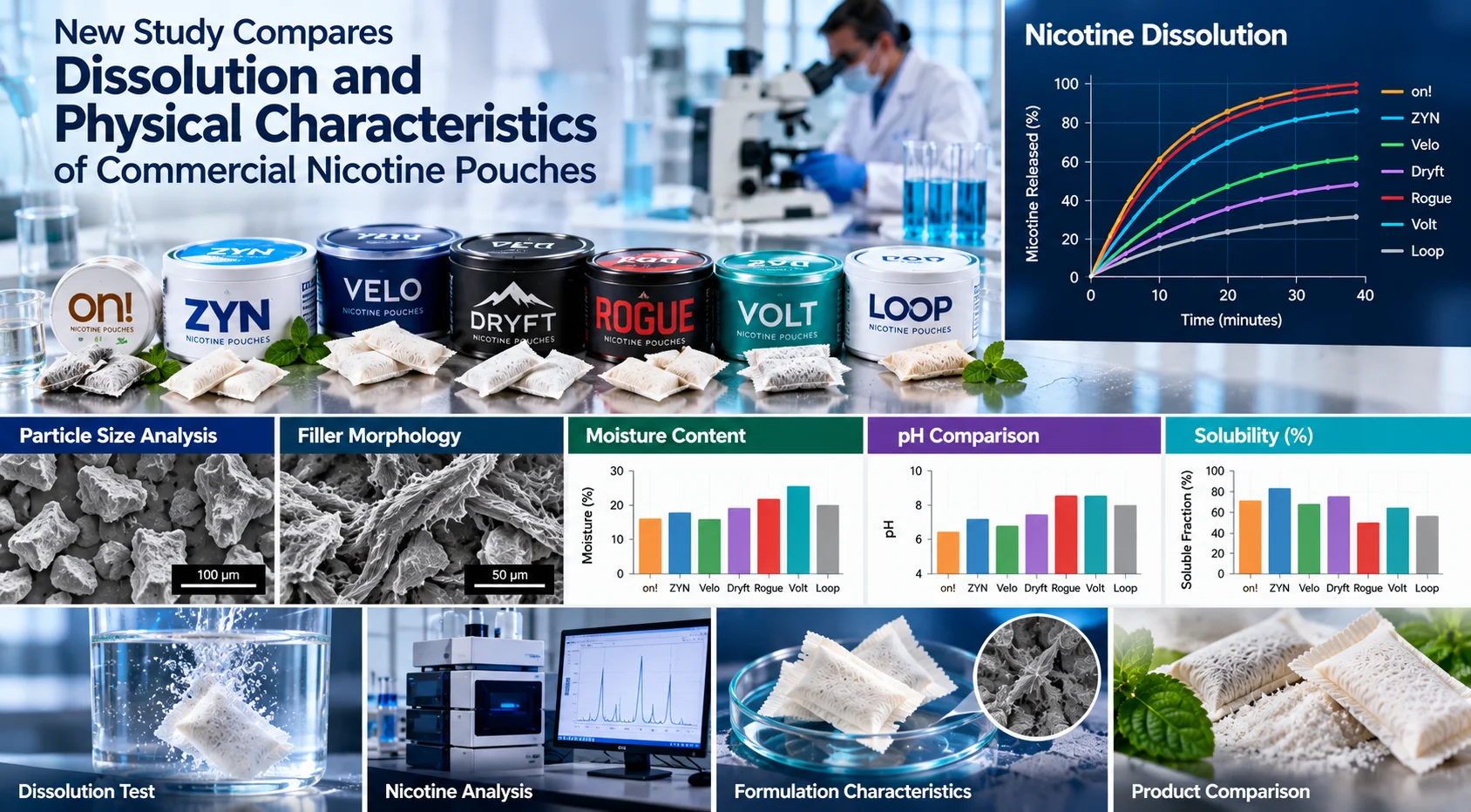
Under the laboratory conditions used, on!, Zyn and Rogue showed faster nicotine release compared with Velo, Dryft, Volt and Loop.
When the researchers compared the dissolution profiles against on!, only Zyn and Rogue were considered equivalent using the study’s statistical comparison approach.
These findings demonstrate that labeled nicotine content alone does not describe every aspect of how a pouch behaves during a laboratory dissolution test.
Product formulation and physical characteristics can also influence nicotine-release profiles.
Solubility Also Varied Across Products
The study found substantial differences in the proportion of soluble components in the tested pouch fillers.
Zyn had the highest measured percentage of soluble filler at 78.26%, while Rogue had the lowest at 41.21%.
The other products fell between these values, with Dryft, on!, Velo and Volt reported at 68.03%, 66.35%, 64.41% and 59.75%, respectively.
Solubility is one of several characteristics that researchers can examine when trying to understand how pouch materials behave in an aqueous environment.
Particle Size and Filler Structure Were Also Examined
The researchers used particle-size analysis to examine the distribution of filler particles.
The study reported Gaussian-like particle-size distributions for on!, Rogue and Zyn, while the other products showed bimodal distributions.
Microscopy was also used to investigate filler morphology and the structure of the outer pouch material.
Importantly, the researchers noted that particle size did not appear to directly explain the differences in dissolution rate. Other factors, including filler composition and granulation processes, may contribute to the observed differences.
Moisture and pH Can Be Important Formulation Characteristics
The study also evaluated moisture content and pH of aqueous extracts.
These measurements are relevant because the chemical environment within a nicotine pouch can affect nicotine availability and other product characteristics.
Our related article, Manufacturers Explore Alternative pH Buffering Systems for Flavor Stability, discusses why formulation teams are examining pH and buffering systems in greater detail.
However, pH should not be considered in isolation. A pouch’s nicotine content, filler composition, moisture, solubility and other formulation properties can interact with one another.
Viscosity and Flowability Showed Product Differences
The study also examined the physical behaviour of pouch fillers and extracts.
Rogue and Loop showed the highest and lowest filler flowability, respectively, based on the study’s bulk-density measurements.
For extracts prepared in artificial saliva, Loop showed the highest viscosity, while Volt and Rogue showed the lowest viscosity.
These measurements provide additional information about how different formulations behave under controlled laboratory conditions.
Crystallinity Was Observed Across the Products
Differential scanning calorimetry was used to investigate the thermal behaviour and crystallinity of the pouch fillers.
The researchers reported crystalline structures across all seven products, with both higher- and lower-temperature melting characteristics observed among the materials.
Thermal characterization can help researchers understand the physical state and composition of formulation components.
Why Physical Characteristics Matter
The study highlights an important point for nicotine-pouch research: product performance cannot necessarily be explained by nicotine concentration alone.
Different characteristics can interact during the release process.
These may include:
- Filler composition
- Particle-size distribution
- Moisture
- Solubility
- pH
- Pouch material
- Density
- Granulation
- Nicotine concentration
- Physical structure
Researchers can therefore use multiple analytical techniques to build a more complete picture of a commercial pouch.
How This Research Connects With Nicotine Absorption
Dissolution and absorption are related but are not the same measurement.
Dissolution testing examines how nicotine is released from a product under defined laboratory conditions. Absorption studies investigate how nicotine becomes available to and enters the body.
Our earlier article New Study Compares Nicotine Absorption Rates Across Pouch Formats discusses research into nicotine release and absorption across different pouch formats.
Together, these areas of research can help scientists understand how formulation characteristics may relate to nicotine delivery.
However, laboratory dissolution results should not automatically be interpreted as equivalent to real-world nicotine exposure.
Implications for Nicotine Pouch Product Development
The findings may be relevant to researchers and product-development teams evaluating commercial nicotine pouches.
A broader analytical approach can help teams investigate relationships between formulation and measurable product characteristics.
Areas of interest can include:
Formulation Development
Different filler materials and formulation components may produce different physical characteristics and release profiles.
Quality Control
Analytical testing can help manufacturers characterize raw materials and finished products against defined specifications.
Product Consistency
Consistent physical and chemical properties can be important when manufacturers produce products at commercial scale.
Research and Method Development
Standardized analytical methods can help researchers compare products and generate reproducible data.
Importance of Analytical Testing
The study demonstrates how multiple analytical techniques can be combined to characterize nicotine pouch products.
For B2B manufacturers and suppliers, analytical testing and documentation can also be important when evaluating nicotine raw materials.
Our article New Testing Methods Could Improve Nicotine Product Quality Assessment covers emerging approaches to nicotine quality assessment.
For raw-material procurement, Why Batch Traceability Is Becoming More Important in the Global Nicotine Supply Chain explains why batch information, COAs, testing records and traceability are becoming increasingly important for B2B buyers.
Study Funding and Interpretation
An important point when reporting the findings is the study’s disclosure statement.
PubMed reports that the study was funded by Altria Client Services LLC, and several authors were employees of the company at the time of the research. The paper also discloses additional industry relationships involving affiliated companies.
This does not by itself determine the validity of the findings, but it is relevant context for readers evaluating the research.
Independent studies using different products, methods and laboratories can provide additional evidence about nicotine pouch dissolution and physical characteristics.
What Researchers May Study Next
The study provides a broad characterization of seven commercial products, but further research can examine additional questions.
Potential areas include:
- Larger numbers of commercial products
- Different nicotine strengths
- Different pouch materials
- Additional filler compositions
- Alternative dissolution methods
- Independent laboratory replication
- Relationship between dissolution and clinical nicotine exposure
- Changes in product characteristics during storage
- Batch-to-batch variation
Research comparing standardized methods across laboratories may also help improve consistency in how nicotine pouch characteristics are measured.
A 2026 interlaboratory study, for example, examined particle-size analysis methods across eight laboratories using dry and wet nicotine pouch filler samples.
Broader Nicotine Industry Context
The research comes as manufacturers continue developing new nicotine pouch formats and formulations.
Our report Global Nicotine Industry Enters a New Phase of Product Development in 2026 looks at the industry’s growing focus on product formats, formulation, nicotine strength, scientific evaluation and regulatory requirements.
As the category develops, detailed characterization may become increasingly relevant to researchers, manufacturers and regulators.