
Nicotine Absorption: Cigarettes, Vapes, Heated Tobacco and Nicotine Pouches Compared
Nicotine absorption cigarettes vapes heated tobacco nicotine pouches has been examined in a newly published randomized clinical study comparing how quickly and how strongly nicotine reaches the bloodstream from different commercially available nicotine products.
Published in Scientific Reports on September 16, 2026, the open-label, randomized, controlled study evaluated conventional cigarettes, heated tobacco products (HTPs), e-cigarettes, snus and tobacco-free nicotine pouches in adult smokers. Researchers measured serum nicotine concentrations and subjective effects after product use.
Clinical Study Compares Nicotine Delivery Across Product Categories
The 2026 study provides a direct comparison of nicotine pharmacokinetics across several major product categories.
Researchers focused on two important measures:
- Cmax: the maximum nicotine concentration reached in the blood
- Tmax: the time required to reach that maximum concentration
The study found clear differences between inhaled and oral nicotine products.
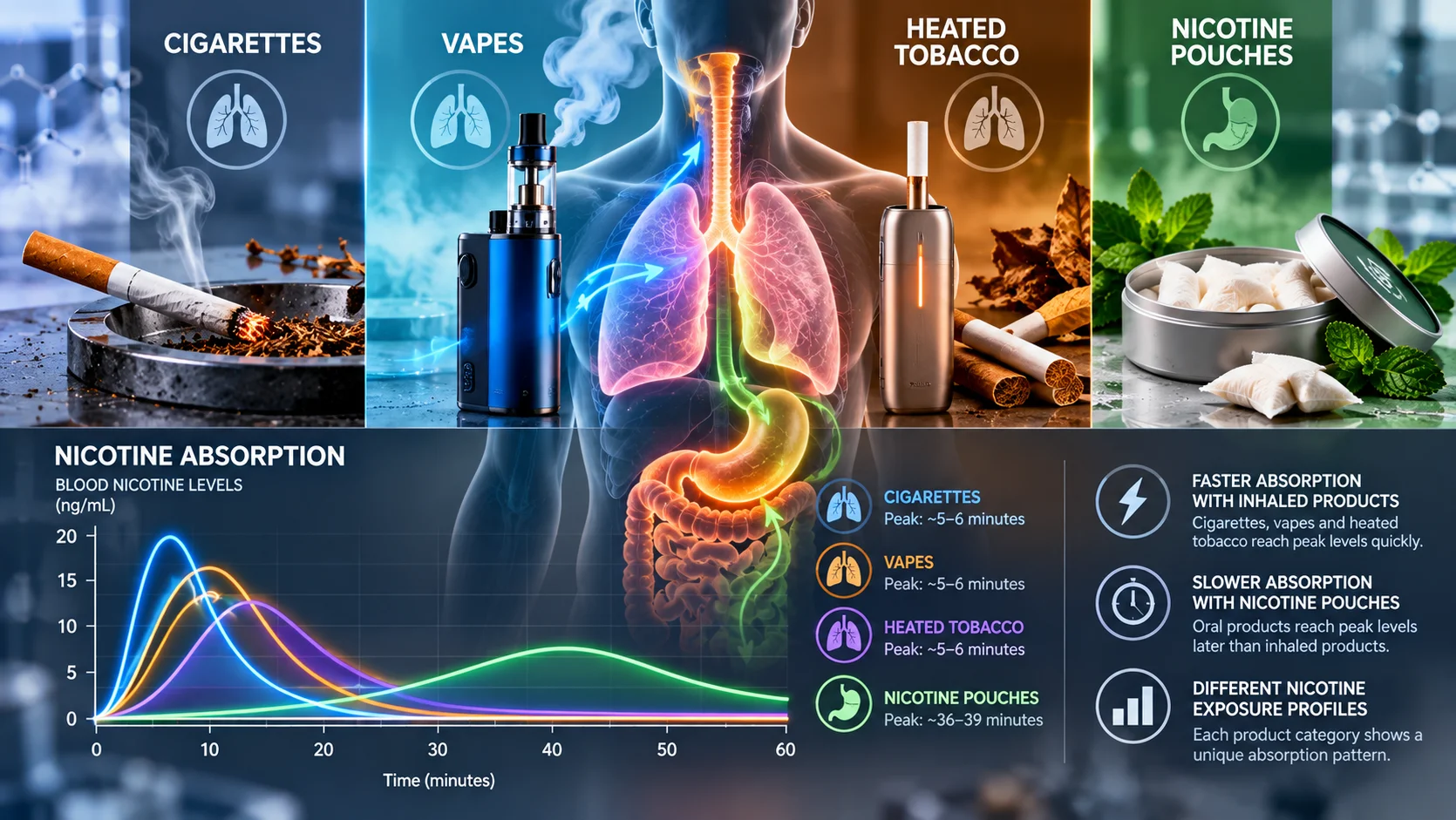
Cigarettes, heated tobacco products and e-cigarettes produced rapid nicotine absorption, with peak concentrations generally occurring within approximately 5–6 minutes.
By comparison, oral products such as snus and tobacco-free nicotine pouches showed a slower absorption pattern, with peak nicotine concentrations occurring at approximately 36–39 minutes.
Cigarettes Show Rapid Nicotine Delivery
Among the products evaluated, conventional cigarettes demonstrated a particularly rapid nicotine delivery profile.
The rapid increase in blood nicotine concentration following cigarette use is consistent with the well-established pharmacokinetic characteristics of inhaled nicotine.
The speed of nicotine delivery is an important factor when evaluating the pharmacological effects of different products because nicotine reaches the bloodstream much more quickly through the lungs than through oral mucosal absorption.
The 2026 study also reported stronger early nicotine exposure and higher subjective liking and craving scores for inhaled products compared with the oral products evaluated.
How Do Vapes Compare?
E-cigarettes were included among the inhaled products examined in the study.
The researchers found that e-cigarettes, like cigarettes and heated tobacco products, produced relatively rapid nicotine absorption compared with oral nicotine products.
However, nicotine delivery from e-cigarettes can vary substantially depending on the device, liquid formulation, nicotine concentration, aerosol generation and user behaviour.
Previous clinical research has shown that nicotine-salt e-cigarettes can deliver nicotine rapidly, with absorption rates approaching those observed with conventional cigarettes under certain study conditions.
This means that “vaping” should not be treated as a single standardized nicotine-delivery profile. Device design and formulation can materially influence nicotine pharmacokinetics.
Heated Tobacco Products Show Rapid Absorption
Heated tobacco products were another major category examined in the 2026 research.
HTPs heat tobacco material rather than burning it in the same way as a conventional cigarette. From a nicotine-delivery perspective, the study grouped HTPs with the inhaled products that produced relatively rapid nicotine absorption.
Earlier randomized clinical research has similarly found that certain heated tobacco systems can produce nicotine pharmacokinetic profiles approaching those of cigarettes, although nicotine exposure can be lower depending on the product and study conditions.
Other research has found lower nicotine uptake from specific heated tobacco products compared with participants’ usual-brand cigarettes, demonstrating that product formulation and device characteristics matter.
Nicotine Pouches Have a Different Absorption Pattern
One of the most important findings for the modern oral nicotine category concerns tobacco-free nicotine pouches.
Unlike cigarettes, vapes and heated tobacco products, nicotine pouches deliver nicotine primarily through the oral mucosa.
The 2026 clinical study found that oral products had a slower time to peak nicotine concentration than inhaled products. Oral products reached peak concentrations at approximately 36–39 minutes compared with approximately 5–6 minutes for the inhaled products studied.
This difference highlights the importance of distinguishing between speed of nicotine delivery and total nicotine exposure.
A slower peak does not necessarily mean that total nicotine exposure will always be lower.
Total Nicotine Exposure Can Vary by Product
The amount of nicotine absorbed is influenced by several factors, including:
- Nicotine concentration
- Product formulation
- Product design
- Duration of use
- User behaviour
- Nicotine release characteristics
- Absorption route
The 2026 study reported that total nicotine exposure was similar between cigarettes and tobacco-derived pouches in the specific products and conditions evaluated, while cigarettes produced a significantly stronger early nicotine boost.
Earlier clinical research has also demonstrated substantial differences between nicotine pouch strengths.
A randomized study comparing five nicotine pouch products with a cigarette found that some higher-strength pouches produced nicotine exposure equal to or greater than the cigarette comparator.
This demonstrates why nicotine pouch strength and formulation need to be considered when comparing products.
Nicotine Pouches vs Cigarettes: What Previous Research Shows
The latest study adds to an existing body of clinical research.
A randomized crossover study published in Psychopharmacology compared two tobacco-free nicotine pouches with cigarettes in 24 adult tobacco users.
The cigarette produced a higher and faster peak nicotine concentration, with a Cmax of 11.6 ng/mL and a Tmax of approximately 8.6 minutes. The tested nicotine pouches produced lower peak concentrations and slower absorption, with Tmax values of approximately 22–26 minutes.
A 2025 systematic review and meta-analysis also found that nicotine delivery from pouches depends strongly on pouch strength. The review reported that 4 mg pouches delivered approximately 91.7% of cigarette total nicotine exposure, while peak nicotine concentration was approximately 69.2% of cigarette levels in the pooled analysis.
These findings demonstrate that nicotine pouches should not be treated as a single uniform product category.
Does Faster Absorption Mean Higher Total Exposure?
Not necessarily.
Nicotine absorption speed and total nicotine exposure are different pharmacokinetic measurements.
A product may deliver nicotine very quickly but have a different total exposure profile over several hours.
Similarly, a product with slower absorption may continue releasing and delivering nicotine for a longer period.
For this reason, clinical researchers commonly examine both:
Cmax → How high the nicotine concentration peaks
Tmax → How quickly the peak occurs
AUC → Overall nicotine exposure over a defined period
Looking at all three measurements provides a more complete picture of nicotine delivery.
Product Formulation Plays a Major Role
The clinical evidence also shows why product formulation matters.
Two nicotine pouches containing different nicotine concentrations can produce substantially different blood-nicotine profiles.
Similarly, different e-cigarette devices and formulations can produce different nicotine-delivery rates.
For manufacturers, this makes raw-material quality and formulation consistency important parts of product development.
Variables such as nicotine purity, concentration, pH, release characteristics and formulation composition can influence the final product’s nicotine-delivery profile.
Why the Findings Matter for Manufacturers
The latest clinical research has implications for companies developing and manufacturing nicotine products.
Manufacturers increasingly need to understand not only the amount of nicotine contained in a product but also how formulation and product design influence nicotine release and absorption.
For B2B manufacturers and formulators, important quality considerations can include:
- Nicotine purity
- Batch-to-batch consistency
- Accurate concentration
- Certificate of Analysis
- Raw-material specifications
- Formulation consistency
- Stability
- Traceability
- Quality-control testing
Consistent raw materials can help manufacturers maintain reproducibility when developing nicotine-containing products.
Clinical Research Is Becoming More Important
As the global nicotine market becomes increasingly diversified, clinical pharmacokinetic studies are providing useful data for comparing different product formats.
The 2026 Scientific Reports study is notable because it places cigarettes, heated tobacco, e-cigarettes and oral nicotine products within the same research framework.
However, the results should be interpreted within the study’s specific conditions.
Nicotine delivery can vary according to product characteristics, nicotine strength, device configuration, user behaviour and duration of use.
Therefore, one clinical study should not be interpreted as establishing a universal nicotine-delivery ranking for every product available on the market.
What the 2026 Study Shows
The research provides several important observations:
1. Inhaled products deliver nicotine rapidly.
Cigarettes, heated tobacco products and e-cigarettes reached peak nicotine concentrations much faster than the oral products examined.
2. Oral products have a slower absorption profile.
Nicotine from snus and tobacco-free pouches reached peak concentrations later than inhaled products.
3. Total exposure depends on product characteristics.
Nicotine strength and formulation can substantially influence overall nicotine exposure.
4. Nicotine delivery is not the same across product categories.
Device design, formulation and absorption route all contribute to differences in pharmacokinetics.
5. More research is needed.
Comparisons across products are most useful when researchers consider both pharmacokinetic measurements and real-world patterns of use.
Looking Ahead
The growing diversity of nicotine products means that nicotine absorption research is likely to remain an important area of clinical investigation.
Cigarettes, e-cigarettes, heated tobacco products and nicotine pouches use different delivery mechanisms, resulting in different nicotine absorption profiles.
For manufacturers, the research reinforces the importance of consistent formulation, reliable raw materials, accurate nicotine specifications and scientifically supported product development.
For the wider nicotine industry, continued clinical research can provide a better understanding of how different products deliver nicotine and how those delivery profiles vary according to product design and nicotine strength.
The 2026 clinical study adds another important data point to the growing scientific literature on nicotine pharmacokinetics across conventional and newer nicotine products.