How to Read a Nicotine Certificate of Analysis: A Practical Guide for Buyers
A nicotine Certificate of Analysis (CoA) is an important quality document that helps buyers review the analytical results and specifications associated with a particular batch of nicotine. For B2B procurement teams, understanding how to read a CoA can support supplier evaluation, incoming material checks and purchasing decisions.
However, a CoA should not be reviewed simply to find a purity percentage or a general statement such as “Pass.” Buyers should also examine the product identity, batch number, analytical methods, reported results and applicable acceptance criteria.
This guide explains the main sections of a nicotine CoA and the questions procurement and quality-assurance teams should consider when reviewing supplier documentation.
1. What Is a Nicotine Certificate of Analysis?
A Certificate of Analysis is a document that reports analytical findings for an identified sample or batch against specified quality requirements.
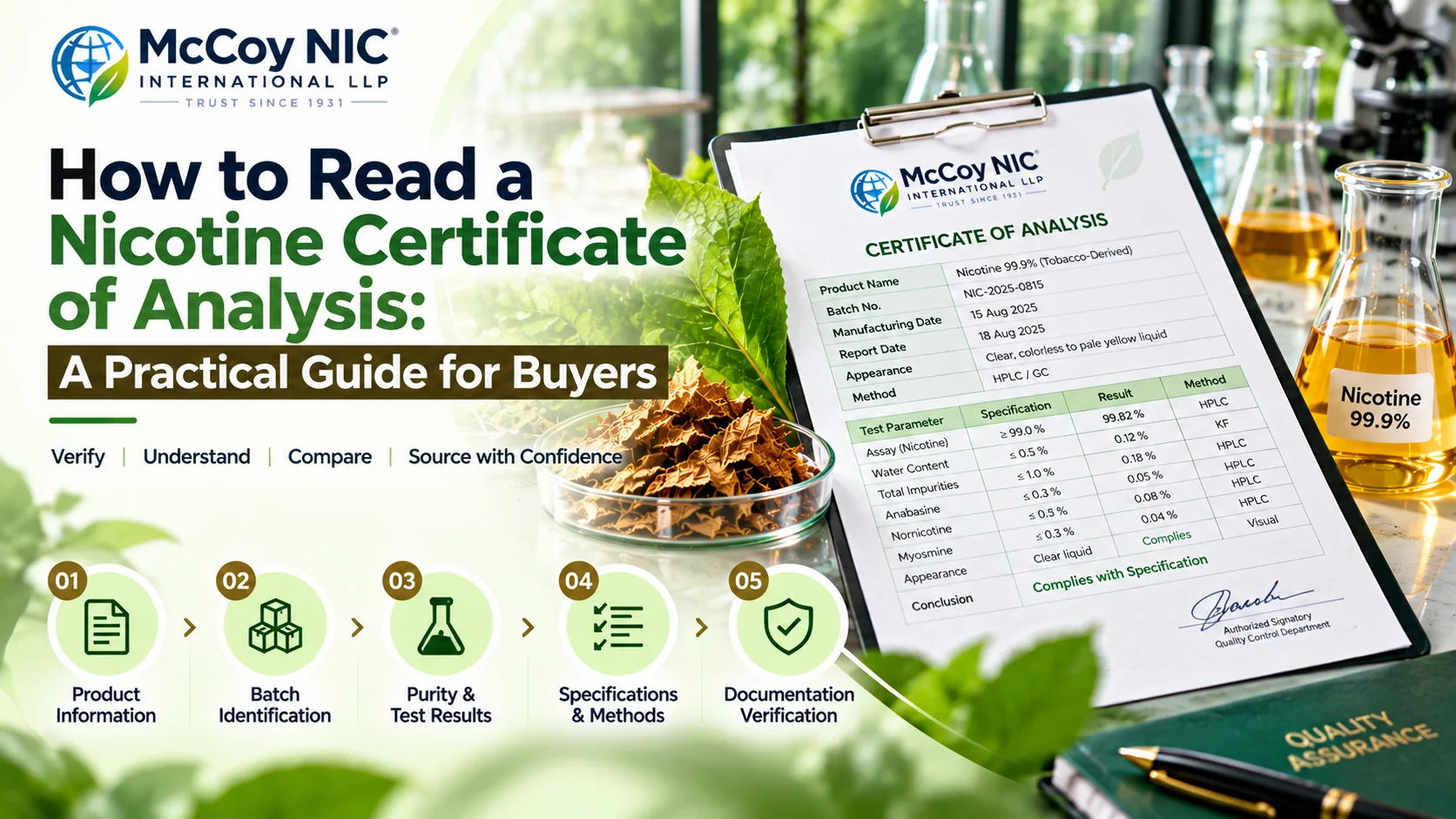
Depending on the product and the supplier’s documentation system, it may contain information such as:
- Product name and grade
- Batch or lot number
- Nicotine assay or purity result
- Relevant impurity test results
- Analytical methods
- Specification limits and acceptance criteria
- Testing and report dates
- Laboratory or quality-department details
- Authorisation or release information
The exact contents depend on the product, testing programme and applicable requirements.
For buyers, the primary purpose of reviewing a CoA is to determine whether the documented results correspond to the material being evaluated and whether those results meet the agreed specifications.
A general product specification sheet is different from a batch-specific CoA. A specification sheet describes the intended quality requirements, while a CoA records analytical findings for an identified sample or batch.
2. Check the Product Name and Grade
The first step is to confirm that the document identifies the correct material.
A nicotine supplier may offer different grades or product types, and their specifications may not be interchangeable. The product name on the CoA should therefore match the material quoted, ordered or received.
Buyers should review:
- Product name and grade
- Nicotine concentration or assay basis, where applicable
- Product identification details
- Relevant specification or standard references
- Intended product form, where stated
If a buyer requires a particular grade, the CoA should be reviewed against that specific requirement rather than against a general product description.
For an overview of product specifications, visit the McCoy NIC Pure Nicotine 99.9% product page.
3. Match the Batch or Lot Number
Batch identification is one of the most important checks when reviewing a CoA.
The batch or lot number on the document should correspond to the batch identification on the supplied material and its associated records.
A certificate for one batch does not automatically establish the analytical results of another batch, even if both products have the same name and stated grade.
Buyers should compare the batch details across the relevant documents, including:
- Certificate of Analysis
- Product label and packaging records
- Purchase order or delivery documentation
- Supplier batch or traceability records
If the batch number is missing, inconsistent or difficult to read, buyers should request clarification before accepting the document as evidence for the supplied material.
The document should also identify the relevant report number or other reference where applicable.
4. Understand the Nicotine Assay or Purity Result
The assay or purity result is often one of the first values buyers notice on a nicotine CoA.
However, the reported percentage should be interpreted in the context of the specified test method, calculation basis, units and acceptance criteria.
For example, a document may report an assay result as a percentage. Buyers should check whether the report explains the basis of that result and whether the applicable specification defines a minimum, maximum or permitted range.
A purity figure alone does not provide a complete picture of product quality.
The result should be reviewed alongside the other tests and requirements relevant to the specific material. Buyers should also avoid assuming that two reported purity values are directly comparable if the methods or reporting bases differ.
The practical questions are:
- What parameter was measured?
- Which analytical method was used?
- What units or calculation basis were reported?
- What specification applies?
- Does the reported result meet that specification?
These checks help buyers interpret the reported result rather than relying on a headline percentage alone.
5. Review Impurity and Other Quality Results
Depending on the product grade and agreed specification, a nicotine CoA may include additional analytical parameters beyond assay.
These may relate to impurities, water content, residual solvents or other relevant quality characteristics.
The applicable test panel should be determined by the product specification, intended application and relevant regulatory or customer requirements. Not every CoA will contain the same tests.
When reviewing the results, buyers should look for the following information:
| Information | What Buyers Should Check |
|---|---|
| Test parameter | Is the parameter relevant to the agreed specification? |
| Analytical method | Is the method identified or referenced? |
| Specification limit | Is the applicable acceptance criterion stated? |
| Reported result | Is the actual result provided where required? |
| Units | Are the units clearly stated and appropriate? |
| Acceptance status | Does the reported result meet the specified criterion? |
A result marked “Pass” may be useful, but a numerical result accompanied by the relevant specification and method can provide more information for technical review.
If a required test is absent, buyers should clarify whether it was not applicable, was not performed or is documented separately.
6. Understand Analytical Methods and Testing Information
The analytical method describes how a particular parameter was assessed.
Different methods may have different measurement capabilities, reporting limits and applicability. Therefore, buyers should not compare results solely because the same parameter name appears on two documents.
When reviewing a CoA, check whether the relevant method is identified, referenced or available in supporting documentation.
For specialised testing requirements, the buyer’s quality team may need to confirm whether the method is appropriate for the parameter and whether the laboratory has suitable competence for the work.
Where laboratory accreditation is relevant to the purchase requirements, buyers can also verify the laboratory’s accreditation status and whether the specific testing activity falls within its accredited scope.
A CoA should provide enough information for the buyer to understand what was tested and how the reported results relate to the agreed specifications.
7. Check the Testing Dates and Report Status
Dates help buyers understand the timeline associated with the reported analysis.
Depending on the document, relevant dates may include:
- Sample collection or sampling date
- Laboratory receipt date
- Testing date
- Report issue date
- Manufacturing date
- Retest or expiry date, where applicable
These dates serve different purposes and should not be treated as interchangeable.
For example, the report issue date does not automatically represent the product’s manufacturing date or expiry date.
Buyers should confirm that the report is complete and final where a final report is required. If the document is marked as preliminary, draft or pending, they should ask the supplier for clarification before treating it as final quality evidence.
8. Review Authorisation and Supporting Documents
The final review should consider whether the document is complete, identifiable and supported by the records required for the purchase.
Depending on the supplier’s quality system and the buyer’s requirements, the CoA may include an authorised signature, electronic approval, release status or other verification details.
Buyers may also need additional documents, such as:
- Product specification sheet
- Safety Data Sheet (SDS)
- Batch traceability records
- Relevant certification or compliance documents
- Packaging and labelling information
- Storage and transport documentation
A CoA should not be treated as a substitute for every other quality or regulatory document.
It also does not, by itself, establish regulatory approval, prove that all possible contaminants have been tested, or confirm that the material is suitable for every intended application.
For further information, review the McCoy NIC quality and certification information.
9. Common Mistakes to Avoid When Reading a Nicotine CoA
Procurement teams can reduce documentation misunderstandings by avoiding several common mistakes.
Checking only the purity percentage: A single value does not replace a review of the complete specification and relevant test results.
Ignoring the batch number: A CoA should be connected to the specific material being evaluated.
Overlooking the test method: The method helps explain how a result was obtained and how it should be interpreted.
Accepting unclear units: Values should be reviewed using the correct units and reporting basis.
Assuming every CoA contains the same tests: Test requirements depend on the product and applicable specification.
Treating a CoA as regulatory approval: Analytical results and regulatory authorisation are different matters.
Ignoring missing information: If an essential field or test result is missing, the buyer should request clarification rather than make assumptions.
A consistent review process helps purchasing teams identify questions early and communicate them clearly to suppliers.
10. A Practical CoA Review Checklist for B2B Buyers
Before completing a supplier-documentation review, buyers can use the following checklist.
| Checkpoint | Review Question |
|---|---|
| Product identity | Does the product name and grade match the purchase requirement? |
| Batch identification | Does the batch or lot number match the supplied material? |
| Specifications | Are the applicable acceptance criteria available? |
| Assay or purity | Is the result clearly reported with the relevant basis and units? |
| Additional tests | Are the required impurity and quality parameters addressed? |
| Analytical methods | Are the relevant methods identified or referenced? |
| Dates | Are the testing and report dates clear? |
| Report status | Is the document final where a final report is required? |
| Supporting records | Are additional documents available where required? |
| Clarifications | Have missing or inconsistent details been resolved? |