Nicotine Import Documentation: What International B2B Buyers Should Prepare
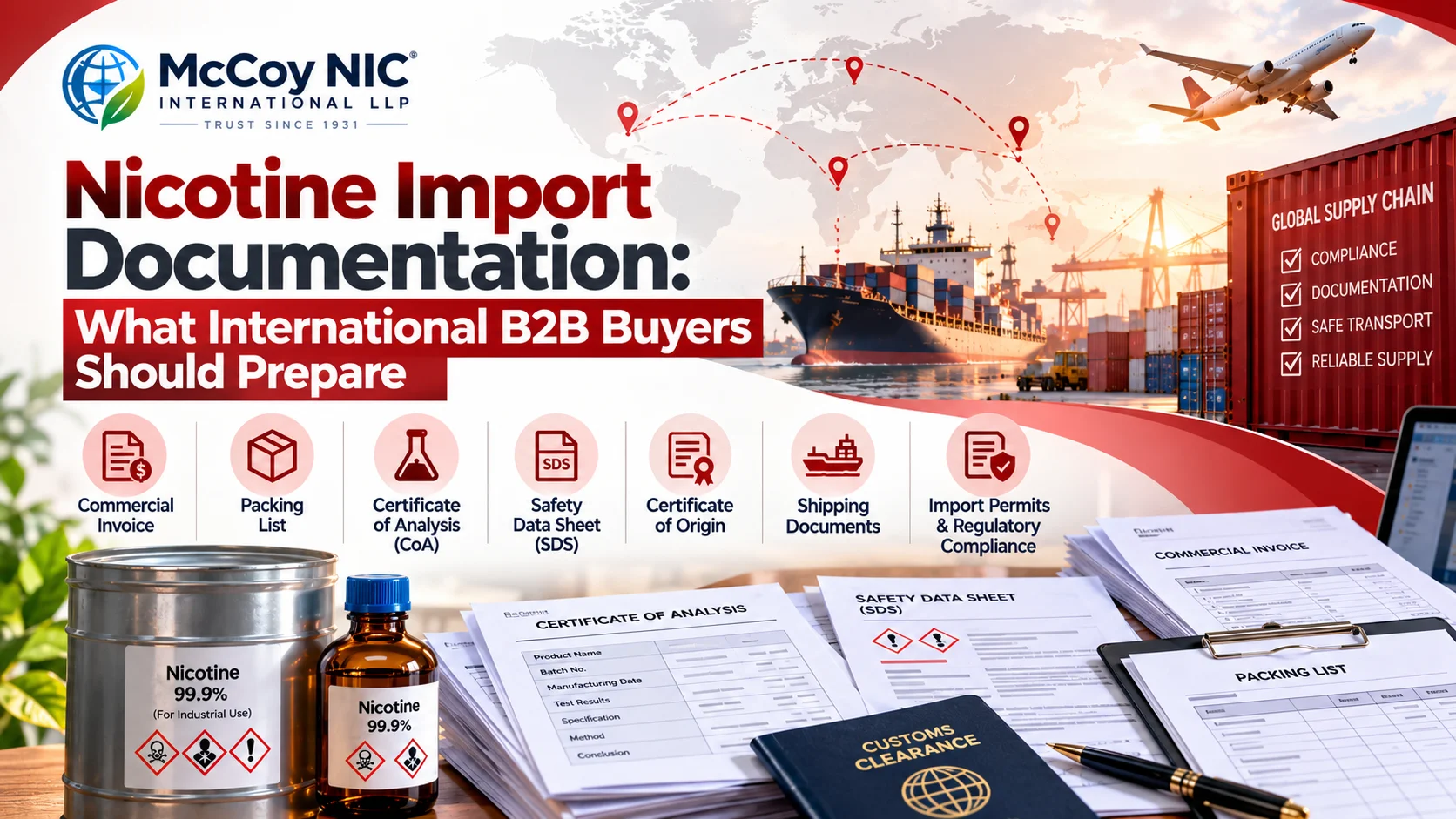
Nicotine import documentation is an important consideration for international B2B buyers sourcing nicotine ingredients from overseas suppliers. Before placing an order, procurement teams should understand which commercial, technical, shipping and regulatory documents may be required for their particular product and destination market.
Incomplete or inconsistent paperwork can lead to customs queries, shipment delays and additional coordination between buyers, suppliers, freight forwarders and customs brokers.
For businesses importing nicotine ingredients, preparing the documentation checklist early can help improve communication and make procurement planning more organised.
The exact requirements depend on the destination country, product classification, intended application and applicable laws. Buyers should confirm the requirements with the relevant authorities and their customs broker before shipment.
1. Understand the Product and Import Requirements First
Before requesting documents from a supplier, buyers should establish the identity and classification of the material they intend to import.
The documentation required for a particular chemical may differ according to its composition, grade, intended use and regulatory classification.
International buyers should confirm:
- The exact product name and grade
- Product specifications and intended application
- Applicable customs tariff or HS classification
- Country of origin
- Destination country and port of entry
- Relevant import permissions or restrictions
- Applicable labelling, packaging and transport requirements
These details help determine which documents should be prepared and which authorities or regulatory bodies may need to be consulted.
Buyers should not assume that a document accepted for one chemical, application or destination will automatically be sufficient for another.
2. Commercial Invoice and Packing List
The commercial invoice and packing list are important components of international shipping documentation.
A commercial invoice generally records the transaction details, including the seller, buyer, product description, quantity, unit price, total value and applicable commercial terms.
The packing list provides information about the shipment’s contents and packaging. Depending on the shipment, this may include the number of packages, net and gross weights, package descriptions and other identification details.
Buyers should check that the information in these documents is consistent with the purchase order and shipping arrangements.
Particular attention should be given to:
- Buyer and seller details
- Product description and quantity
- Invoice and purchase-order references
- Package count and weights
- Currency and declared value
- Country-of-origin information, where applicable
Discrepancies between the invoice, packing list and shipping records can create unnecessary clarification requests.
Importers should also confirm whether a combined invoice and packing list is acceptable under the relevant procedure.
3. Certificate of Analysis (CoA)
A Certificate of Analysis (CoA) records analytical results associated with an identified sample or product batch.
For B2B buyers purchasing nicotine ingredients, the CoA helps support the review of product identity, specified quality parameters and batch-specific test results.
Depending on the product and agreed specifications, buyers may need to review:
- Product name and grade
- Batch or lot number
- Assay or purity results
- Relevant impurity results
- Analytical methods
- Applicable specification limits
- Testing and report dates
- Authorisation or release information
The CoA should correspond to the material being supplied. Buyers should not assume that a general specification sheet or a certificate for another batch establishes the quality of the current shipment.
Before shipment, procurement teams should confirm whether a batch-specific CoA is required and whether it must be submitted to a particular authority, customer or inspection body.
4. Safety Data Sheet (SDS)
A Safety Data Sheet provides information about the hazards associated with a chemical and the precautions required for its safe handling.
For chemicals such as concentrated nicotine, reviewing safety information is particularly important because the material can be toxic and requires appropriate handling controls.
Depending on the applicable requirements, an SDS may cover:
- Chemical identification
- Hazard identification
- Composition information
- First-aid measures
- Firefighting measures
- Accidental-release procedures
- Handling and storage
- Exposure controls and personal protection
- Physical and chemical properties
- Stability and reactivity
- Toxicological information
- Transport and regulatory information
Buyers should verify that the SDS corresponds to the supplied product and is appropriate for the destination market’s applicable requirements.
Language, format and labelling requirements can vary by jurisdiction. The supplier and importer should confirm which version is needed before dispatch.
Where the product is subject to specific chemical-import controls, an SDS alone may not satisfy every documentation or authorisation requirement.
5. Certificate of Origin and Supporting Records
A Certificate of Origin identifies the country in which goods qualify as originating under the applicable origin rules.
Depending on the transaction, it may be relevant for customs assessment, trade-agreement preferences or other import procedures.
Buyers should determine whether a Certificate of Origin is required for their shipment and whether a preferential tariff claim is being made.
They should also confirm the applicable origin rules rather than assuming that the dispatch country is necessarily the country of origin.
Other supporting records may be requested depending on the product and destination, including:
- Product specification sheets
- Technical documentation
- Inspection or test reports
- Manufacturer declarations
- Import permits or licences, where applicable
- End-use documentation, where required
- Insurance documentation
- Other certificates specified by the buyer, customs authority or applicable regulation
For example, India’s Directorate General of Valuation describes documents that may generally accompany import clearance procedures, including invoices, packing lists, transport documents and, where applicable, chemical test reports and certificates of origin. The precise requirements must be checked for the particular import. Directorate of Vigilance
6. Shipping and Transport Documents
Shipping documents connect the commercial transaction with the physical movement of the goods.
The applicable documents depend on the transport mode and the shipment arrangement.
Common examples include:
Bill of Lading: Generally associated with sea freight and records key details of the carriage of goods.
Air Waybill: Used for air cargo and records key details of the air shipment.
Delivery Order: May be needed in the relevant shipping or cargo-release process.
Insurance Document: May be required under the purchase agreement, trade terms or financing arrangements.
The buyer should confirm which original or electronic documents are required, who will issue them and how they will be delivered.
Product descriptions, package details and shipment references should be checked across the relevant records.
For chemicals, transport classification, packaging, marking and documentation must also be reviewed where applicable. Buyers should coordinate with their supplier and qualified logistics provider rather than relying solely on ordinary commercial shipping paperwork.
7. Import Licences and Regulatory Authorisations
Some products or transactions may require additional permissions, notifications or regulatory documentation before they can be imported.
The requirements depend on the product’s classification, destination market, intended use and applicable legislation.
Before placing an order, buyers should check whether any of the following apply:
- Import licence or permit
- Chemical-specific authorisation
- Registration or notification
- End-use declaration
- Special labelling requirements
- Restrictions on import, sale or use
- Requirements imposed by another relevant government authority
For chemicals covered by particular international controls, additional procedures may apply.
For instance, the Indian Department of Chemicals and Petrochemicals explains that certain chemicals covered by the Rotterdam Convention’s Prior Informed Consent framework may involve additional documentation and coordination. This applies to the relevant regulated chemicals, not automatically to every chemical import. chemicals.gov.in
Buyers should verify the product’s actual regulatory status before assuming that a permit or notification is either necessary or unnecessary.
8. Customs Declaration and Importer Information
Customs declarations are used to provide information about imported goods and support the assessment of applicable duties, taxes and compliance requirements.
For imports into India, the Bill of Entry is a key import declaration. Importers should coordinate with their customs broker or authorised representative to ensure that the required details and supporting documents are prepared correctly.
Relevant information may include:
- Importer and supplier details
- Product description and classification
- Quantity and declared value
- Country of origin
- Applicable duties and taxes
- Invoice and transport-document references
- Required supporting certificates or authorisations
The supporting documentation required for a shipment depends on the goods and any applicable regulatory requirements.
India’s official customs portal, ICEGATE, provides customs-related services and information for importers and trade users.
Importers should ensure that declarations are accurate. Product classification, valuation and regulatory declarations should be confirmed with a qualified customs professional when necessary.
9. Prepare a Documentation Checklist Before Shipment
A practical documentation checklist helps buyers identify missing information before goods are dispatched.
The following table provides a starting point for supplier coordination.
| Document | Purpose | Buyer Action |
|---|---|---|
| Commercial invoice | Records transaction details and declared value | Check product description, quantities and values |
| Packing list | Describes packages and shipment contents | Verify package counts and weights |
| Certificate of Analysis | Records specified analytical results | Confirm batch identification and required tests |
| Safety Data Sheet | Communicates chemical hazards and handling precautions | Verify product identity and applicable format |
| Certificate of Origin | Supports origin verification where relevant | Confirm whether it is required |
| Bill of Lading or Air Waybill | Records shipment and transport details | Check the transport mode and document details |
| Import licence or permit | Provides required regulatory authorisation where applicable | Confirm requirements with the relevant authority |
| Test or inspection report | Supports specified quality or compliance checks | Confirm whether the report is required |
| Insurance document | Records applicable cargo insurance arrangements | Check the contract and shipping terms |
| Customs declaration | Declares imported goods to customs | Coordinate with the customs broker |
This is a general planning checklist, not a universal list of mandatory documents. The buyer should confirm the final list based on the specific product, destination country and shipment.
10. Common Documentation Mistakes to Avoid
Several preventable issues can complicate international procurement.
Inconsistent product descriptions
The invoice, packing list, CoA and transport records should identify the material consistently, subject to the format required for each document.
Incorrect batch information
Where a CoA or other record is batch-specific, its identification details should correspond to the supplied material.
Missing supporting documents
Buyers should establish the document list before dispatch rather than waiting until the shipment reaches the destination.
Outdated or unsuitable safety information
The SDS should correspond to the product and meet applicable destination-market requirements.
Unverified import permissions
Buyers should not assume that a supplier’s ability to export a product means it can automatically be imported into every destination country.
Last-minute document requests
Agreeing on documentation responsibilities early can reduce avoidable delays and repeated communication.
11. How Suppliers and Buyers Can Coordinate More Effectively
Effective documentation management requires cooperation between the buyer, supplier, freight forwarder and customs broker.
A structured process can include:
- Confirming product identity and destination-market requirements.
- Agreeing on the required documents before finalising shipment arrangements.
- Assigning responsibility for preparing and checking each document.
- Verifying consistency across commercial, technical and shipping records.
- Resolving discrepancies before dispatch.
- Retaining the relevant records for future procurement and compliance reviews.
For repeat purchases, buyers may benefit from maintaining a standard documentation checklist for each product and destination.
However, that checklist should be reviewed whenever the product, intended application, destination or applicable requirements change.