
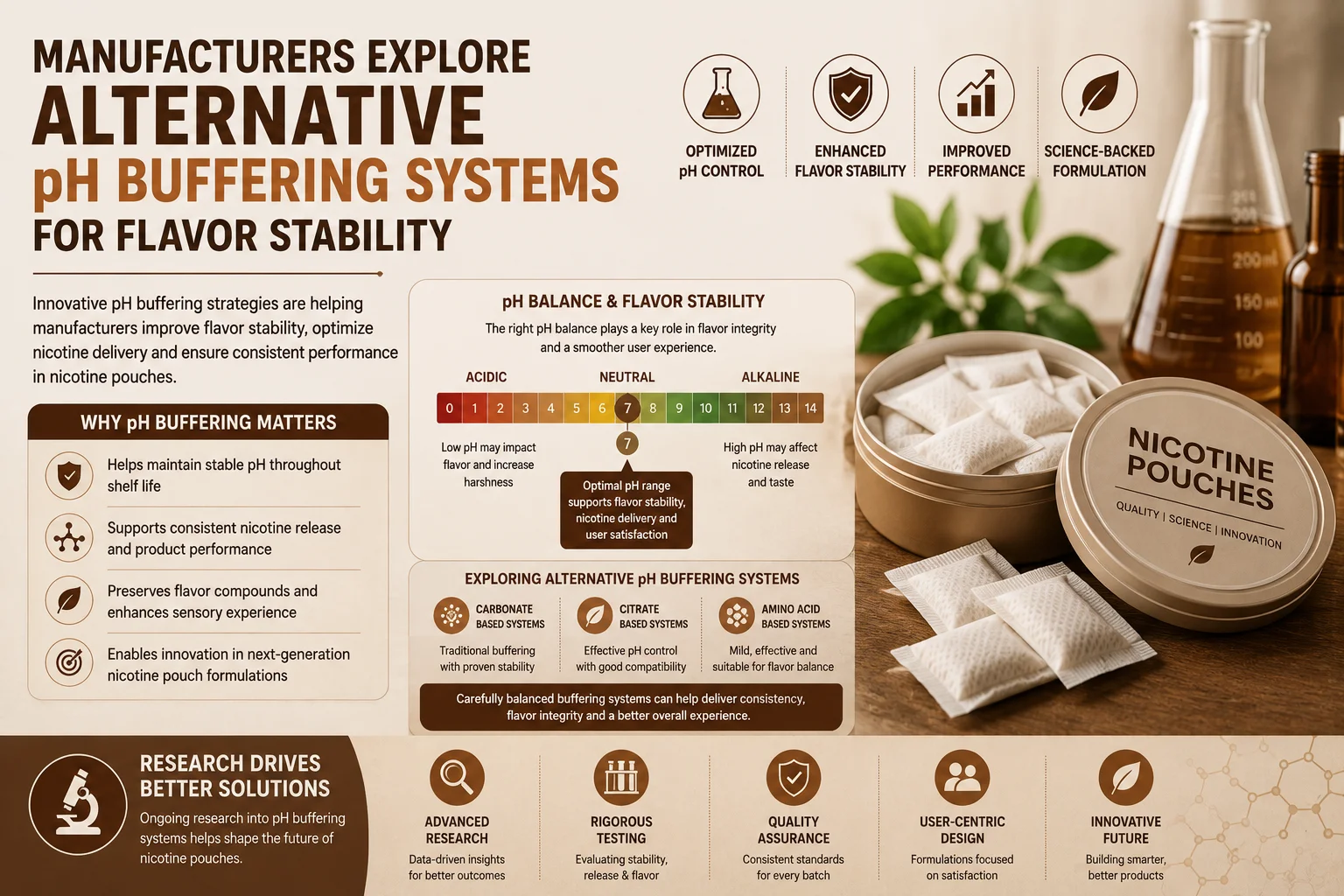
Manufacturers Explore Alternative pH Buffering Systems for Flavor Stability
Manufacturers are exploring pH buffering systems for nicotine pouches as researchers and product developers look for ways to improve formulation consistency, flavor stability and nicotine delivery. pH is an important characteristic of oral nicotine products because it can influence nicotine chemistry as well as the sensory properties of a finished pouch.
As the nicotine pouch category continues to develop, formulation teams are paying closer attention to how buffering ingredients interact with nicotine, flavor compounds, moisture and other components.
Why pH Matters in Nicotine Pouch Formulation
The pH level of a nicotine pouch can affect the chemical environment in which nicotine and other ingredients are present. Different commercial products can have substantially different pH values, depending on their formulation and manufacturing process.
Research examining commercially available nicotine pouches has identified differences in characteristics such as nicotine concentration, moisture, pH and other ingredients. These differences can contribute to variations in product performance and sensory characteristics.
For manufacturers, controlling pH is therefore more than simply reaching a particular numerical value. The goal can also include maintaining a consistent formulation throughout the product’s shelf life.
Role of Buffering Systems
Buffering systems are used in formulations to help resist changes in pH. In nicotine pouches, alkaline ingredients such as carbonates and bicarbonates may be used to adjust the formulation’s pH.
Researchers are increasingly interested in how different buffering approaches behave when a pouch comes into contact with saliva. Buffering capacity, dissolution and the release of nicotine can all interact during use.
This has created interest in alternative pH buffering systems for nicotine pouches that could provide more controlled pH behavior while maintaining other desired product characteristics.
Flavor Stability Becomes a Key Consideration
Flavor stability is another important challenge for manufacturers. Flavor compounds can be sensitive to changes in their surrounding chemical environment. Changes in pH, moisture and temperature may influence the stability of certain ingredients over time.
A formulation that maintains relatively stable conditions during storage could help manufacturers achieve greater consistency between production batches and throughout the intended shelf life.
However, adjusting pH is not necessarily a simple process. A buffering ingredient may affect not only pH but also taste, mouthfeel, nicotine release and compatibility with other ingredients.
Balancing pH and Sensory Characteristics
Recent research has highlighted the relationship between pH and sensory characteristics in nicotine pouch formulations. Experimental work has investigated how changes in pH and nicotine concentration may influence measures such as sweetness, harshness, smoothness and overall appeal.
These findings suggest that formulation decisions can involve several competing objectives. A manufacturer may want sufficient pH control for nicotine delivery while also avoiding unwanted sensory effects.
The choice and concentration of buffering ingredients can therefore become an important part of product development.
Impact on Nicotine Delivery
pH can also influence the proportion of nicotine present in different chemical forms. This is relevant because the chemical form of nicotine can affect how readily it is available for absorption through the oral tissues.
For this reason, manufacturers studying pH buffering systems for nicotine pouches may need to evaluate both product stability and nicotine-release characteristics.
Laboratory testing can help researchers compare formulations under controlled conditions. However, laboratory results do not always directly represent the experience of consumers during real-world use.
Alternative Formulation Strategies
Alternative buffering approaches may involve changes to the type, concentration or combination of ingredients used to control pH. Researchers can evaluate these approaches by measuring pH, buffering capacity, nicotine release, flavor stability and other product characteristics.
The objective is not necessarily to maximize pH. Instead, formulation developers may seek an appropriate balance that supports consistent product performance while maintaining the desired sensory profile.
This type of formulation research could become increasingly important as manufacturers develop different pouch sizes, nicotine strengths and flavor profiles.
What Manufacturers Are Watching
Several factors are likely to remain important during the development of new nicotine pouch formulations:
- pH stability during storage
- Buffering capacity during use
- Nicotine release characteristics
- Flavor stability over shelf life
- Moisture content
- Ingredient compatibility
- Sensory characteristics
Considering these factors together can help researchers understand how changes to one part of a formulation may influence the overall product.
More Research Is Needed
Although research into pH buffering systems for nicotine pouches is providing useful information, additional independent studies are needed to understand how different formulations perform over time.
The interaction between pH, buffering capacity, nicotine concentration, flavor ingredients and oral conditions is complex. Results from one formulation may not necessarily apply to every nicotine pouch on the market.
Future research could provide more information about how alternative buffering approaches influence flavor stability and nicotine delivery under both laboratory and real-world conditions.
Bottom Line
Manufacturers are continuing to investigate pH buffering systems for nicotine pouches as part of broader efforts to improve formulation consistency and flavor stability. pH can influence nicotine chemistry, sensory characteristics and product behavior, making buffering an important area of formulation research.
As the nicotine pouch market evolves, further research into buffering systems could help manufacturers better understand the relationship between pH, flavor stability and nicotine delivery.