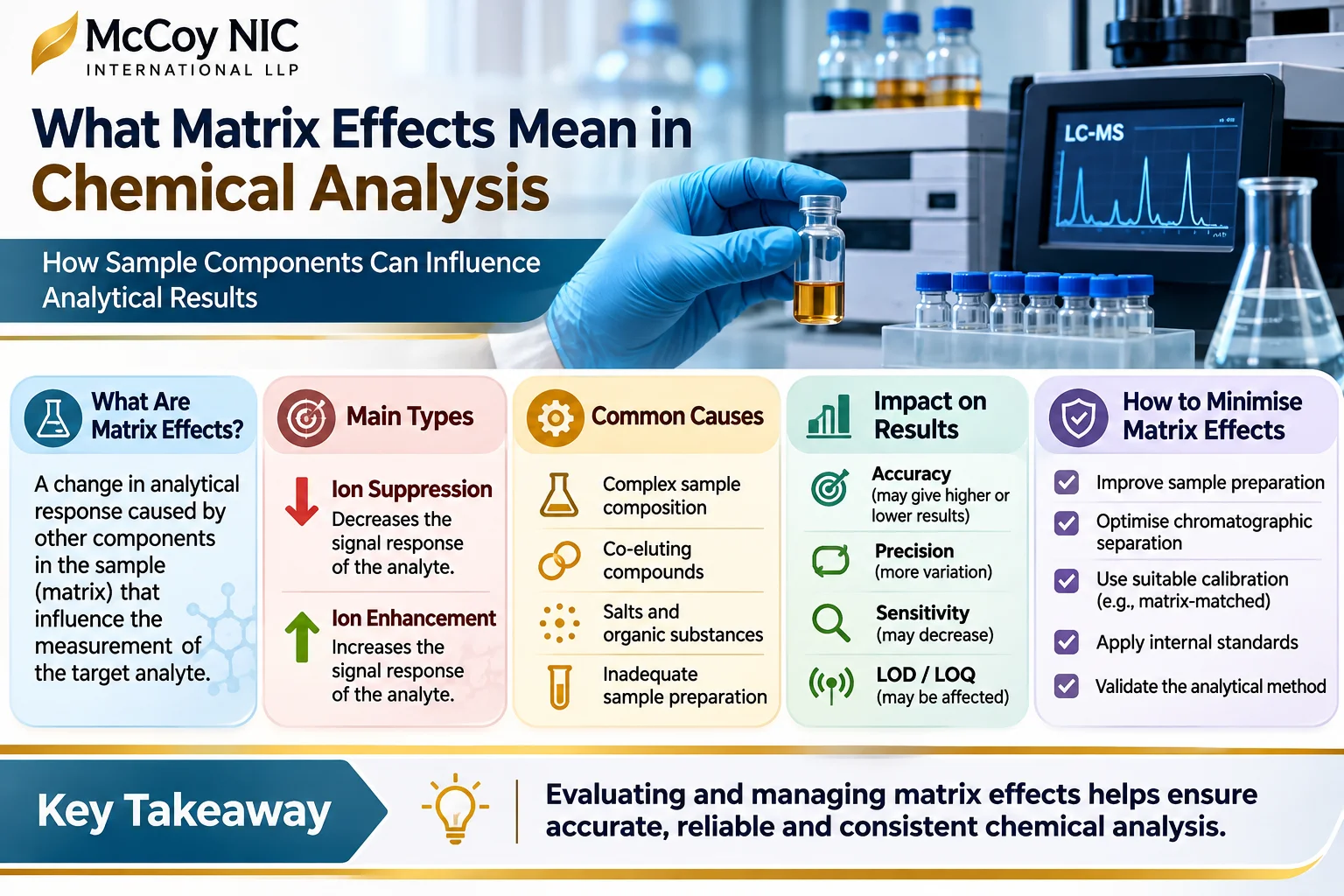
What Matrix Effects Mean in Chemical Analysis
Accurate chemical analysis depends on more than selecting the right instrument or analytical method. The composition of a sample can also influence the measurement process. One important factor is matrix effects in chemical analysis, which occur when other components present in a sample affect the response or measurement of the target substance, also known as the analyte.
Matrix effects are particularly important in techniques such as liquid chromatography-mass spectrometry (LC-MS), gas chromatography-mass spectrometry (GC-MS), and inductively coupled plasma mass spectrometry (ICP-MS). If these effects are not properly evaluated, they may influence analytical sensitivity, accuracy, precision and reliability.
Understanding matrix effects helps analytical laboratories develop better methods, evaluate results and improve the quality of chemical measurements.
1. What Are Matrix Effects in Chemical Analysis?
A matrix refers to all the components of a sample other than the specific analyte being measured. These components may include solvents, salts, organic compounds, proteins, lipids, minerals and other substances.
Matrix effects occur when these components influence the analytical response of the target analyte. Depending on the analytical technique and sample composition, the measured signal may increase or decrease.
In mass spectrometry, particularly LC-MS, matrix effects are commonly associated with two phenomena:
- Ion suppression: Other sample components reduce the ionisation efficiency or signal response of the target analyte.
- Ion enhancement: Other sample components increase the signal response of the target analyte.
Both effects can create differences between the actual concentration of a substance and the value reported by an analytical method.
2. What Causes Matrix Effects?
Several factors can contribute to matrix effects during chemical analysis. The exact causes depend on the sample, analytical method and instrument configuration.
A. Complex Sample Composition
Samples containing multiple chemical compounds may introduce substances that interfere with the measurement of the target analyte. Biological fluids, food extracts, environmental samples and pharmaceutical formulations can contain complex mixtures.
B. Co-eluting Compounds
In chromatography-mass spectrometry, matrix components may pass through the chromatographic system at the same time as the target analyte. These compounds can influence the ionisation process and affect the measured signal.
C. Salts and Organic Compounds
Salts, lipids, proteins, carbohydrates and other organic or inorganic substances may influence the analytical response, particularly during mass spectrometry measurements.
D. Sample Preparation
Insufficient extraction, filtration or sample clean-up may allow unwanted matrix components to remain in the final sample. These components can contribute to signal suppression or enhancement.
3. How Do Matrix Effects Influence Analytical Results?
Matrix effects can influence several important performance characteristics of an analytical method.
Accuracy: The reported concentration may differ from the actual concentration of the analyte.
Precision: Variations in sample composition can lead to inconsistent measurements between repeated analyses.
Sensitivity: Signal suppression may reduce the ability of an instrument to detect low concentrations.
Limit of Detection (LOD): Matrix-related signal changes may affect the minimum concentration that can be reliably detected.
Limit of Quantification (LOQ): Matrix effects may also influence the minimum concentration that can be measured with acceptable accuracy and precision.
For laboratories working with pharmaceutical ingredients, chemical intermediates and complex formulations, evaluating these factors is an important part of analytical method development and validation.
4. How Are Matrix Effects Evaluated?
Analytical laboratories use different approaches to identify and assess matrix effects. The appropriate method depends on the analytical technique and sample type.
A. Post-Column Infusion
In this approach, a continuous flow of the analyte is introduced into the mass spectrometer after the chromatography column. Changes in the signal during the sample run can help identify regions where matrix components cause ion suppression or enhancement.
B. Post-Extraction Spike Method
The analyte is added to an extracted blank sample matrix. Its response is compared with the response obtained from a standard solution prepared without the matrix. This comparison helps assess the influence of the matrix on the analytical signal.
C. Matrix-Matched Calibration
Calibration standards are prepared using a matrix similar to the samples being analysed. This approach can help compensate for matrix-related differences in analytical response.
D. Internal Standards
Suitable internal standards, particularly stable isotope-labelled standards where appropriate, can help compensate for variations during sample preparation and measurement.
These methods are commonly discussed in analytical research and bioanalytical method-validation guidance.
5. Techniques to Reduce or Minimise Matrix Effects
Matrix effects cannot always be completely eliminated. However, laboratories can use several strategies to reduce their influence.
- Improve sample preparation: Use appropriate extraction and clean-up procedures to remove unwanted components.
- Optimise chromatographic separation: Adjust chromatographic conditions to reduce the co-elution of matrix components with the analyte.
- Select suitable ionisation conditions: Evaluate instrument settings and ionisation techniques for the specific sample and analyte.
- Use appropriate calibration methods: Matrix-matched calibration or suitable internal standards may compensate for matrix-related signal changes.
- Validate analytical methods: Evaluate matrix effects as part of method development and validation, where relevant.
The most suitable approach depends on the sample matrix, target compound and analytical instrument.
6. Why Matrix Effects Matter in Pharmaceutical and Chemical Analysis
In pharmaceutical and specialty chemical analysis, reliable measurements are important for evaluating identity, purity, concentration and consistency.
Matrix effects are especially relevant when analytical methods are used to measure compounds in complex formulations or biological samples. A method that performs well with a simple reference solution may behave differently when applied to a real sample.
For this reason, laboratories should evaluate whether the sample matrix influences the analytical response and determine whether corrective measures are required.
It is also important to distinguish between a product specification, a batch-specific Certificate of Analysis (CoA), and an analytical method-validation report. These documents serve different purposes and should be reviewed according to the intended quality assessment.
7. The Importance of Quality Documentation in Chemical Supply
For buyers evaluating chemical and pharmaceutical ingredient suppliers, product information and quality documentation are important parts of supplier assessment.
Relevant documents may include:
- Product specification sheets
- Batch-specific Certificate of Analysis (CoA)
- Safety Data Sheets (SDS)
- Applicable quality and compliance certificates
- Batch identification and traceability information
At McCoy NIC International LLP, buyers can review product information and applicable quality documentation during the supplier evaluation process.
Explore the following resources:
- McCoy NIC Certifications and Compliance Documents
- McCoy NIC Frequently Asked Questions
- Pure Nicotine
- Tobacco-Derived Nicotine
- Synthetic Nicotine
- Nicotine Salts
- Pharmaceutical NRT Nicotine
Product-specific specifications and batch documentation should always be confirmed for the relevant product and order.