Nicotine Exposure From Oral Nicotine Pouches: 2026 Research Develops a Predictive Model
Nicotine exposure from oral nicotine pouches is becoming an increasingly important area of research as manufacturers, scientists and regulators seek better ways to understand how formulation characteristics influence nicotine absorption. A 2026 study published in Scientific Reports has developed a predictive pharmacokinetic model designed to estimate nicotine exposure from oral nicotine pouches using laboratory-based dissolution and pH data.
New Model Targets Nicotine Exposure From Oral Nicotine Pouches
The research focuses on a challenge faced during the development and evaluation of oral nicotine pouches: understanding how much nicotine becomes available for absorption and how quickly it may appear in the bloodstream.
Traditional pharmacokinetic studies generally require controlled human studies and repeated blood sampling. These studies can provide important information, but they can also require considerable time, resources and clinical testing.
The researchers therefore explored whether laboratory measurements could be combined with established pharmacokinetic parameters to predict nicotine exposure and plasma concentration profiles.
The study developed a predictive model based on nicotine dissolution, dynamic pH measurements and established nicotine pharmacokinetic parameters.
How the Predictive Model Works
The model uses laboratory data generated from oral nicotine pouches under controlled conditions.
Researchers used a specialized dissolution approach to measure how nicotine was released from pouch products over time. Dynamic pH measurements were also incorporated because the pH environment can influence nicotine permeability and buccal absorption.
The model then combined these measurements with established pharmacokinetic parameters to estimate plasma nicotine concentration over time.
This approach creates a connection between in-vitro product performance and predicted in-vivo nicotine pharmacokinetics.
That relationship is particularly relevant for product development because manufacturers need to understand not only the amount of nicotine contained in a pouch, but also how formulation characteristics can influence nicotine release and absorption.
Three Oral Nicotine Pouches Were Evaluated
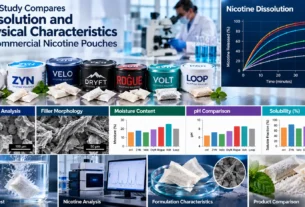
The researchers validated the model using three commercially available oral nicotine pouch products:
- ZYN Cool Mint 6 mg
- DRYFT Spearmint 7 mg
- VELO Mint 4 mg
The study compared predicted pharmacokinetic profiles with clinical data from these products.
The observed clinical ranking of nicotine exposure was consistent with the in-vitro dissolution results, with ZYN followed by DRYFT and VELO in the tested conditions.
The researchers reported that the model was able to predict important pharmacokinetic measures including AUC and Cmax, two commonly used indicators for evaluating drug or nicotine exposure.
Why pH Matters in Nicotine Pouch Research
One of the important findings from the research is the role of pH in nicotine absorption.
Nicotine chemistry and permeability can be affected by the surrounding pH environment. In an oral nicotine pouch, this can include the formulation itself as well as conditions within saliva and the oral cavity.
The study therefore did more than simply measure nicotine dissolution. It incorporated dynamic pH information into the prediction model.
This helped the model account for differences between nicotine being released from a pouch and nicotine actually becoming available for buccal absorption.
McCoy NIC has also covered the role of pH buffering systems in nicotine pouches, particularly how formulation characteristics can influence nicotine chemistry, flavor stability and product performance.
Predicting Pharmacokinetic Performance From Laboratory Data
The research demonstrates the potential value of linking dissolution testing with pharmacokinetic modelling.
According to the study, predicted AUC values were approximately 106% to 116% of the corresponding clinical values for the three products, while predicted Cmax values were approximately 88% to 92% of the clinical values. The authors noted that the model predictions were within the 95% confidence intervals of the clinical measurements.
These results suggest that laboratory dissolution and pH measurements may provide useful information about expected nicotine exposure.
However, the research does not establish that predictive modelling can completely replace human pharmacokinetic studies. The authors describe the approach as a complementary tool that could strengthen product characterization and development rather than automatically serving as a substitute for clinical evidence.
Potential Applications for Manufacturers
Predictive pharmacokinetic modelling could become useful at several stages of oral nicotine product development.
1. Early Formulation Screening
Manufacturers may be able to compare different formulations using laboratory measurements before moving selected candidates into more extensive testing.
This could help development teams identify differences in nicotine release and predicted exposure at an earlier stage.
2. Pouch Design Evaluation
Pouch size, composition, moisture, nicotine concentration and other formulation characteristics can affect nicotine release.
A predictive model could provide another analytical tool for comparing different designs under controlled laboratory conditions.
3. Supporting Regulatory Research
Regulatory submissions for nicotine-containing products require detailed product characterization and supporting evidence.
A validated predictive model could potentially provide additional scientific context connecting measurable product characteristics with expected pharmacokinetic performance.
The study nevertheless emphasizes that regulatory use would require appropriate validation and a clearly defined context of use.
4. Improving Clinical Study Design
Model predictions could also help researchers plan future clinical studies, including dose selection, sampling schedules and comparator selection.
This could make subsequent human studies more targeted and informative.
Product Quality Remains Important
Predictive modelling does not eliminate the importance of raw-material quality.
For manufacturers developing oral nicotine products, the consistency of the nicotine ingredient can influence formulation performance. Parameters such as assay, related alkaloids, water content, residual solvents and other quality attributes therefore remain important during supplier qualification.
McCoy NIC’s 99.9% pure nicotine product is supplied with batch-specific documentation and a certificate of analysis, providing manufacturers with quality information for their own qualification and formulation processes.
For tobacco-derived nicotine, source traceability and alkaloid profile can also be important considerations when evaluating raw materials.
Research Is Moving Toward More Data-Driven Product Development
The 2026 study reflects a broader movement toward more scientific and data-driven development of nicotine products.
Research is increasingly examining:
- Nicotine dissolution
- Buccal absorption
- Product pH
- Nicotine concentration
- Moisture characteristics
- Pouch formulation
- Pharmacokinetic profiles
- Analytical testing
- Product consistency
This direction is consistent with the broader evolution of the nicotine industry, where manufacturers are placing greater emphasis on scientific evaluation, product quality and regulatory requirements.
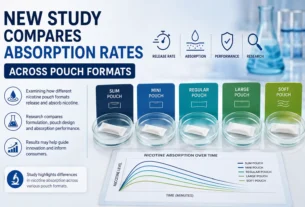
Recent research has also examined differences in nicotine pouch absorption rates, highlighting the importance of formulation and product characteristics when evaluating nicotine delivery.
What This Research Means for the Nicotine Industry
The development of a predictive nicotine pharmacokinetic model could be significant for manufacturers because it provides a potential bridge between laboratory testing and clinical performance.
Instead of looking only at the labelled nicotine content of a pouch, researchers can investigate how nicotine dissolves, how pH changes during use and how these factors may influence absorption.
For B2B manufacturers and raw-material suppliers, this reinforces the importance of consistent specifications and reliable analytical documentation.
As nicotine pouch formulations become more diverse, understanding the relationship between raw-material quality, formulation characteristics, dissolution and nicotine exposure could become increasingly important.