
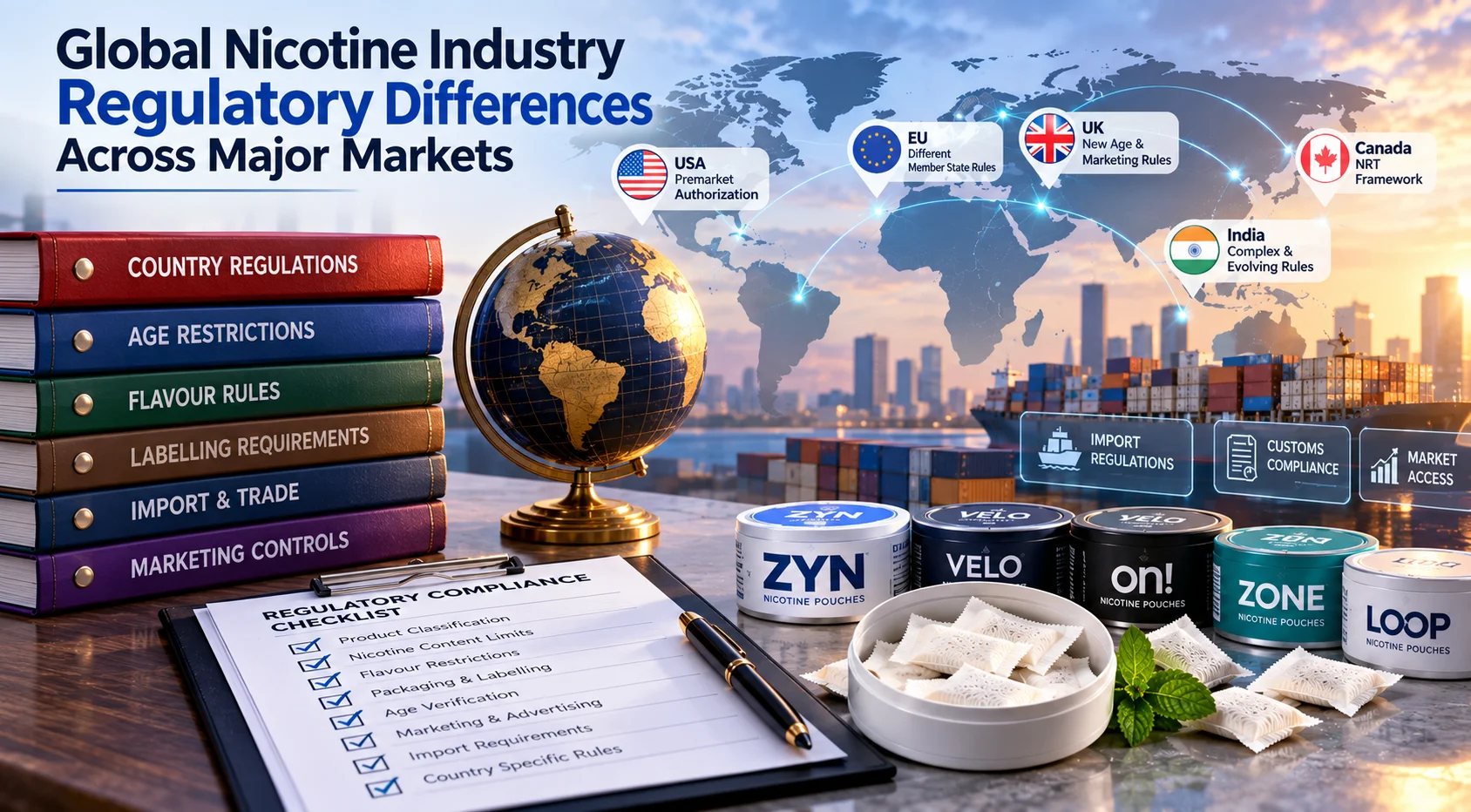
Global Nicotine Regulatory Differences: Major Markets in 2026
The global nicotine regulatory differences across major markets are becoming increasingly important for manufacturers, suppliers, importers and B2B buyers in 2026. Nicotine products that may be permitted under one country’s framework can face different authorization, classification, labelling, age, flavour, marketing or import requirements in another.
The regulatory picture is particularly complex for newer products such as nicotine pouches, which are treated differently across countries and, in some regions, are not covered by a dedicated product-specific framework.
The World Health Organization reported in May 2026 that around 160 countries had no specific regulation for nicotine pouches, while 16 countries had banned their sale and 32 countries had introduced some form of regulation. These controls can include flavour restrictions, age restrictions and advertising restrictions.
Why Global Nicotine Regulations Are Becoming More Fragmented
Traditional tobacco products have been regulated for decades in many countries. Newer nicotine products, however, have developed faster than legislation in several markets.
Nicotine pouches are a clear example.
Depending on the country, a tobacco-free nicotine pouch can be treated as a tobacco-related product, medicine, consumer product or another category. Some markets have introduced specific nicotine-pouch rules, while others rely on existing legislation or are still developing their approach.
This creates a challenge for companies operating internationally.
A product formulation, package or marketing strategy designed for one market may require changes before it can be supplied to another.
United States: Premarket Authorization Is a Central Requirement
The United States has a more formal federal regulatory pathway for nicotine pouches.
The U.S. Food and Drug Administration regulates tobacco products containing nicotine, including nicotine from sources other than tobacco.
In 2026, the FDA continued to authorize specific nicotine pouch products through the Premarket Tobacco Product Application (PMTA) pathway. On August 21, 2026, the FDA authorized 11 additional ZYN ULTRA nicotine pouch products manufactured by Swedish Match USA.
At the same time, the FDA has increased enforcement attention toward unauthorized nicotine pouch products.
In May 2026, the agency issued guidance describing enforcement priorities involving unauthorized nicotine pouch and ENDS products, including products that have not obtained required premarket authorization.
For businesses targeting the U.S. market, regulatory authorization therefore becomes a major consideration before commercial marketing.
European Union: Member States Take Different Approaches
The European market presents a different challenge.
Nicotine pouches are currently not covered by a single harmonized EU-wide tobacco-control framework in the same way as established tobacco products.
The European Commission’s 2026 assessment notes that Member States have adopted different approaches. Some countries have introduced bans, while others have established requirements relating to nicotine content, ingredients, age restrictions, labelling, packaging, notification, advertising or other controls. Some countries continue to treat these products under consumer-product or other national frameworks.
This means that businesses cannot simply treat the European Union as one uniform nicotine market.
A product that complies with requirements in one EU country may need additional review before entering another.
United Kingdom: New Rules Are Being Introduced
The United Kingdom is also moving toward a more defined framework for nicotine products.
UK government guidance states that from 29 October 2026, the legal age of sale for vaping and nicotine products will be 18. The restrictions specifically include nicotine pouches and other nicotine products. The rules will also prohibit certain forms of free distribution and promotional discounting.
Further advertising and sponsorship restrictions are scheduled to apply from 1 June 2027 according to the UK guidance.
For manufacturers and retailers, this illustrates how regulatory requirements can change over a relatively short period.
Canada: Nicotine Pouches Can Fall Under the NRT Framework
Canada provides another example of a market-specific approach.
Health Canada amended its Prescription Drug List in January 2026 to clarify the non-prescription status of nicotine buccal pouches containing 4 mg of nicotine or less per dosage unit.
The agency describes these products within the context of nicotine replacement therapy and smoking cessation.
This illustrates why companies need to assess not only nicotine content but also the product’s intended use, claims and regulatory classification when entering a new market.
India: Regulatory Classification Remains Complex
India presents a different regulatory environment for newer nicotine products.
Existing legislation covers different categories of tobacco and nicotine products, but tobacco-free nicotine pouches do not fit neatly into one dedicated nationwide product framework.
McCoy NIC’s earlier analysis, Where India’s Nicotine Rules Actually Stand: A Plain-English Guide to the Patchwork, explains the distinction between e-cigarettes, conventional tobacco products and tobacco-free oral nicotine pouches.
More recently, Indian authorities have also increased attention toward illegal nicotine pouches, adding another layer of enforcement activity.
For international suppliers, India’s market therefore requires careful assessment of the specific product, intended use, formulation and applicable legal requirements rather than relying on the regulatory treatment used in another country.
Regulatory Differences Affect Product Development
Regulatory requirements can influence product development from the earliest stages.
Manufacturers may need to consider:
- Maximum nicotine concentration
- Nicotine source
- Ingredients
- Flavour systems
- Pouch composition
- Packaging
- Labelling
- Health warnings
- Product notifications
- Age restrictions
- Advertising rules
- Import requirements
- Manufacturing documentation
A formulation designed for a single market may therefore not be suitable for direct distribution in another jurisdiction.
This makes regulatory planning an increasingly important part of product development.
Flavours Are Becoming a Major Regulatory Issue
Flavour policy is another area where international rules can differ significantly.
Some jurisdictions have introduced restrictions on characteristic flavours, while others continue to permit a wider range of flavour options.
Denmark, for example, has introduced specific requirements affecting nicotine pouches and tobacco-surrogate products, including restrictions on characteristic flavours and a maximum nicotine level of 9 mg per pouch.
For businesses operating across multiple countries, flavour formulation may therefore need to be adapted to destination-market requirements.
Our related report on Cross-Border Shipping Rules for Nicotine Products provides additional context on how changing rules can affect international nicotine trade.
Marketing Rules Are Also Becoming More Important
Regulatory differences extend beyond the product itself.
Governments and public-health organizations are increasingly examining:
- Advertising
- Social-media promotion
- Product claims
- Sponsorship
- Packaging design
- Youth appeal
- Influencer marketing
- Retail displays
The WHO’s 2026 global report highlighted regulatory gaps surrounding nicotine pouches and called attention to marketing practices, youth exposure and product appeal.
McCoy NIC’s earlier article, Agencies Signal Tighter Review of Nicotine Pouch Marketing Claims, covers this developing area of regulatory attention.
Global Trade Is Becoming More Compliance-Intensive
For international manufacturers and B2B suppliers, regulatory differences can affect the entire supply chain.
Before shipping a nicotine-related product internationally, companies may need to evaluate:
Product Classification
Determine how the destination country legally classifies the product.
Product Specifications
Confirm nicotine concentration, ingredients and formulation details.
Documentation
Maintain appropriate specifications, certificates, testing information and batch records.
Packaging and Labelling
Check whether destination-market packaging and warning requirements differ.
Import Requirements
Review customs, import authorization and other applicable requirements.
Marketing Restrictions
Ensure that claims and promotional activities comply with destination-market rules.
This is particularly important because compliance requirements may apply before a product reaches the retail stage.
Why One Global Compliance Strategy May Not Be Enough
A major challenge for multinational nicotine businesses is that a single global product strategy may not satisfy every jurisdiction.
For example:
- The U.S. focuses heavily on premarket authorization.
- EU Member States can apply different national approaches.
- The UK is introducing specific age and promotional restrictions.
- Canada can regulate certain nicotine pouches within its NRT framework.
- India has a more complex and evolving framework for tobacco-free oral nicotine products.
These differences demonstrate why international companies increasingly need market-specific compliance assessments.
What B2B Nicotine Buyers Should Check
B2B buyers sourcing nicotine products or raw materials for international markets should consider establishing a destination-market checklist.
Important areas can include:
- Product classification
- Intended use
- Nicotine concentration
- Nicotine source
- Ingredient specifications
- Certificate of Analysis
- Batch traceability
- Packaging requirements
- Labelling requirements
- Import documentation
- Product authorization
- Marketing restrictions
Our article Why Batch Traceability Is Becoming More Important in the Global Nicotine Supply Chain provides additional context on documentation and traceability.
Scientific Testing Is Also Becoming More Relevant
As regulations become more detailed, analytical testing can play an increasingly important role.
Manufacturers may need reliable data relating to nicotine concentration, impurities, formulation characteristics and product consistency.
Recent research has also examined the physical and chemical characteristics of commercial nicotine pouches, including dissolution, solubility, moisture, pH and particle-size characteristics.
Our article New Study Compares Dissolution and Physical Characteristics of Commercial Nicotine Pouches covers this research in greater detail.
Regulatory Differences Could Shape the Next Phase of the Industry
The nicotine industry is entering a period in which regulatory requirements may become as important as product innovation.
Companies developing new nicotine products will need to consider not only whether consumers may want a product, but also whether the product can be legally manufactured, imported, marketed and sold in each target market.
The result may be greater product differentiation between countries.
Different nicotine strengths, flavours, packaging formats and marketing strategies could emerge depending on local regulatory requirements.
What Manufacturers Should Watch in 2026 and Beyond
Several regulatory themes are likely to remain important:
- New nicotine-pouch authorization decisions
- Maximum nicotine-strength limits
- Flavour restrictions
- Youth-access controls
- Advertising and sponsorship rules
- Packaging and labelling requirements
- Import controls
- Product notification systems
- Synthetic versus tobacco-derived nicotine classification
- Cross-border enforcement
The global regulatory picture is likely to continue evolving as governments respond to the expansion of newer nicotine products.