
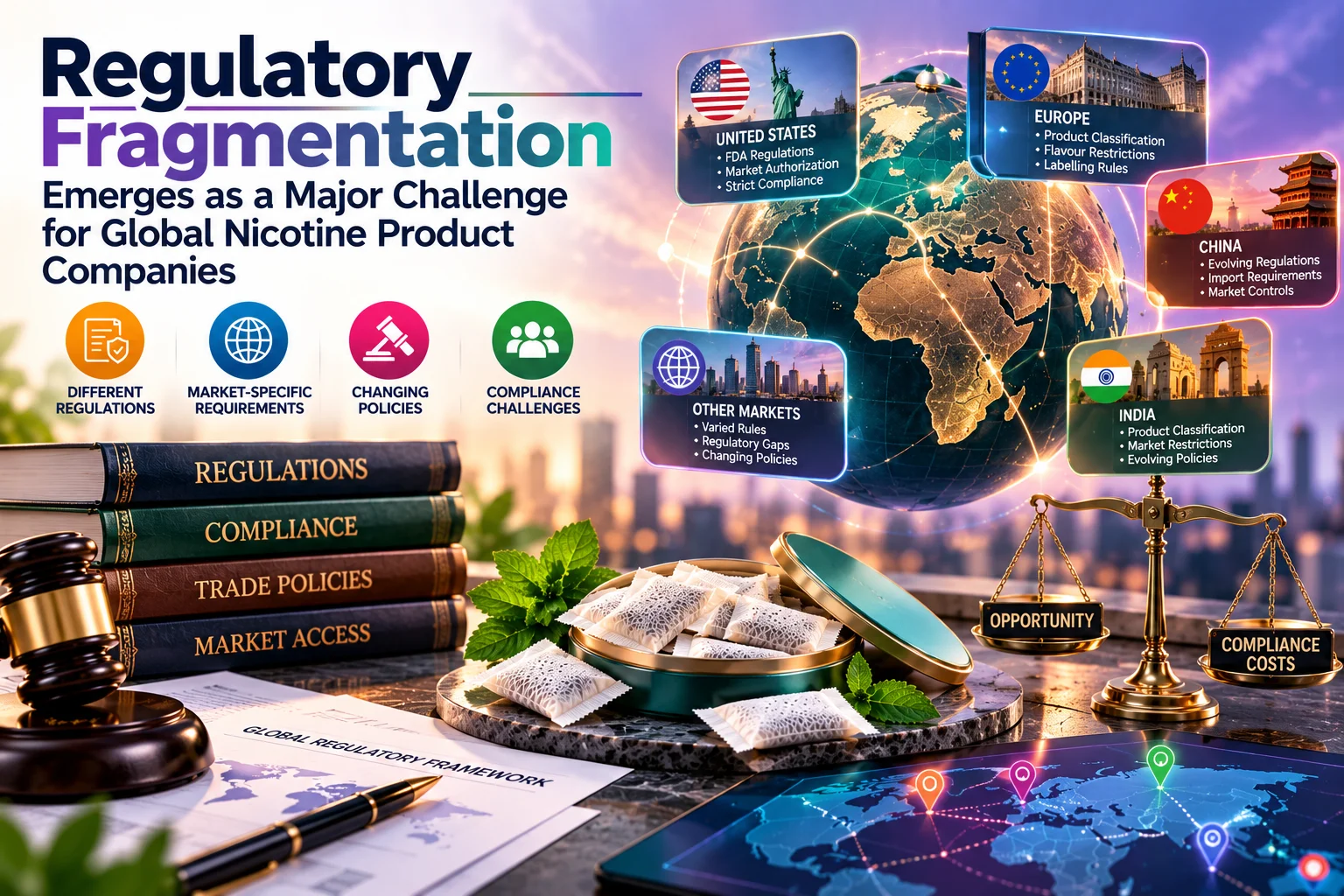
Regulatory Fragmentation Emerges as a Major Challenge for Global Nicotine Product Companies
Regulatory fragmentation is emerging as one of the major challenges for global nicotine product companies as governments introduce different rules for nicotine pouches and other emerging nicotine formats.
While the global nicotine industry continues to expand and manufacturers develop new products, companies operating across multiple markets are increasingly required to navigate different rules covering product classification, nicotine levels, flavours, packaging, labelling, advertising, sales and market authorization.
The issue is particularly visible in the nicotine pouch category, where regulatory approaches vary substantially between countries.
Regulatory Rules Differ Across Global Markets
Nicotine products do not follow a single global regulatory framework.
Instead, individual countries may classify and regulate products differently depending on their composition, intended use and existing tobacco, consumer-product, pharmaceutical or other legislation.
This creates additional complexity for companies that want to manufacture a product for several international markets.
A formulation that meets the requirements of one country may require changes before it can be introduced into another market.
The regulatory differences can include:
- Product classification
- Maximum nicotine concentration
- Permitted ingredients
- Flavour restrictions
- Packaging requirements
- Health warnings
- Minimum purchase age
- Advertising restrictions
- Online sales rules
- Product notification or authorization
- Import and customs requirements
The European Union provides a clear example of this fragmented environment. A 2026 European Commission staff working document notes that nicotine pouches are not currently covered by the EU tobacco-control framework and that Member States have adopted different national approaches, including bans, nicotine-content limits, ingredient controls, age restrictions, labelling requirements and notification systems.
Europe Highlights the Complexity of Market-by-Market Compliance
Europe has become one of the clearest examples of regulatory fragmentation in the nicotine pouch market.
Different countries have adopted different approaches to these products. Some have imposed restrictions or bans, while others regulate them through consumer-product, pharmaceutical or tobacco-related frameworks.
This means manufacturers cannot necessarily use one compliance strategy for the entire European market.
For companies planning expansion, each destination country may require a separate review of:
- Product legality
- Nicotine strength
- Ingredients
- Flavour rules
- Packaging
- Labelling
- Advertising
- Retail channels
- Online sales
- Import requirements
Related reading: European Nicotine Pouch Markets Enter a New Phase of Competition and Regulation
The European Commission has also proposed expanding the scope of the EU Tobacco Products Directive to include nicotine pouches and other nicotine products, illustrating that the regulatory framework remains an evolving area.
Global Regulatory Gaps Add Another Layer of Complexity
The challenge is not limited to Europe.
The World Health Organization reported in May 2026 that around 160 countries had no specific regulation for nicotine pouches, while other countries had introduced controls covering areas such as flavours, sales to minors and advertising.
This creates an unusual situation for international manufacturers.
Some markets may have detailed requirements, while others may have limited or no product-specific rules. Companies therefore have to determine not only what the regulations say, but also whether an emerging product fits into an existing legal category.
The WHO has called for comprehensive regulation of nicotine products, including measures related to flavours, advertising, age verification, health warnings, nicotine levels and taxation.
United States Takes a Different Regulatory Approach
The U.S. market demonstrates another model.
The U.S. Food and Drug Administration continues to evaluate nicotine pouch products through the premarket tobacco product framework. In May 2026, the FDA also issued guidance outlining enforcement priorities for unauthorized nicotine pouch and electronic nicotine-delivery products.
This means companies seeking access to the U.S. market need to consider authorization and compliance requirements that may differ significantly from those in European or other international markets.
Related reading: Nicotine Regulations in the United States: Key Rules for 2026
The different regulatory approaches demonstrate why a global nicotine company may need market-specific regulatory strategies rather than relying on a single international compliance model.
Product Development Is Increasingly Connected to Regulation
Regulatory requirements are also beginning to influence product development at an earlier stage.
Manufacturers developing new nicotine products may need to consider regulatory requirements before finalizing:
- Nicotine strength
- Flavour formulation
- Ingredient selection
- Packaging design
- Product claims
- Labelling
- Marketing strategy
- Distribution channels
This is particularly important for companies developing several product variants for different countries.
A formulation developed for one market may need to be modified for another market because of differences in permitted ingredients, nicotine limits or packaging requirements.
Related reading: Global Nicotine Industry Enters a New Phase of Product Development in 2026
The broader nicotine industry is already moving toward greater emphasis on product development, scientific evaluation, quality control and regulatory readiness.
Flavour Regulation Is Becoming a Key Issue
Flavours are another area where international requirements can differ considerably.
Governments and public-health organizations are increasingly examining flavours because of concerns about youth appeal and product marketing.
The WHO’s 2026 report specifically highlights youth-appealing flavours and digital marketing as regulatory concerns surrounding nicotine pouches.
For manufacturers and exporters, this means a flavour portfolio may need to be reviewed separately for each destination market.
Related reading: Cross-Border Shipping Rules Tighten for Flavored Nicotine Products
Cross-border trade requirements can also involve import restrictions, flavour rules, product registration, documentation and customs requirements.
International Trade Becomes More Complicated
Regulatory fragmentation can directly affect international trade.
When countries apply different requirements, exporters may need additional documentation and market-specific product information before shipping.
Potential areas of concern include:
- Import eligibility
- Product registration
- Customs documentation
- Nicotine concentration
- Ingredient compliance
- Packaging and labelling
- Age restrictions
- Online sales
- Advertising rules
For businesses operating across multiple markets, regulatory review therefore becomes part of the supply-chain process rather than a task completed only after product development.
India Also Illustrates Regulatory Complexity
India provides another example of why classification can matter.
The country’s regulatory framework differs depending on the type of nicotine product and how that product is classified. E-cigarettes, for example, are subject to a nationwide prohibition under the Prohibition of Electronic Cigarettes Act, while newer nicotine formats may raise different classification questions.
Related reading: Where India’s Nicotine Rules Actually Stand: A Plain-English Guide to the Patchwork
For companies considering India as a manufacturing, sourcing or distribution market, understanding the applicable regulatory category is therefore important before entering into commercial arrangements.
What Regulatory Fragmentation Means for B2B Buyers
The changing regulatory environment also affects B2B buyers.
A buyer sourcing nicotine-related products internationally may need to evaluate more than price and product specifications.
Important considerations can include:
- Destination-market legality
- Product classification
- Nicotine concentration
- Ingredient requirements
- Quality documentation
- Packaging and labelling
- Import requirements
- Product registration
- Supplier documentation
- Batch traceability
A supplier that understands market-specific documentation and product specifications can provide additional value to international buyers.
Compliance and Supply-Chain Planning Are Becoming Connected
As regulations become more market-specific, compliance and supply-chain planning are becoming increasingly connected.
Manufacturers may need to maintain detailed records covering raw materials, formulations, testing, product specifications and batch information.
This can become particularly important when a company supplies customers across several countries with different regulatory requirements.
Related reading: Why Batch Traceability Is Becoming More Important in the Global Nicotine Supply Chain
Strong documentation and traceability can help companies respond more efficiently when regulatory requirements change or customers request additional information.
A More Market-Specific Nicotine Industry
The global nicotine industry is moving into a period where regulatory knowledge is becoming almost as important as product innovation.
Companies continue to invest in new nicotine pouch formats, strengths and formulations, but commercial expansion increasingly depends on whether products can meet the requirements of individual markets.
The World Health Organization’s 2026 assessment highlights the scale of regulatory gaps, while the European Union and United States demonstrate how different jurisdictions are developing their own approaches to emerging nicotine products.
Outlook for Global Nicotine Product Companies
Regulatory fragmentation is likely to remain a major challenge for global nicotine product companies throughout 2026 and beyond.
As governments continue reviewing nicotine pouches and other emerging products, manufacturers, suppliers, exporters and B2B buyers will need to monitor regulatory changes more closely.
The companies best positioned to operate internationally may be those that combine product innovation with strong quality systems, reliable documentation and market-specific regulatory planning.
For the global nicotine industry, the next phase of growth may therefore depend not only on developing new products, but also on understanding where, how and under which regulatory framework those products can be marketed.