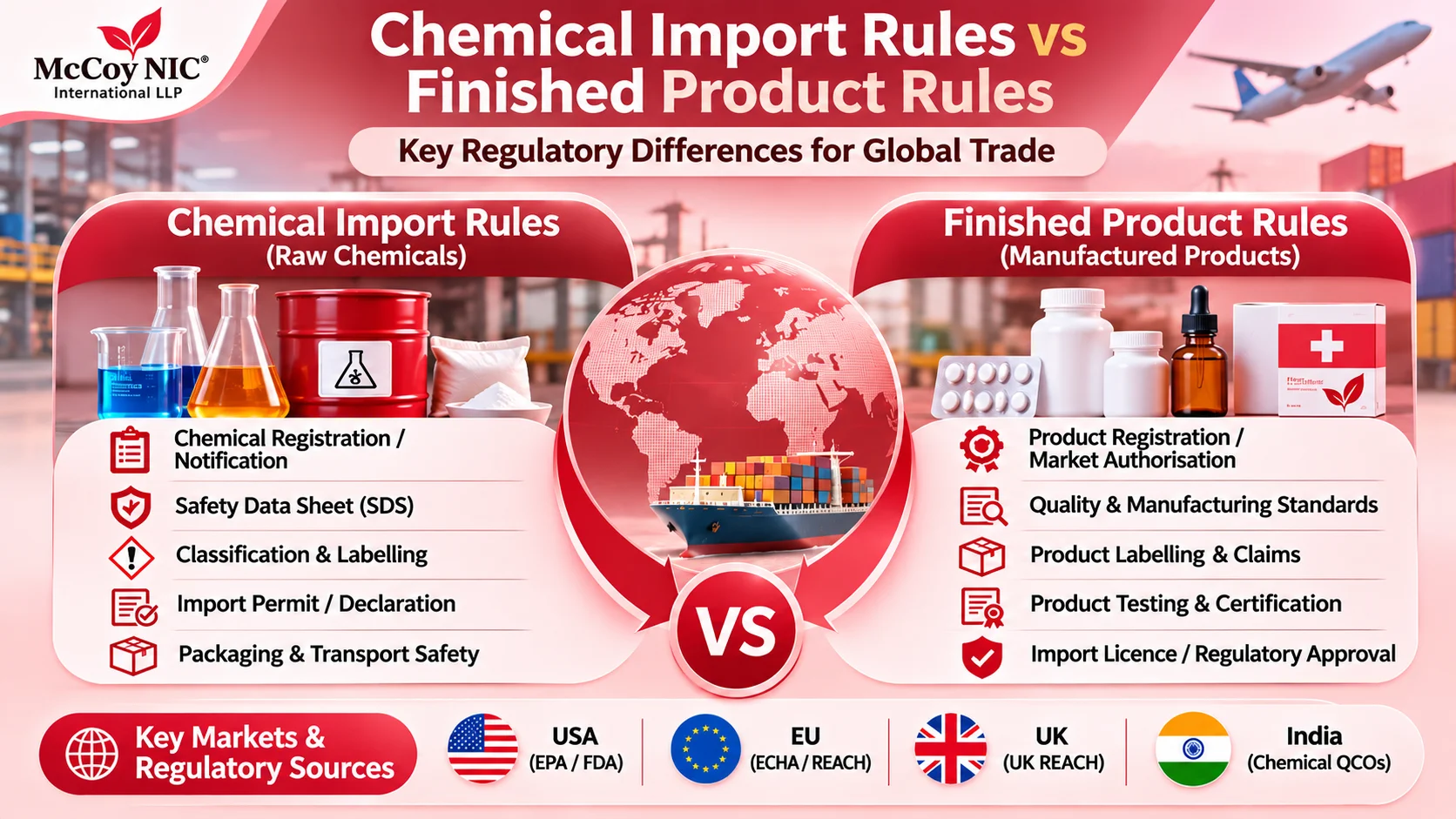
Chemical Import Rules vs Finished-Product Rules: Key Differences Businesses Should Understand
International trade regulations can vary significantly depending on whether a business imports a chemical substance as a raw material or brings in a finished product containing that substance. Although both categories may involve similar chemical ingredients, their regulatory requirements, documentation obligations and product compliance procedures are not necessarily the same.
Understanding chemical import rules vs finished product rules is important for manufacturers, pharmaceutical companies, specialty chemical suppliers, distributors and international buyers.
A chemical imported for industrial processing may be subject to substance registration, chemical classification, safety documentation and import certification requirements. A finished product, on the other hand, may fall under additional regulations covering its intended use, product category, labelling, safety standards and market authorisation.
However, there is no single international rule that applies to every chemical or finished product. Requirements depend on the destination country, chemical identity, formulation, product classification and intended application.
1. What Are Chemical Import Rules?
Chemical import rules are regulations governing the entry of individual chemical substances, mixtures and certain chemical-containing materials into a country.
These requirements are generally designed to manage potential risks to human health, workplace safety and the environment.
Depending on the jurisdiction and chemical category, importers may need to consider:
- Chemical registration or notification requirements.
- Chemical inventory compliance.
- Hazard classification and labelling.
- Safety Data Sheet (SDS) requirements.
- Import permits or regulatory declarations.
- Restrictions on specific chemical substances.
- Packaging, handling and transportation requirements.
- Customs classification and import documentation.
For example, the United States regulates chemical imports under the Toxic Substances Control Act (TSCA). The US Environmental Protection Agency (EPA) explains that importers may need to provide TSCA import certification and ensure that applicable chemical requirements are satisfied.
Official reference: US EPA – TSCA Requirements for Importing Chemicals.
2. What Are Finished-Product Import Rules?
Finished-product import rules apply to products that have been manufactured, formulated or assembled and are intended to be supplied for a particular commercial or consumer application.
These products may contain one or more chemical ingredients, but their regulatory treatment can depend on the finished product’s category and intended use.
Examples include:
- Pharmaceutical products and medicines.
- Nicotine replacement therapy (NRT) products.
- Cosmetics and personal care products.
- Industrial cleaning formulations.
- Consumer chemical products.
- Electronic products containing regulated substances.
- Finished tobacco and nicotine-containing products.
Depending on the product category, importers may need to consider:
- Product registration or market authorisation.
- Manufacturing and quality standards.
- Product-specific safety assessments.
- Ingredient and formulation disclosures.
- Packaging and labelling requirements.
- Product testing and certification.
- Import licences and regulatory approvals.
- Post-market monitoring and traceability.
For example, pharmaceutical products may require regulatory authorisation and compliance with applicable pharmaceutical quality requirements. In the United States, the FDA reviews imported FDA-regulated products to determine their admissibility under the applicable laws.
Official reference: US FDA – FDA Import Process.
3. Chemical Imports vs Finished Products: Key Differences
Although both categories may be subject to customs and safety regulations, their compliance requirements can differ.
| Compliance Area | Chemical Imports | Finished Products |
|---|---|---|
| Main classification | Chemical substance or mixture | Product category and intended use |
| Registration | Chemical registration may apply | Product-specific registration may apply |
| Safety documentation | SDS and chemical hazard information | Product safety and technical documentation |
| Labelling | Chemical hazard and handling labels | Product-specific labelling |
| Quality requirements | Chemical identity, purity and specifications | Finished-product specifications and testing |
| Import approvals | Chemical-specific permits or notifications, where applicable | Product-specific licences or authorisations, where applicable |
| Customs classification | Depends on chemical identity and composition | Depends on product characteristics and classification |
The distinction is important because compliance with chemical import requirements does not automatically establish that a finished product is approved for sale or distribution.
Similarly, a finished-product approval should not automatically be treated as satisfying every separate chemical or import obligation.
4. How Regulations Differ Across Major Markets
Different countries use different regulatory frameworks to control chemical substances and finished products.
United States
The United States applies the Toxic Substances Control Act (TSCA) to relevant chemical substances and mixtures.
Importers must evaluate whether the imported material is subject to TSCA and whether positive or negative import certification is required.
Certain products, such as drugs, cosmetics, food and pesticides, may fall under different regulatory frameworks or exclusions from particular TSCA provisions. However, this does not mean that they are exempt from all federal import requirements.
Finished pharmaceutical products and other FDA-regulated goods must meet the applicable FDA requirements for importation.
Useful official sources:
European Union
The European Union regulates chemicals through the Registration, Evaluation, Authorisation and Restriction of Chemicals (REACH) framework.
Depending on the product category, importers may need to evaluate substance registration, classification, labelling, packaging and restrictions.
Under REACH, importers bringing substances into the European Economic Area may have responsibilities similar to manufacturers. Mixtures also require consideration of the individual substances they contain.
Finished articles can have different obligations, including requirements relating to substances of very high concern (SVHCs) and substances intended to be released during normal use.
Products covered by more specific legislation, such as medicines, may also have additional regulatory requirements.
Useful official source:
European Chemicals Agency (ECHA) – Importer Responsibilities.
United Kingdom
The United Kingdom operates its own UK REACH framework.
Businesses importing chemicals into Great Britain must understand their role in the supply chain and assess the applicable registration, restriction and safe-use communication requirements.
Finished products may also be subject to relevant sector-specific regulations.
Official source:
UK Health and Safety Executive – UK REACH Explained.
India
In India, chemical imports may be subject to customs requirements, applicable chemical-specific restrictions and mandatory quality standards.
The Department of Chemicals and Petrochemicals publishes information on Quality Control Orders (QCOs) covering specified chemicals.
Where a QCO applies, the relevant product may need to comply with the prescribed Indian Standard and applicable BIS certification requirements.
Importers should verify the exact chemical, tariff classification, applicable notification and enforcement date rather than assuming that every chemical import is covered by the same requirements.
Finished products may additionally fall under sector-specific frameworks, including pharmaceutical, cosmetic, food or consumer-product regulations, depending on their classification and intended use.
Useful official source:
Department of Chemicals and Petrochemicals – Chemicals Quality Control Orders.
5. Why Product Classification Matters During Import
Correct product classification is one of the most important parts of international trade compliance.
A chemical substance, a chemical mixture and a finished consumer product may have different customs classifications and regulatory obligations.
Importers should consider:
- Chemical composition and product identity.
- Whether the material is supplied as a pure substance or mixture.
- Whether further manufacturing or processing is required.
- The intended industrial, pharmaceutical or consumer application.
- The product’s physical form and presentation.
- Applicable HS classification and national tariff requirements.
For example, a pharmaceutical ingredient imported for further formulation should not automatically be treated as an authorised finished medicine.
Similarly, a finished product containing a regulated chemical may require additional product-specific checks.
Businesses should obtain appropriate customs classification advice and verify applicable regulations with the destination country’s authorities before shipping.
6. Documentation Requirements for Chemical and Finished-Product Imports
Documentation requirements depend on the product, destination market and applicable regulatory framework.
Common Documents for Chemical Imports
- Commercial Invoice.
- Packing List.
- Certificate of Analysis (CoA), where applicable.
- Safety Data Sheet (SDS).
- Product Specification Sheet.
- Certificate of Origin, where required.
- Chemical registration or notification details, where applicable.
- Import permits or declarations, where required.
- Dangerous Goods Declaration, where applicable.
Common Documents for Finished Products
- Commercial Invoice.
- Packing List.
- Product Specification.
- Certificate of Analysis or test reports, where applicable.
- Manufacturing and quality documentation.
- Product registration or marketing authorisation, where applicable.
- Product labels and ingredient information.
- Applicable safety and conformity certificates.
- Import permits or licences, where required.
An SDS or CoA alone does not establish that a product is legally authorised for import or sale. Importers should confirm the complete documentation requirements for their particular product and destination.
7. Special Considerations for Nicotine and Pharmaceutical Ingredients
Nicotine and pharmaceutical ingredients are particularly important examples of products that require careful classification.
Nicotine may be supplied as a chemical ingredient, a pharmaceutical raw material, a formulated product or a finished nicotine-containing consumer product.
Each category may have different regulatory implications.
For example:
- Pure nicotine supplied as an industrial or pharmaceutical ingredient may require chemical safety and import compliance checks.
- Pharmaceutical-grade nicotine intended for NRT manufacturing may require additional quality documentation and assessment against the relevant pharmaceutical standards.
- Finished NRT products may be subject to product-specific pharmaceutical authorisation and labelling requirements.
- Consumer nicotine products may fall under separate tobacco or consumer-product regulatory frameworks.
Businesses should not assume that the regulatory status of a raw ingredient automatically determines the status of the finished product.
For pharmaceutical applications, manufacturers and buyers should review the applicable specifications, batch-specific CoA, analytical methods, impurity controls and relevant quality documentation.
Further reading: Pharmaceutical Grade Nicotine for NRT – McCoy NIC.
8. Common Compliance Mistakes Businesses Should Avoid
Importers and manufacturers can face unnecessary delays when they confuse chemical import requirements with finished-product regulations.
Some common mistakes include:
- Using an incorrect HS code or product description.
- Assuming that a chemical import approval covers finished-product sales.
- Treating an SDS as a substitute for all required regulatory documentation.
- Ignoring product-specific registration requirements.
- Overlooking changes in chemical classification or restrictions.
- Failing to verify the effective date of a regulatory notification.
- Assuming that the same requirements apply in every destination country.
- Dispatching goods before confirming import permissions and documentation.
A structured compliance review before shipment can help reduce these risks.
9. How Businesses Can Build an Effective Import Compliance Process
Companies involved in international chemical trade should establish a standard compliance process for every destination market.
A practical process includes:
Step 1: Identify the product category
Determine whether the shipment contains a raw chemical, mixture, pharmaceutical ingredient or finished product.
Step 2: Confirm the destination country’s regulations
Review the relevant customs and regulatory authority requirements.
Step 3: Verify classification
Confirm the applicable customs tariff classification and product-specific regulatory category.
Step 4: Prepare documentation
Collect the required technical, safety, quality and commercial documents.
Step 5: Review import permissions
Check whether registrations, permits, licences or notifications are required.
Step 6: Complete a pre-shipment compliance review
Verify that the product description, packaging, labels and shipment documents are consistent with applicable requirements.
Step 7: Maintain records
Keep regulatory approvals, declarations, test reports and shipment records available for future audits and inspections.