EU REACH and CLP Considerations for Nicotine Supply Chains
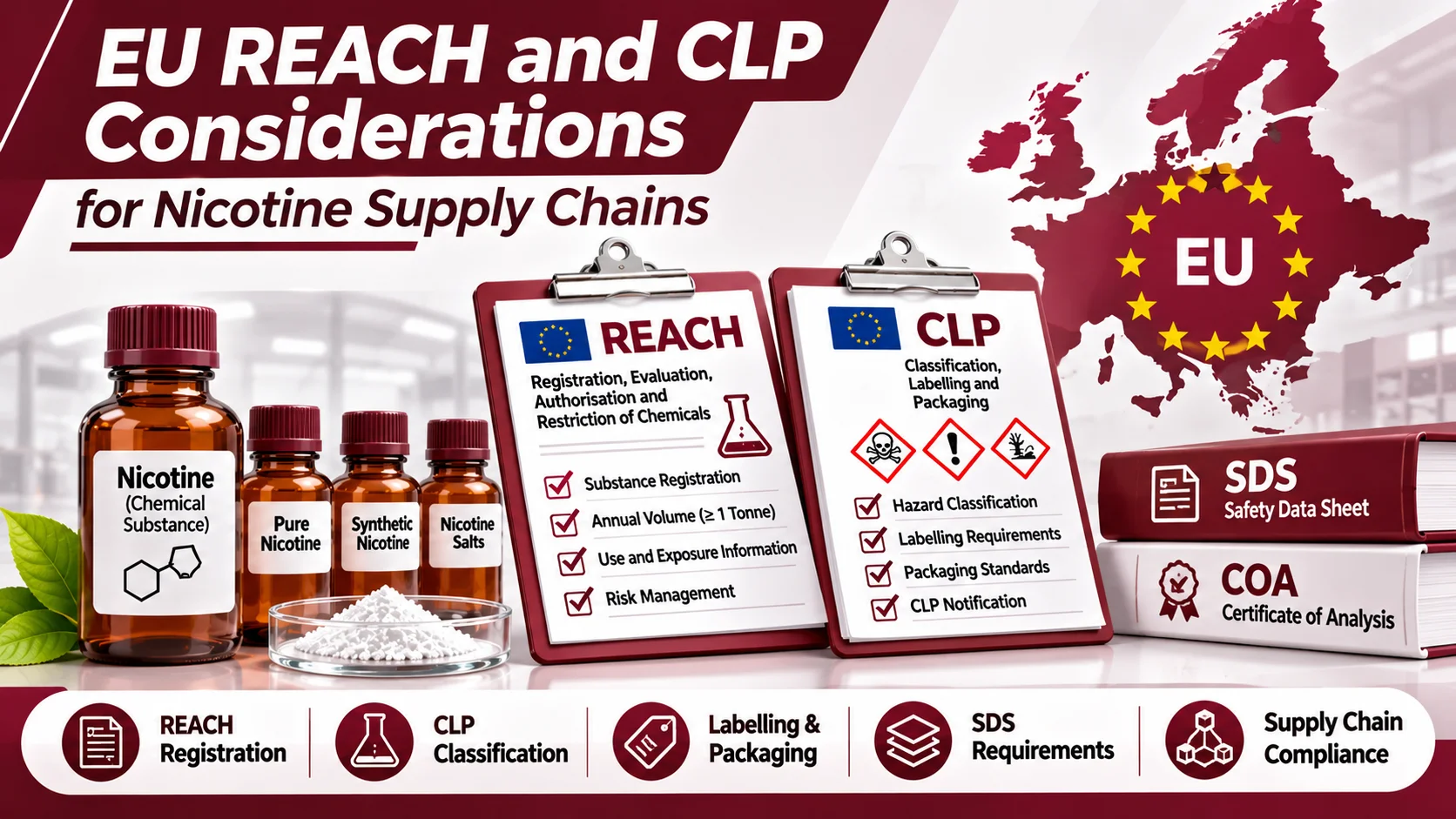
EU REACH and CLP Considerations are becoming increasingly important for companies supplying, importing and distributing nicotine ingredients across European markets. Businesses handling tobacco-derived nicotine, synthetic nicotine, pure nicotine and nicotine salts must understand how EU chemical regulations affect substance registration, hazard classification, labelling, packaging and supply-chain communication.
For international suppliers, regulatory compliance should be considered before shipping nicotine materials to an EU-based customer. The responsibilities of an importer may differ from those of a non-EU manufacturer, distributor or downstream user, depending on the product and the company’s role in the supply chain.
Understanding these differences can help businesses prepare appropriate technical documentation and support smoother procurement and distribution activities.
1. What Are REACH and CLP Regulations?
The European Union uses two major regulatory frameworks to manage chemical substances and communicate their hazards.
REACH stands for Registration, Evaluation, Authorisation and Restriction of Chemicals. Regulation (EC) No 1907/2006 establishes responsibilities for companies manufacturing or importing chemical substances into the European Economic Area (EEA).
CLP stands for Classification, Labelling and Packaging. Regulation (EC) No 1272/2008 establishes requirements for identifying chemical hazards and communicating them through appropriate labels and packaging.
Both regulations are relevant to chemical supply chains, but they serve different purposes.
- REACH focuses on substance registration, evaluation, authorisation and restrictions.
- CLP focuses on hazard classification, labelling and packaging.
- Safety Data Sheets communicate relevant safety and risk-management information.
- Supply-chain communication helps businesses understand how chemicals should be handled and used safely.
The European Commission explains that REACH places responsibility on industry to identify and manage chemical risks and provide relevant safety information. Companies can review the European Commission’s official REACH overviewfor further information.
2. REACH Registration: What Should Nicotine Importers Know?
Under REACH, EU-based manufacturers and importers generally need to register substances manufactured or imported at one tonne or more per year per legal entity, subject to applicable exemptions.
The registration process requires companies to collect information about the substance’s identity, properties, uses and potential risks. This information is submitted to the European Chemicals Agency (ECHA) through the appropriate registration process.
For nicotine supply chains, companies should establish:
- Exact chemical substance identity.
- Chemical name and relevant identifiers.
- Substance composition and purity.
- Annual import volume.
- Intended and identified uses.
- Relevant hazard and safety information.
- Applicable registration or exemption status.
An important point is that the threshold is assessed for the substance and legal entity, not simply for an individual shipment.
For example, an EU importer receiving several shipments of the same substance during a calendar year should assess the total relevant annual quantity rather than evaluating each shipment in isolation.
ECHA explains the registration obligations and the one-tonne threshold in its official REACH registration guidance.
Key compliance question: Does every nicotine shipment automatically require a new REACH registration?
No. The requirement depends on the substance, annual quantity, legal entity, applicable exemptions and whether an existing registration covers the relevant obligations and uses.
3. Who Is Responsible: EU Importer or Non-EU Nicotine Supplier?
The allocation of responsibilities is an important consideration for international nicotine suppliers.
Under REACH and CLP, the legal responsibilities generally fall on relevant EU/EEA-established entities. A non-EU manufacturer does not directly become an EU importer simply because it exports a chemical to Europe.
The EU-based importer may have obligations relating to substance registration, classification, labelling, packaging and supply-chain communication.
However, a non-EU manufacturer can support its EU customers by providing accurate technical and safety information.
For example, a nicotine supplier outside the EU may provide:
- Chemical identity and product specification.
- Batch-specific Certificate of Analysis (COA).
- Safety Data Sheet (SDS).
- Manufacturing and quality information.
- Relevant hazard and impurity information.
- Information about intended applications.
What Is an Only Representative?
REACH provides a mechanism known as an Only Representative (OR).
A non-EU manufacturer, formulator or article producer may appoint an eligible legal entity established in the EU/EEA to fulfil relevant REACH obligations on behalf of its EU importers.
When an appointment is valid and the relevant conditions are fulfilled, the covered EU importers are generally treated as downstream users for the substances and quantities covered by the Only Representative arrangement.
This can be an important consideration for non-EU nicotine manufacturers supplying multiple European customers.
ECHA explains these responsibilities in its guidance for non-EU companies under REACH and CLP.
4. CLP Classification: Identifying the Hazards of Nicotine Materials
CLP requires substances and mixtures placed on the EU market to be assessed and classified according to their relevant hazardous properties.
For nicotine supply chains, the classification assessment should be based on the actual substance or mixture, available scientific information and applicable CLP criteria.
Companies should not assume that every nicotine material has identical classification requirements simply because it contains nicotine.
Relevant considerations include:
- Chemical identity and composition.
- Available toxicological information.
- Physical and chemical properties.
- Environmental hazard information.
- Concentration of hazardous ingredients in mixtures.
- Applicable harmonised classification entries, where relevant.
Once a substance or mixture is classified as hazardous, the appropriate hazard communication requirements must be followed.
ECHA explains the classification framework and supplier responsibilities in its official CLP regulation guidance.
Key compliance question: Is CLP classification required only for substances above one tonne per year?
No. The REACH registration threshold and CLP classification obligations are different. CLP classification and relevant notification obligations can apply irrespective of the REACH one-tonne threshold.
5. CLP Labelling and Packaging Requirements
Where a nicotine substance or mixture is classified as hazardous, its labelling and packaging must comply with applicable CLP requirements before being placed on the EU market.
Depending on the classification and applicable rules, the label may need to include:
- Product identifier.
- Supplier identification and contact details.
- Hazard pictograms.
- Signal word.
- Hazard statements.
- Precautionary statements.
- Supplemental information, where required.
Packaging must also be designed to prevent unintended leakage and withstand normal handling and transport conditions.
The exact requirements depend on the hazard classification, packaging type, intended user and applicable legal provisions.
For businesses supplying nicotine ingredients, it is important to ensure that product labels, technical specifications and SDS information remain consistent.
ECHA provides details on these requirements in its CLP labelling and packaging guidance.
6. Safety Data Sheets: An Important Part of Nicotine Supply-Chain Compliance
A Safety Data Sheet is an essential source of information for communicating chemical hazards and appropriate risk-management measures.
Under REACH, an SDS must be provided when required by the relevant provisions. Importers and suppliers should ensure that the document is accurate, complete and appropriate for the material being supplied.
For nicotine ingredients, relevant SDS information may include:
- Identification of the substance or mixture.
- Hazard identification.
- Composition and ingredient information.
- First-aid measures.
- Firefighting measures.
- Accidental release procedures.
- Handling and storage precautions.
- Exposure controls and personal protection.
- Physical and chemical properties.
- Toxicological and ecological information.
- Transport information.
- Regulatory information.
The SDS should be consistent with the actual product composition and applicable hazard classification.
For EU supply chains, businesses should also consider the applicable SDS format and content requirements under REACH Annex II, including relevant amendments.
ECHA explains the importer’s responsibility to provide safety information and communicate hazards in its guidance on supply-chain responsibilities.
7. CLP Notification: When Must Companies Notify ECHA?
CLP includes notification obligations for certain substances placed on the EU market.
Manufacturers and importers may need to submit classification and labelling information to ECHA’s Classification and Labelling Inventory when the relevant conditions are met.
These include situations where:
- A substance is subject to REACH registration.
- A substance is classified as hazardous, irrespective of quantity.
- A hazardous substance is imported as part of a mixture above relevant concentration limits, resulting in the mixture being classified as hazardous.
The notification generally needs to be submitted within one month of placing the substance on the market, where the applicable obligation is triggered.
The responsible company should verify whether the information is already covered through a relevant REACH registration submission or another permitted notification route.
ECHA provides further details in its official CLP notification guidance.
8. Supply-Chain Communication: What Information Should Nicotine Suppliers Share?
REACH and CLP compliance requires effective information exchange between manufacturers, importers, distributors and downstream users.
A non-EU nicotine supplier should be prepared to provide its European customer with accurate technical information needed to assess regulatory responsibilities.
A practical documentation package may include:
| Document or information | Compliance purpose |
|---|---|
| Product Specification | Confirms product identity and technical parameters |
| Certificate of Analysis | Provides batch-specific quality results |
| Safety Data Sheet | Communicates hazards and safe handling information |
| Chemical Identity | Supports substance identification |
| Composition Information | Supports classification and regulatory assessment |
| Manufacturing Information | Supports supplier qualification and traceability |
| Intended Use | Helps assess relevant registration and exposure information |
| REACH Registration Information | Supports verification of applicable registration status |
| CLP Classification Information | Supports hazard communication and labelling |
A COA and SDS are important documents, but they do not independently establish REACH registration or full regulatory compliance.
Suppliers should also maintain a process for communicating changes in product composition, specifications, hazard information and relevant safety recommendations.
9. How Do Nicotine Product Categories Affect Regulatory Assessment?
Nicotine supply chains may involve different materials, including tobacco-derived nicotine, synthetic nicotine, pure nicotine and nicotine salts.
The chemical identity and composition of the actual substance are important when determining REACH and CLP obligations.
A product’s commercial description alone is not sufficient to establish its regulatory status.
For example, the terms “synthetic nicotine” and “tobacco-derived nicotine” describe different sources, but REACH and CLP assessments must still consider the actual chemical substance and applicable regulatory information.
Similarly, a nicotine salt may require its own substance identity and classification assessment rather than automatically adopting the same documentation as another nicotine form.
Businesses evaluating nicotine materials can review McCoy NIC’s product information on:
For finished electronic cigarettes and refill containers, additional requirements under Article 20 of the Tobacco Products Directive may apply, including product notification and specific safety and quality provisions. These requirements should not be confused with REACH and CLP obligations for raw chemical ingredients.
The European Commission explains these separate requirements in its official electronic cigarette regulatory guidance.
10. Practical REACH and CLP Readiness Checklist for Nicotine Suppliers
Before supplying nicotine ingredients to an EU customer, international manufacturers and exporters should consider the following preparation steps:
- Confirm the exact chemical identity of the nicotine material.
- Prepare an accurate product specification.
- Maintain batch-specific COAs.
- Prepare an SDS that meets applicable requirements.
- Provide relevant composition and hazard information.
- Confirm whether the EU importer has assessed REACH registration obligations.
- Discuss whether an Only Representative arrangement is relevant.
- Verify the applicable CLP classification.
- Review labelling and packaging requirements.
- Maintain records of product changes and supply-chain communication.
This approach can help suppliers respond more efficiently to customer documentation requests and support better regulatory coordination.
Conclusion: Building a More Compliant European Nicotine Supply Chain
REACH and CLP play different but complementary roles in the European chemical regulatory framework. REACH establishes responsibilities for substance registration and risk management, while CLP governs hazard classification, labelling and packaging.
For nicotine manufacturers, suppliers and importers, the most important steps are to establish accurate substance identity, understand the responsibilities of the EU-based importer, prepare appropriate technical documentation and assess the applicable registration and classification requirements.
A well-organised supply-chain documentation process can help reduce regulatory uncertainty and support responsible business relationships across European markets.
Regulatory disclaimer: This article is intended for general industry information and does not constitute legal or regulatory advice. REACH and CLP obligations depend on the exact substance, annual quantity, company role, intended use and applicable exemptions. Businesses should verify current requirements with ECHA, relevant national authorities and qualified regulatory professionals before placing nicotine materials on the EU/EEA market.