FDA Non-Tobacco Nicotine PMTA: Chiral Isomer Testing and Regulatory Updates
FDA non-tobacco nicotine PMTA requirements are an important consideration for manufacturers, importers and suppliers involved in the US nicotine market. The US Food and Drug Administration (FDA) regulates tobacco products containing nicotine from any source, including non-tobacco nicotine (NTN) and synthetic nicotine. For manufacturers preparing a Premarket Tobacco Product Application (PMTA), product identity, nicotine composition, analytical methods and supporting scientific data all matter.
For companies evaluating synthetic nicotine and its available isomer specifications, understanding enantiomeric purity is particularly relevant. Buyers comparing it with tobacco-derived nicotine should also distinguish the source of nicotine from its measured chemical composition.
1. FDA Regulation Covers Nicotine From Any Source
The regulatory position changed in 2022, when federal legislation clarified FDA authority over products containing nicotine from sources other than tobacco. This includes synthetic nicotine, often described as non-tobacco nicotine or tobacco-free nicotine.
Manufacturers seeking to legally market a new tobacco product in the United States generally need to submit the applicable premarket application and receive FDA marketing authorization before marketing the product.
A product does not become exempt from FDA requirements simply because its nicotine is manufactured synthetically rather than extracted from tobacco.
2. What Is a PMTA?
A Premarket Tobacco Product Application is a submission to FDA seeking authorization to market a new tobacco product in the United States.
The application is expected to provide scientific and technical information that allows FDA to assess the product under the applicable public-health standard. Depending on the product, the submission may include:
- Product identity, ingredients and composition
- Manufacturing and quality-control information
- Nicotine concentration and relevant chemical characteristics
- Analytical testing methods and validation information
- Harmful and potentially harmful constituent data, where applicable
- Stability and other product-characterization information
- Scientific evidence relevant to the product and its intended use
Submitting an application is not the same as receiving marketing authorization. Companies should not treat a pending application as automatic permission to market a product.
3. Why Chiral Isomer Verification Matters
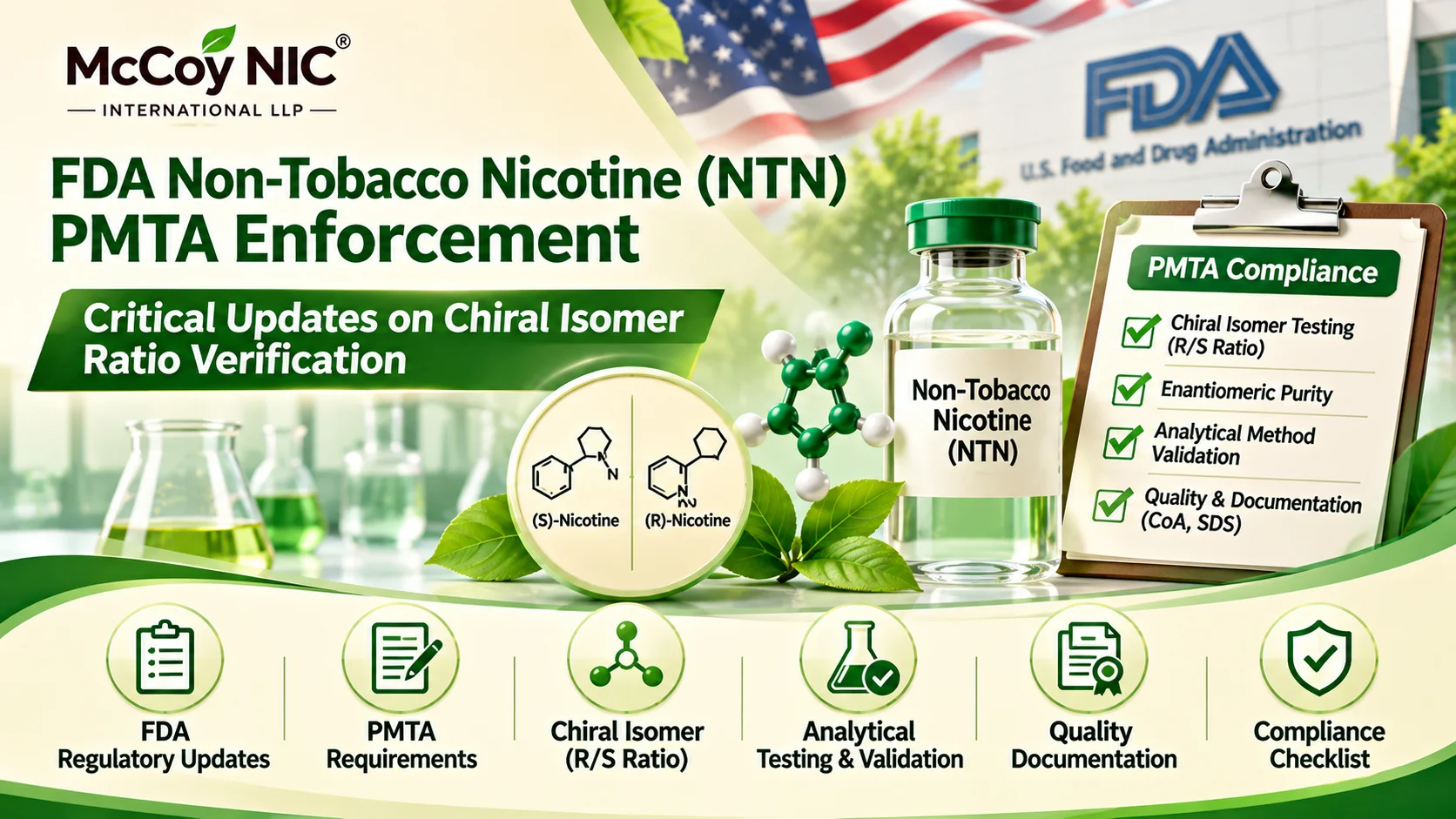
Nicotine exists in two mirror-image molecular forms, known as enantiomers:
- (S)-(-)-nicotine
- (R)-(+)-nicotine
These forms have the same molecular formula but differ in their three-dimensional arrangement. The proportion of each form is commonly described as the R/S ratio or enantiomeric composition.
Nicotine naturally occurring in tobacco is predominantly the (S)-enantiomer. Synthetic nicotine can be manufactured with different enantiomeric compositions, including material that is predominantly (S)-nicotine or a racemic mixture containing both forms.
For this reason, an assay reporting only total nicotine content may not provide all the information needed to characterize the nicotine material. Where relevant to the product and regulatory submission, a separate chiral analytical method can help identify and quantify the individual enantiomers.
4. FDA’s 2026 PMTA Discussion: Enantiomeric Purity
During its February 10, 2026 roundtable on PMTA submissions for electronic nicotine delivery system products, FDA representatives discussed the scientific information expected in applications. The transcript specifically notes that, for non-tobacco nicotine, FDA needs information on enantiomeric purity for scientific review of the PMTA.
This is an important technical point for manufacturers using NTN. It indicates that the composition of the nicotine material, including its enantiomeric profile, can be relevant to FDA’s scientific assessment.
However, this discussion should not be misinterpreted as the announcement of a universal R/S ratio limit. The transcript does not establish a single acceptable ratio for all products, nor does it create a standalone chiral-testing enforcement rule. Applicants should determine the appropriate specifications and supporting data for their specific product and application.
5. Analytical Methods for R/S Nicotine Measurement
Chiral analytical methods are used to separate and measure nicotine enantiomers. The choice of method should be suitable for the material, sample matrix and intended analytical purpose.
Methods discussed in scientific literature include:
- Chiral liquid chromatography
- Chiral gas chromatography
- Polarimetry
- Other specialized analytical approaches described in the scientific literature
A laboratory should demonstrate that its selected method is fit for purpose. Relevant method-performance characteristics may include accuracy, precision, selectivity, sensitivity, robustness and reproducibility.
Where the results are intended to support a regulatory submission, the analytical procedure and its validation or verification documentation should be presented clearly.
6. What Manufacturers Should Include in Their Quality Documentation
Manufacturers and quality teams can consider maintaining a technical documentation package that clearly identifies the material and the tests performed.
Depending on the product and intended regulatory use, relevant records may include:
- Product identity and source declaration
- Nicotine assay and purity results
- Chiral-isomer testing results, where applicable
- Analytical method description and validation or verification report
- Related-substance and impurity profile
- Batch-specific Certificate of Analysis (COA)
- Stability and storage information
- Manufacturing and batch traceability records
A COA should identify the actual batch tested, the analytical method used, the specification and the reported result. A generic specification sheet should not be presented as a substitute for batch-specific test results.
7. FDA Enforcement: Why Authorization Status Matters
FDA continues to take action against new tobacco products marketed without the required premarket authorization. Its enforcement activities may include warning letters and other actions available under the Federal Food, Drug, and Cosmetic Act.
In May 2026, FDA issued final guidance describing enforcement priorities for certain new tobacco products marketed without premarket authorization, including certain electronic nicotine delivery systems and oral nicotine pouch products.
The guidance describes circumstances in which FDA does not intend to prioritize enforcement. It does not grant marketing authorization to products covered by the policy, and it does not mean that every product with a pending application can automatically be marketed.
Manufacturers and importers should therefore verify the authorization status of the specific product and review the current FDA guidance before making US-market decisions.
8. Practical Checklist for NTN Manufacturers
Before preparing or updating a PMTA-related technical package, manufacturers can review the following points:
- Confirm whether the product falls within FDA’s tobacco-product regulatory framework.
- Identify whether the nicotine is tobacco-derived or non-tobacco-derived.
- Define the nicotine composition and relevant isomer specification.
- Confirm whether chiral testing is appropriate for the product and application.
- Use a fit-for-purpose analytical method with supporting validation or verification records.
- Maintain batch-specific COAs and traceability documents.
- Review the current PMTA requirements and FDA guidance.
- Obtain regulatory advice for product-specific questions.
9. What This Means for Nicotine Suppliers and Buyers
The regulatory treatment of nicotine depends on the product and the destination market, not simply on the commercial description of the raw material.
For B2B buyers, supplier qualification should include a review of product identity, source declaration, agreed specifications, relevant analytical results and batch documentation. For manufacturers preparing regulatory submissions, the test method and supporting data should be suitable for the intended scientific assessment.
Companies can also review McCoy NIC’s certifications and compliance documents as part of their supplier-documentation review. The documents applicable to a particular product or batch should always be requested and independently checked.
Conclusion
FDA non-tobacco nicotine PMTA requirements make accurate product characterization and scientific documentation important for manufacturers seeking access to the US market. Chiral-isomer verification can provide additional information about nicotine composition, particularly where enantiomeric purity is relevant to the product’s scientific assessment.
FDA’s February 2026 PMTA roundtable transcript specifically identifies enantiomeric purity information as relevant for the scientific review of non-tobacco nicotine applications. Manufacturers should follow current FDA requirements, use fit-for-purpose analytical methods and avoid assuming that a single R/S ratio threshold applies to every product.
FDA – Regulation and Enforcement of Non-Tobacco Nicotine Products