
Global Nicotine Industry Enters a New Phase of Product Development in 2026
Global Nicotine Industry 2026 is entering a new phase of product development, with manufacturers placing greater emphasis on product formats, formulation, nicotine strength, scientific evaluation and regulatory requirements.
After several years of rapid expansion in newer nicotine categories, the industry is increasingly moving toward a more mature development stage. Manufacturers are now looking beyond simple product launches and focusing on differentiation, quality, consistency and market-specific requirements.
Nicotine Pouches Remain a Major Area of Development
Nicotine pouches continue to be one of the most closely watched segments of the global nicotine market.
The World Health Organization reported that global retail sales of nicotine pouches exceeded 23 billion units in 2024, representing an increase of more than 50% from the previous year. WHO also reported that the global nicotine pouch market was worth nearly US$7 billion in 2025.
This continued market activity is encouraging manufacturers to explore different product formats, strengths, flavours, pouch characteristics and formulation approaches.
At the same time, growing regulatory attention is influencing how these products are developed and marketed.
Product Innovation Becomes More Important
As competition increases, manufacturers are looking for ways to differentiate products while maintaining consistent specifications.
Areas receiving attention include:
- Different nicotine strengths
- Pouch size and format
- Moisture characteristics
- Flavour systems
- Nicotine-release profiles
- Packaging and product presentation
- Manufacturing consistency
The focus is increasingly shifting from simply introducing new products to developing products that can meet specific market, quality and regulatory requirements.
Regulatory Review Is Shaping Product Development
Regulation is becoming an increasingly important part of nicotine product development.
In the United States, the FDA continues to review nicotine pouch products through the premarket tobacco product application pathway. In August 2026, the agency authorized four additional nicotine pouch products under the “on!” brand, including 2 mg and 4 mg products.
The FDA has also authorized additional ZYN ULTRA nicotine pouch products during 2026, demonstrating continued regulatory activity around new nicotine pouch formulations and strengths.
For manufacturers, this means product development increasingly has to take regulatory requirements into account from the early stages.
Scientific Testing and Product Quality Gain Importance
Another important development is the increasing focus on scientific evaluation and quality control.
Manufacturers and laboratories may assess parameters such as nicotine concentration, formulation characteristics, impurities and product consistency depending on the product and applicable requirements.
Scientific evaluation can help manufacturers understand how formulation and product characteristics influence performance and consistency.
As the industry becomes more competitive, reliable analytical data and quality-control processes can become important components of product development.
Global Regulation Remains Uneven
The regulatory environment for nicotine products continues to vary significantly between countries.
WHO reported in May 2026 that around 160 countries had no specific regulation for nicotine pouches, while other countries had introduced restrictions or regulatory controls covering areas such as flavours, sales to minors and advertising.
This regulatory variation creates both opportunities and challenges for manufacturers entering international markets.
Companies developing nicotine products for multiple markets may need to consider differences in product classification, permitted ingredients, nicotine strengths, packaging, labelling, age restrictions and marketing rules.
Manufacturers Focus on More Mature Growth
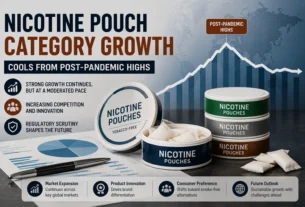
The nicotine pouch category is also showing signs of market maturation in some established markets.
Recent industry analysis indicates that growth rates in certain markets are beginning to normalize after the rapid expansion seen during the post-pandemic period. However, demand remains substantial and manufacturers continue to invest in product development and market expansion.
This changing environment could shift competition toward product quality, innovation, consumer retention, operational efficiency and regulatory compliance.
Supply Chains Are Becoming Part of Product Strategy
Product development is also connected to the availability and consistency of raw materials.
Manufacturers need reliable access to ingredients and nicotine raw materials that meet defined specifications. Consistent supply can become particularly important when companies scale production or introduce multiple product variants.
For suppliers, this creates greater importance around quality documentation, batch consistency, testing and dependable delivery.
What to Watch in the Global Nicotine Industry in 2026
Several developments are likely to remain important during the remainder of 2026:
- Continued nicotine pouch innovation
- New nicotine strengths and product formats
- Greater scientific and analytical evaluation
- Changing flavour and formulation strategies
- Increasing regulatory scrutiny
- Expansion into developing markets
- Stronger focus on product consistency
- Greater attention to supply-chain reliability
These trends are closely connected. Regulatory developments can influence product design, while changes in consumer demand can influence formulation and manufacturing decisions.
Outlook
The global nicotine industry appears to be moving into a more mature phase of product development in 2026.
Rather than relying only on rapid market expansion, manufacturers are increasingly focusing on innovation, product differentiation, scientific evaluation, quality control and regulatory readiness.
Nicotine pouches are likely to remain an important area of industry activity, while regulatory developments and changing market conditions will continue to influence how manufacturers develop and commercialize new products.
For companies operating across the nicotine supply chain, understanding these developments will be important as the industry moves toward its next stage of growth.
Bottom Line: The global nicotine industry in 2026 is increasingly defined by product innovation, scientific evaluation, regulatory developments and supply-chain discipline. Manufacturers that can combine innovation with consistent quality and market-specific compliance may be better positioned for the industry’s next phase.