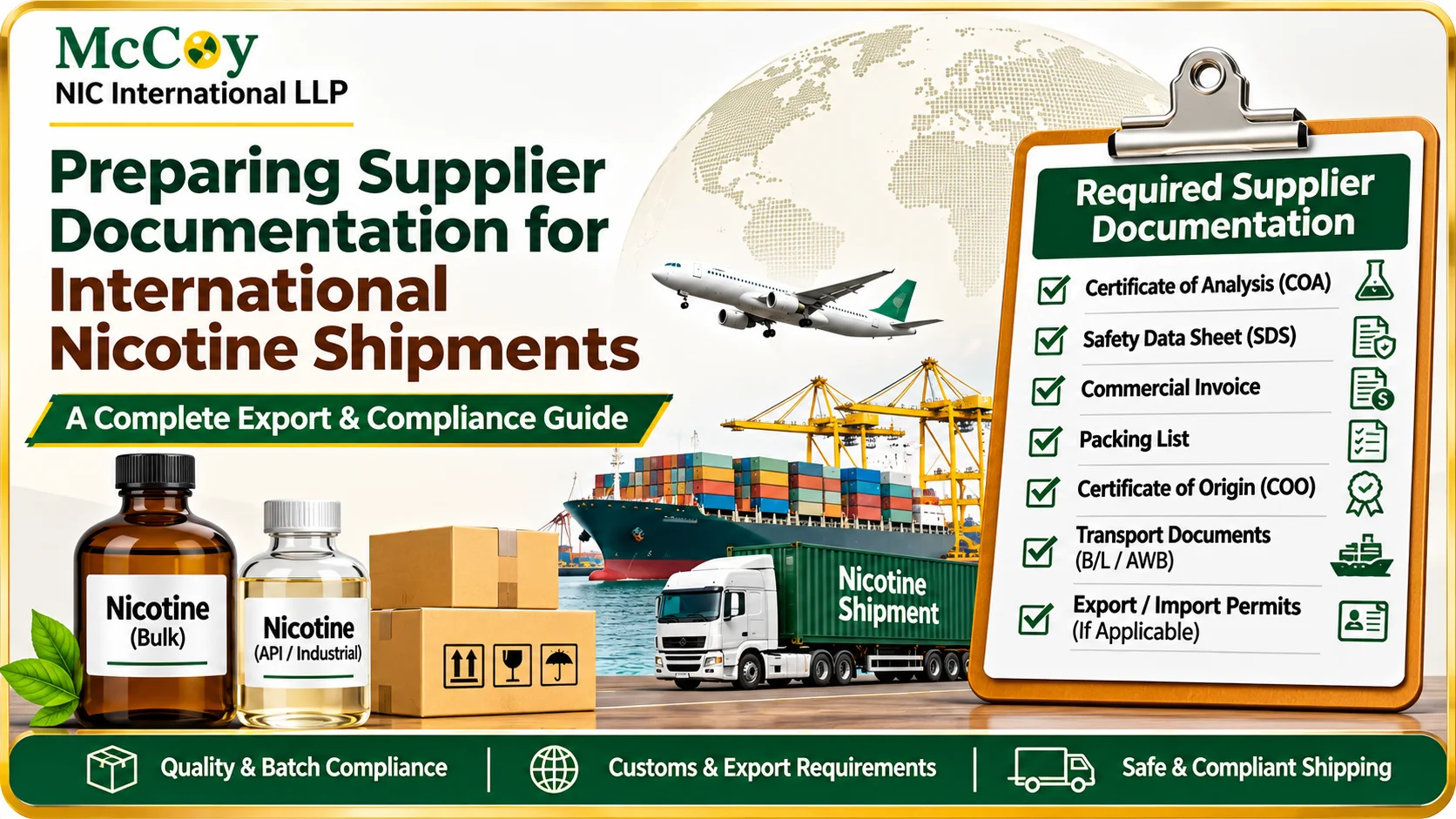
Preparing Supplier Documentation for International Nicotine Shipments: A Complete Guide
International nicotine shipments require careful preparation of supplier, product, safety, and export documentation. For manufacturers, exporters, importers, and procurement teams, accurate paperwork is essential for customs clearance, shipment coordination, product verification, and regulatory compliance.
Nicotine may be supplied as a bulk chemical ingredient, pharmaceutical raw material, or component for a finished product. Each application can involve different regulatory and documentation requirements. Therefore, suppliers should understand the product’s intended use, destination country, transport method, and applicable import restrictions before dispatch.
This guide explains the key documents suppliers should prepare and the checks buyers should complete before arranging international nicotine shipments.
1. Why Supplier Documentation Is Important for International Nicotine Shipments
Supplier documentation provides buyers, customs authorities, freight forwarders, and regulatory agencies with information about the identity, quality, safety, origin, and movement of a shipment.
Proper documentation can help businesses:
- Verify product identity and agreed specifications.
- Confirm batch quality and traceability.
- Support customs declarations and clearance.
- Communicate relevant safety information to logistics providers.
- Meet applicable import and export requirements.
- Reduce errors between purchase orders, invoices, and shipping documents.
- Maintain reliable procurement and compliance records.
Documentation requirements vary according to the product, country of origin, destination market, and mode of transport. Buyers should therefore confirm the required documents before the shipment is booked.
2. Certificate of Analysis (COA)
A Certificate of Analysis (COA) is an important quality document supplied with or in relation to a specific product batch.
It provides analytical results showing whether the material meets the agreed product specifications.
For nicotine shipments, buyers should review the following information where applicable:
- Product name and identification.
- Batch or lot number.
- Manufacturing or testing date.
- Assay or purity result.
- Relevant impurity test results.
- Testing methods or references.
- Specification limits and actual results.
- Authorised approval or quality representative details.
The COA should correspond to the actual batch being shipped. Buyers should check that the product name, batch number, and specifications match the purchase order and other supporting documents.
A COA is a quality document; it should not be treated as a substitute for regulatory authorisation or import permission.
3. Safety Data Sheet (SDS)
A Safety Data Sheet (SDS) communicates important information about a chemical’s hazards, safe handling, storage, exposure controls, and emergency procedures.
For nicotine-related materials, suppliers should provide an SDS that accurately identifies the product and reflects its current classification.
The SDS generally follows a 16-section format, including:
- Identification of the substance or mixture and supplier.
- Hazard identification.
- Composition and information on ingredients.
- First-aid measures.
- Fire-fighting measures.
- Accidental release measures.
- Handling and storage.
- Exposure controls and personal protection.
- Physical and chemical properties.
- Stability and reactivity.
- Toxicological information.
- Ecological information.
- Disposal considerations.
- Transport information.
- Regulatory information.
- Other information.
Buyers and logistics providers should pay particular attention to Section 14, which contains transport-related information.
The applicable transport classification must be verified using the product’s actual characteristics and the relevant transport regulations. A supplier should not copy a classification from another nicotine product without checking whether it applies.
Official reference: UNECE – Globally Harmonized System of Classification and Labelling of Chemicals (GHS).
4. Commercial Invoice and Packing List
Commercial invoices and packing lists are essential documents in international trade.
Commercial Invoice
The commercial invoice records the transaction between the exporter and importer.
It commonly includes:
- Exporter and buyer details.
- Invoice number and date.
- Product description.
- Quantity and unit of measurement.
- Unit price and total value.
- Currency.
- Country of origin, where required.
- Applicable delivery and payment terms.
- Relevant product or customs information.
The description and quantity should accurately reflect the goods being shipped.
Packing List
The packing list provides physical details about the shipment and its packages.
It generally includes:
- Product and package descriptions.
- Number and type of packages.
- Net and gross weight.
- Package dimensions.
- Marks and identification numbers.
- Packaging details.
- Shipment reference information.
The packing list should match the commercial invoice and the actual packed cargo.
Reference: U.S. International Trade Administration – Common Export Documents.
5. Certificate of Origin and Product Traceability
A Certificate of Origin (COO) identifies the country in which goods originate, according to the applicable origin rules.
It may be required by the importing country, customs authorities, or the buyer. It can also be relevant when claiming preferential tariff treatment under an applicable trade agreement.
For nicotine suppliers, product traceability is also important. Buyers may request supporting records covering:
- Manufacturer identification.
- Manufacturing location.
- Batch and lot numbers.
- Raw material origin, where relevant.
- Manufacturing or processing information.
- Relevant quality records.
Tobacco-derived and synthetic nicotine may have different source and manufacturing records. Suppliers should describe the actual source and manufacturing route accurately rather than using generic or interchangeable descriptions.
6. Transport Documents and Dangerous Goods Requirements
International shipments may travel by air, sea, or road. Each transport mode has its own documentation and handling requirements.
Common transport documents include:
Bill of Lading (B/L): Generally used for sea freight as a receipt for goods and evidence of the contract of carriage.
Air Waybill (AWB): Used for air freight as a transport document issued by the carrier or its agent.
Shipping Bill: An export customs document used for shipments from India.
Insurance Certificate: Provided where cargo insurance is arranged or required.
Dangerous Goods Declaration: Required when the shipment is classified as dangerous goods under the applicable transport rules.
Nicotine products should not automatically be classified as dangerous goods without checking their actual composition, physical form, concentration, packaging, and applicable transport regulations.
Where dangerous goods rules apply, the shipper must meet the relevant classification, packaging, marking, labelling, and documentation requirements.
For air transport, consult the latest IATA Dangerous Goods Regulations.
For international road transport in applicable countries, review the UNECE ADR requirements.
7. Export and Import Documentation for Shipments from India
Indian exporters and importers must prepare documents according to the applicable Foreign Trade Policy, customs procedures, product category, and destination-country requirements.
The Directorate General of Foreign Trade (DGFT) identifies three key mandatory export documents:
- Bill of Lading, Airway Bill, or another applicable transport receipt.
- Commercial Invoice cum Packing List.
- Shipping Bill or Bill of Export.
For imports into India, the corresponding basic documents include the applicable transport document, commercial invoice cum packing list, and Bill of Entry.
Additional documents, licences, NOCs, or product-specific approvals may be required for restricted goods or products regulated under other laws.
Nicotine suppliers and buyers should confirm the product’s current import-export policy status, applicable HS classification, and any product-specific conditions before arranging a shipment.
Official reference: DGFT – Foreign Trade Policy, Chapter 2: General Provisions Regarding Imports and Exports.
Additional guidance: Indian Trade Portal – General Provisions Regarding Imports and Exports.
8. Product-Specific Regulatory Documents
Depending on the intended application and destination market, buyers may need additional documents beyond standard export paperwork.
Examples include:
- Applicable import licences or permits.
- Product registration or notification details, where required.
- Regulatory declarations.
- Pharmaceutical quality documentation, where relevant.
- Manufacturing quality certificates.
- Technical specifications.
- Testing or inspection reports.
- Country-specific labelling and packaging information.
For pharmaceutical applications, buyers should identify the applicable quality and regulatory requirements for the material and intended use. A general COA or SDS does not replace pharmaceutical approvals or other required quality documentation.
Suppliers should avoid making broad claims that a product is approved for every market. Regulatory status must be checked for the exact product and intended application.
9. Common Documentation Mistakes to Avoid
Even when all major documents are available, inconsistencies can create delays and additional verification requirements.
Common mistakes include:
1. Incorrect Product Description: Different descriptions across the invoice, COA, SDS, and shipping documents can create confusion.
2. Batch Number Mismatch: The batch number on the COA should correspond to the actual shipped material.
3. Outdated SDS: Suppliers should review SDS information and update it when necessary.
4. Incorrect Shipment Weight: Net weight, gross weight, and package quantities should be consistent with the actual cargo.
5. Missing Import Permissions: Buyers should confirm whether the destination market requires an import licence, product authorisation, or other permission.
6. Incorrect Transport Classification: Dangerous goods classification must be based on the applicable rules and product characteristics.
7. Incomplete Customs Information: Incorrect product descriptions, origin details, or customs codes can lead to queries and clearance delays.
A final document review before dispatch can help identify these issues early.
10. Supplier Documentation Checklist Before Shipment
Before releasing a nicotine shipment, suppliers and buyers should review the following checklist:
Product and Quality
- Product specification.
- Batch-specific COA.
- Current SDS.
- Batch and lot identification.
- Relevant manufacturing and traceability records.
Commercial and Customs
- Purchase order.
- Commercial invoice.
- Packing list.
- Certificate of Origin, if required.
- Shipping Bill or other applicable customs declaration.
- Import licence or NOC, where applicable.
Transport and Logistics
- Bill of Lading or Air Waybill.
- Cargo insurance, where applicable.
- Verified transport classification.
- Dangerous goods documentation, where applicable.
- Packaging, marking, and labelling checks.
Final Verification
- Confirm that all product descriptions match.
- Check quantity and weight across documents.
- Verify buyer and consignee details.
- Confirm destination-country requirements.
- Obtain freight forwarder confirmation before dispatch.