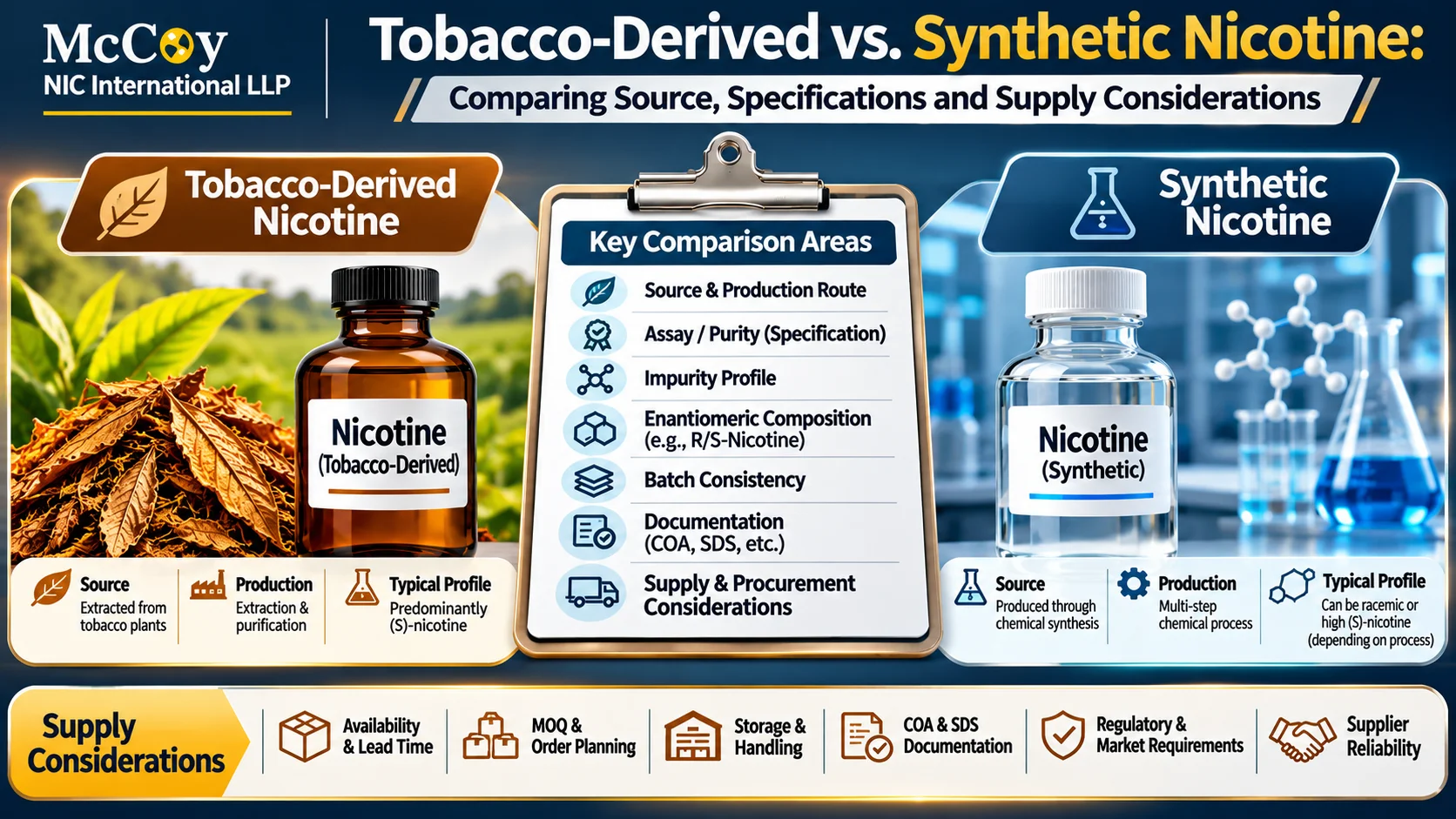
Tobacco-Derived vs. Synthetic Nicotine: Comparing Source, Specifications and Supply Considerations
Nicotine is used in several industrial, pharmaceutical, and nicotine-related product applications. Depending on the intended application and manufacturing process, businesses may source tobacco-derived nicotine or synthetic nicotine. Although both forms contain the same nicotine molecule, their production routes, source characteristics, impurity profiles, and supply-chain requirements can differ.
For manufacturers, importers, procurement professionals, and raw-material buyers, choosing between tobacco-derived and synthetic nicotine requires more than comparing the product label or advertised purity. Buyers should examine analytical specifications, manufacturing information, batch consistency, documentation, supplier reliability, and destination-market requirements.
This article compares tobacco-derived vs. synthetic nicotine and highlights the key factors businesses should consider before selecting a supplier.
1. Understanding Tobacco-Derived Nicotine
Tobacco-derived nicotine is obtained from tobacco plants through extraction, purification, and subsequent processing. Manufacturers use controlled processes to separate nicotine from tobacco material and produce a refined raw material that meets defined product specifications.
Its sourcing and manufacturing process may involve:
- Tobacco raw-material selection and sourcing.
- Extraction and separation processes.
- Purification and refining.
- Quality testing and impurity analysis.
- Batch identification and traceability.
- Packaging and storage under appropriate conditions.
The quality of tobacco-derived nicotine depends on the raw material, manufacturing process, purification controls, and final product specifications.
Buyers should request information about the manufacturing process, product grade, purity, impurity profile, and batch-specific Certificate of Analysis (COA).
Explore Tobacco-Derived Nicotine for further product information.
2. Understanding Synthetic Nicotine
Synthetic nicotine is produced through chemical synthesis rather than extraction from tobacco plants. It is also commonly described as non-tobacco nicotine (NTN) or tobacco-free nicotine.
The manufacturing process uses chemical precursors and controlled synthesis steps to produce nicotine. The resulting material must undergo appropriate purification, testing, and quality verification.
Important manufacturing and quality considerations include:
- Chemical raw-material sourcing.
- Synthesis and process controls.
- Purification and refinement.
- Residual solvent and impurity testing, where relevant.
- Nicotine assay and composition.
- Batch consistency and traceability.
- Packaging and storage requirements.
Synthetic nicotine should not automatically be considered purer or more consistent than tobacco-derived nicotine. Actual quality depends on the manufacturer’s process, purification controls, analytical methods, and product specifications.
Explore Synthetic Nicotine for further product information.
3. Comparing the Source and Manufacturing Process
The primary difference between tobacco-derived and synthetic nicotine is the production route.
| Comparison area | Tobacco-derived nicotine | Synthetic nicotine |
|---|---|---|
| Source | Extracted from tobacco plants | Produced through chemical synthesis |
| Production route | Extraction and purification | Chemical synthesis and purification |
| Raw-material information | Tobacco-source and extraction records | Chemical precursor and manufacturing records |
| Quality assessment | Assay, impurities, and relevant tobacco-related residues | Assay, impurities, and relevant process-related residues |
| Traceability | Tobacco sourcing and processing records | Chemical sourcing and synthesis records |
| Documentation | COA, SDS, specifications, source information | COA, SDS, specifications, synthesis information |
Both types require appropriate quality controls. Buyers should assess the actual manufacturing process rather than assuming that the source alone determines product quality.
4. Nicotine Specifications: What Should Buyers Compare?
Product specifications provide measurable information about the identity and quality of nicotine.
Before purchasing either type, buyers should review the following parameters.
A. Assay and Purity
Assay indicates the measured quantity of nicotine in the material according to a specified analytical method.
Buyers should check:
- Declared assay or purity.
- Specification limits.
- Actual batch test result.
- Analytical method.
- Reporting basis and units.
The United States Pharmacopeia (USP) publishes a Nicotine monograph containing an assay definition and reference standards. Buyers purchasing pharmaceutical-grade material should verify the applicable current pharmacopoeial standard and agreed specification.
Reference: USP – Nicotine Monograph.
B. Impurity Profile
Purity percentage alone does not provide a complete picture of material quality.
Depending on the manufacturing route and intended application, buyers may need to review:
- Related nicotine compounds.
- Residual solvents.
- Process-related impurities.
- Tobacco-related alkaloids.
- Relevant degradation products.
- Other specified contaminants.
A 2026 analytical study published in the Journal of Pharmaceutical and Biomedical Analysis identified impurities in both tobacco-derived and synthetic nicotine samples. This reinforces the importance of evaluating actual analytical results rather than assuming one source is inherently cleaner.
C. Enantiomeric Composition
Nicotine exists in two mirror-image forms, commonly identified as (S)-nicotine and (R)-nicotine.
Naturally occurring tobacco-derived nicotine is predominantly the (S)-enantiomer. Synthetic nicotine may be produced as a racemic mixture or manufactured and processed to obtain a higher proportion of (S)-nicotine.
Therefore, buyers should consider enantiomeric composition when it is relevant to the product specification or intended application.
A conventional assay result does not necessarily establish the enantiomeric composition. Appropriate analytical methods, such as chiral chromatography, may be required.
Scientific reference: Analysis and Differentiation of Tobacco-Derived and Synthetic Nicotine Products.
5. COA and Technical Documentation Requirements
A Certificate of Analysis (COA) is an important document for verifying the quality of a specific nicotine batch.
Whether purchasing tobacco-derived or synthetic nicotine, buyers should review:
- Product name and identification.
- Batch or lot number.
- Manufacturing or testing date.
- Assay or purity result.
- Relevant impurity test results.
- Applicable specification limits.
- Analytical methods.
- Authorised quality approval.
A Safety Data Sheet (SDS) should also be reviewed for hazard classification, handling, storage, exposure controls, and emergency information.
Additional supplier documentation may include:
- Technical Data Sheet (TDS).
- Manufacturing process information.
- Raw-material sourcing details.
- Relevant quality management certificates.
- Batch traceability records.
- Product-specific declarations.
Buyers can also explore the McCoy NIC Certificate and Documentation page for further product documentation information.
6. Supply Considerations: Availability, MOQ and Lead Time
Product quality is only one part of supplier selection. Procurement teams should also evaluate the supplier’s ability to meet recurring business requirements.
Important supply considerations include:
Product Availability: Confirm whether the required nicotine type and grade are regularly available.
Minimum Order Quantity (MOQ): Compare the supplier’s minimum order quantity with actual production and purchasing requirements.
Lead Time: Understand the time required for production, quality testing, packaging, documentation, and dispatch.
Batch Consistency: Review whether the supplier can maintain agreed specifications across recurring orders.
Packaging and Storage: Confirm suitable packaging, storage conditions, handling instructions, and product-specific shelf-life or retest information.
Documentation Support: Check whether the supplier can provide accurate and timely COAs, SDSs, and technical specifications.
These factors can influence production schedules, procurement costs, and long-term supply reliability.
7. Regulatory and Market Considerations
The regulatory treatment of nicotine depends on the destination country, product category, and intended application.
Businesses should not assume that synthetic nicotine is exempt from regulation simply because it is not extracted from tobacco.
For example, in the United States, the FDA’s authority covers tobacco products containing nicotine from any source, including synthetic nicotine. Covered products must meet applicable regulatory requirements, including premarket authorisation where required.
The FDA also identifies nicotine source, enantiomeric purity, and purity grade as relevant information in its guidance for certain product applications.
Official references:
- FDA – Regulation and Enforcement of Non-Tobacco Nicotine Products.
- FDA – Nicotine Source Information for Product Applications.
For international buyers, it is important to distinguish between requirements for bulk chemical ingredients, pharmaceutical materials, and finished consumer products. The applicable requirements should be checked separately for each product and destination market.
8. How Buyers Should Select the Right Nicotine Supplier
A structured supplier evaluation process can help businesses make more informed purchasing decisions.
Before placing an order, buyers should:
- Confirm whether the material is tobacco-derived or synthetic.
- Review the product’s technical specifications and agreed grade.
- Check batch-specific COA and relevant impurity results.
- Evaluate enantiomeric composition where required.
- Request the current SDS and relevant technical documentation.
- Verify manufacturing and batch traceability information.
- Compare MOQ, pricing, availability, and delivery timelines.
- Confirm destination-market regulatory requirements.
- Review the supplier’s quality controls and communication.
- Evaluate performance through initial and recurring orders.
The most suitable supplier is not necessarily the one offering the highest advertised purity or lowest price. Buyers should consider the complete combination of quality, documentation, reliability, and commercial suitability.
9. Building a Reliable Long-Term Supply Relationship
Once a supplier has been selected, businesses should establish clear expectations for recurring purchases.
Manufacturers and buyers can improve long-term supply coordination by agreeing on:
- Approved product specifications.
- Batch documentation requirements.
- Forecasted purchasing quantities.
- Expected order and delivery schedules.
- Packaging and storage arrangements.
- Quality discrepancy procedures.
- Communication and review schedules.
Regular supplier reviews can help identify changes in product quality, lead times, availability, and commercial terms before they affect production.