Why Reference Standards Matter in Analytical Chemistry
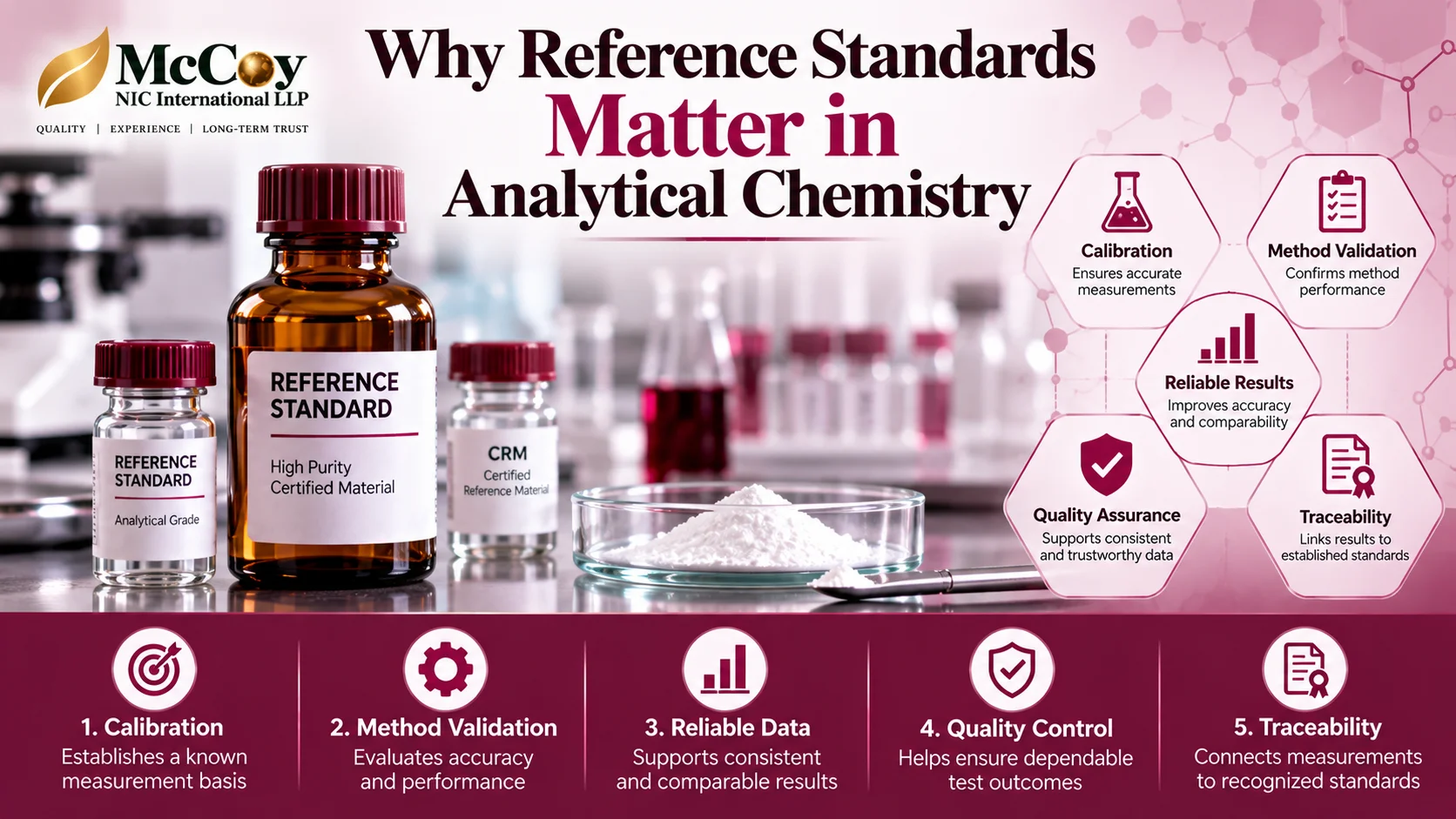
Reliable analytical testing depends on more than laboratory equipment and testing procedures. Laboratories also need appropriate reference standards and reference materials to calibrate instruments, evaluate analytical methods and assess the reliability of measurement results.
Reference standards in analytical chemistry help laboratories compare measurements against established values and improve confidence in the data used for quality control, research and product evaluation. Their suitability depends on the intended application, the analytical method and the characteristics being measured.
According to the National Institute of Standards and Technology (NIST), Standard Reference Materials (SRMs) support instrument calibration, measurement verification and the development of analytical methods. Eurachem also provides guidance on selecting and using reference materials in chemical measurement.
1. What Are Reference Standards in Analytical Chemistry?
Reference standards are materials, substances or established references used to support analytical measurements. Depending on the application, they may be used to calibrate an instrument, verify a method or compare measurements against known or certified values.
Reference materials can include pure substances, prepared solutions and materials with a defined composition or characteristic. Certified reference materials (CRMs) have one or more property values established through a technically valid certification process, together with associated information such as measurement uncertainty and traceability, as applicable.
It is important to distinguish between a general reference material and a certified reference material. A material described as a reference standard is not automatically certified, and the suitability of any material should be assessed against the intended use.
For technical background, consult the NIST overview of Standard Reference Materials.
2. Why Are Reference Standards Important?
A. Supporting instrument calibration
Analytical instruments need appropriate calibration to establish or verify the relationship between instrument response and the quantity being measured.
For example, a laboratory may use suitable reference solutions at known concentrations to establish a calibration curve for a quantitative analytical method. The calibration procedure should be appropriate to the instrument, analyte, method and intended measurement range.
Using suitable calibration materials helps laboratories establish a documented basis for quantitative measurements.
B. Verifying analytical methods
Reference materials can help laboratories assess whether an analytical procedure performs as expected. Depending on the method and material, they may support method verification, validation, recovery assessment or evaluation of measurement bias.
The choice of reference material should consider the intended application and whether its characteristics are sufficiently comparable to those of the samples being analysed.
C. Improving comparability of results
Laboratories may need to compare analytical results obtained at different times, locations or facilities. Appropriate reference materials can help establish a common measurement basis and support comparability.
However, comparability is not guaranteed simply because two laboratories use materials labelled as reference standards. The materials, methods, measurement uncertainty and measurands must be suitable for the comparison.
D. Supporting quality assurance
Reference materials can form part of a laboratory’s quality assurance programme. When used appropriately alongside control samples, calibration checks, documented procedures and other quality controls, they can help identify changes in analytical performance.
A reference material is one component of a broader quality system rather than a replacement for laboratory quality controls.
3. Reference Materials and Certified Reference Materials: Key Differences
Reference materials and certified reference materials serve related purposes, but they are not interchangeable in every application.
Reference materials (RMs) have property values suitable for their intended use. Depending on their characterisation, they may support method development, precision studies, quality control or measurement comparisons.
Certified reference materials (CRMs) have one or more property values established through a valid certification procedure. Their documentation provides certified values and relevant information, which may include uncertainty, traceability and instructions for use.
The right choice depends on the measurement objective. Where certified values and documented uncertainty are necessary, a suitably certified material may be more appropriate than a material with only indicative or manufacturer-assigned values.
For additional guidance, read Eurachem’s publication, The Selection and Use of Reference Materials.
4. The Role of Reference Standards in Chemical Quality Testing
In chemical analysis, test results may influence product acceptance, process control, research conclusions or further technical investigation. Using appropriate reference materials helps laboratories evaluate whether the analytical method is suitable for the required measurement.
Before selecting a reference standard, laboratories should consider:
- The substance or property being measured.
- The intended measurement range and analytical technique.
- The purity, composition or matrix of the reference material.
- The assigned value and associated uncertainty, where applicable.
- The material’s certification and traceability information.
- Storage conditions, stability and expiry or validity information, where specified.
- Compatibility with the laboratory’s validated or verified procedure.
These checks help establish whether the reference material is appropriate for its intended purpose.
5. Why Documentation and Traceability Matter
Reference material documentation provides information needed to use the material correctly and interpret measurement results.
Depending on the material, the documentation may include a certificate, a Certificate of Analysis (CoA), certified values, measurement uncertainty, intended use, storage instructions and validity information.
Metrological traceability involves establishing a documented, unbroken chain of calibrations to specified references, with each step contributing to measurement uncertainty. Simply purchasing a certified reference material or using an instrument calibrated by a recognised organisation does not automatically make every subsequent result traceable.
Laboratories need appropriate procedures, records and measurement controls to support traceability claims.
For more information, see the NIST guidance on metrological traceability.
6. How to Select a Suitable Reference Standard
Selecting a reference standard should begin with the analytical question the laboratory needs to answer.
Step 1: Define the measurement objective. Identify the analyte, property or characteristic that must be measured.
Step 2: Confirm method compatibility. Ensure that the material is suitable for the analytical technique and measurement range.
Step 3: Review the assigned values. Check the certified or stated values and the associated uncertainty information where available.
Step 4: Assess traceability and certification. Review the documentation and confirm that it supports the intended application.
Step 5: Check handling and stability requirements. Follow the manufacturer’s storage, preparation and use instructions.
Step 6: Document its use. Record the material identification, relevant certificate details, preparation and use in the applicable laboratory records.
The selection process should follow the relevant analytical procedure, quality system and regulatory or industry requirements.
7. Relevance to Nicotine and Other Chemical Testing
In nicotine-related chemical analysis, appropriate reference materials may support the measurement of assay, concentration or selected impurities, depending on the analytical method and intended purpose.
For example, a laboratory measuring a particular compound needs a suitable reference material or calibration standard compatible with the analyte and method. A reference material intended for one measurement should not automatically be assumed suitable for a different analyte or analytical technique.
For nicotine-related testing, laboratories should consider the relevant product specification, analytical method, reference material certificate and applicable quality requirements. Product-specific procedures and regulatory obligations must be assessed independently.
For further reading, explore McCoy NIC’s article on Nicotine Purity and Assay Results and its information on Certifications and Compliance Documents.
8. Common Mistakes to Avoid
Laboratories can reduce avoidable measurement problems by avoiding practices such as:
- Using a reference material that is unsuitable for the intended method.
- Assuming that every reference material is certified.
- Ignoring the certificate’s uncertainty, intended use or validity information.
- Using materials outside specified storage or handling conditions.
- Assuming instrument calibration alone proves the accuracy of every result.
- Claiming measurement traceability without appropriate supporting records.
- Failing to review reference material suitability when methods or requirements change.
Careful selection, correct use and adequate documentation are important parts of a reliable analytical measurement process.