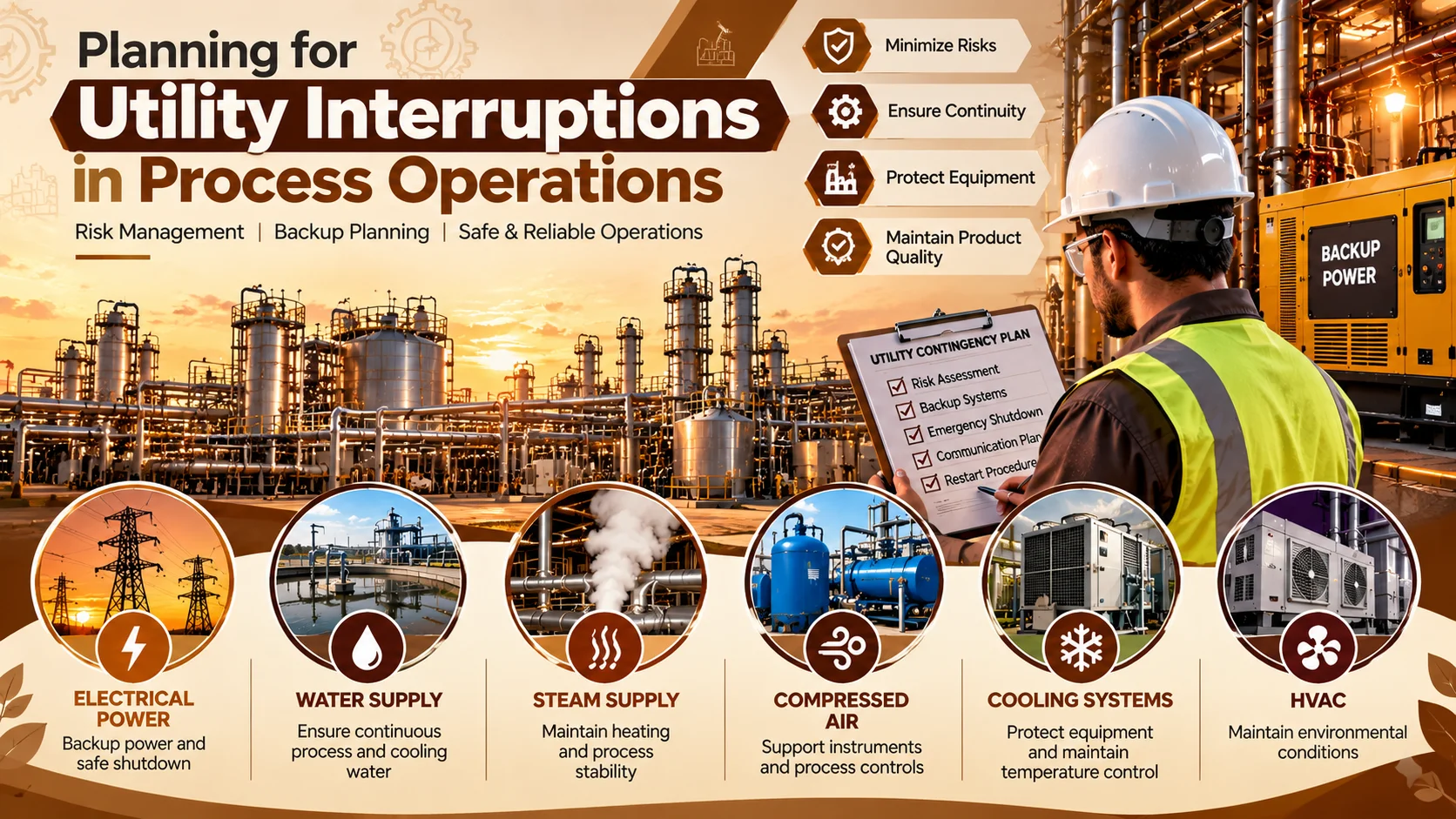
Planning for Utility Interruptions in Process Operations: A Practical Guide
Industrial and manufacturing facilities depend on reliable utility services to maintain safe, stable and efficient operations. Planning for Utility Interruptions in Process Operations is therefore an important part of operational risk management. Unexpected disruptions in electricity, water, steam, compressed air, cooling systems or other essential utilities can affect production schedules, equipment performance, product quality and workplace safety.
A well-developed utility interruption plan helps facilities identify critical dependencies, prepare backup arrangements, define emergency responsibilities and restore operations in a controlled manner. Rather than responding only after a disruption occurs, organisations should build utility resilience into routine maintenance, process planning and business continuity procedures.
1. Understanding Utility Interruptions in Process Operations
Utility interruptions occur when essential services become unavailable, unstable or insufficient for normal process requirements. These interruptions may affect an entire facility, an individual production unit or a specific piece of equipment.
Common examples include:
- Electrical power failure: Interruptions affecting motors, control systems, pumps, instruments and production equipment.
- Water supply disruption: Reduced availability of process water, cooling water or cleaning water.
- Steam supply failure: Loss of heating capacity in processes that depend on steam.
- Compressed air interruption: Reduced availability of pneumatic power for valves, instruments and machinery.
- Cooling system failure: Loss of temperature control in equipment, storage areas or production processes.
- HVAC disruption: Changes in temperature, humidity, ventilation or controlled environmental conditions.
The actual impact depends on the process, equipment design, operating conditions and duration of the interruption.
2. Identify Critical Utility Dependencies
The first step in effective planning is to understand which utilities support each critical operation. A facility should map its production processes and identify the services required to operate safely.
For example, a process may require continuous electrical power for instrumentation, cooling water for temperature control and compressed air for automated valves. If one of these services fails, the process may need to move to a safe condition.
A utility dependency assessment should consider:
- Which production activities depend on each utility?
- Which equipment requires continuous or uninterrupted supply?
- What happens if the utility becomes unavailable?
- Are independent backup sources available?
- How long can the process remain in a safe condition?
- Which departments and employees must respond?
The UK Health and Safety Executive highlights the importance of assessing the risks associated with loss of utility supplies, including possible process hazards and cascading effects.
3. Assess the Operational and Safety Risks
Not every utility interruption creates the same level of risk. A short interruption to a non-critical service may cause only a minor delay, while the loss of cooling, electrical power or an essential control system may require an immediate process response.
Facilities should evaluate potential consequences such as:
- Unplanned production stoppages.
- Equipment damage or abnormal operating conditions.
- Temperature or pressure deviations.
- Loss of process control or monitoring.
- Material degradation or product quality concerns.
- Environmental and workplace safety risks.
- Delays in restarting production.
Risk assessments should consider both short-duration and extended interruptions. They should also examine combined failures, such as a power outage that affects pumps, cooling systems and control equipment simultaneously.
Where applicable, process hazard analysis techniques such as HAZOP can help identify potential consequences and suitable safeguards.
4. Establish Backup Utility Arrangements
Backup arrangements should be designed around the critical requirements of the facility. A backup system should not simply exist on paper; it must be suitable for the intended load, properly installed, maintained and periodically tested.
Common planning considerations include:
Electrical power: Identify essential electrical loads and assess whether standby generators, UPS systems or alternative power arrangements are appropriate. Critical control and safety systems may require a different backup strategy from general production equipment.
Water supply: Evaluate emergency storage, alternative supply arrangements and the minimum water requirements for safe shutdown or essential operations.
Steam and heating: Identify processes that require controlled heating or cooling during an interruption. Establish safe operating and shutdown procedures for affected equipment.
Compressed air and inert gases: Review receiver capacity, supply redundancy and the requirements for maintaining essential instrument or process functions.
Cooling systems: Identify critical cooling loads and determine how equipment will be protected if normal cooling becomes unavailable.
The design and implementation of backup arrangements should be reviewed by qualified engineering and safety personnel. Backup systems must comply with applicable technical requirements and site procedures.
5. Develop Clear Shutdown and Emergency Response Procedures
When a critical utility fails, employees should know what actions are required. Written procedures help reduce confusion and support a consistent response.
An emergency response procedure should define:
- How an interruption is detected and reported.
- Who has authority to initiate an emergency shutdown.
- Which equipment or process sections must be isolated.
- How affected materials and equipment should be managed.
- Which backup systems should be activated by authorised personnel.
- How employees should communicate during the incident.
- What conditions must be verified before restarting operations.
Procedures must be specific to the facility and process. Employees should not attempt unfamiliar electrical, mechanical or process interventions without appropriate training and authorisation.
6. Maintain Communication During an Interruption
Communication is essential when normal operations are disrupted. Production, maintenance, engineering, quality, safety and management teams should receive timely information about the incident.
Facilities should maintain an updated contact list for:
- Plant and operations managers.
- Maintenance and engineering personnel.
- Safety and quality teams.
- Utility service providers.
- Emergency response personnel.
- Relevant contractors and equipment suppliers.
Where normal communication systems depend on the affected utility, alternative communication arrangements should be considered. The response team should also maintain an incident record covering the interruption time, affected systems, actions taken and recovery progress.
7. Protect Product Quality and Process Integrity
Utility interruptions can affect product quality even when equipment appears to be functioning normally after the service is restored.
For example, an interruption in cooling or temperature control may expose materials to conditions outside approved process limits. Changes in pressure, airflow, humidity or environmental conditions may also affect certain production activities.
Before accepting affected materials or resuming normal production, organisations should:
- Review process records and available monitoring data.
- Identify batches or materials exposed to abnormal conditions.
- Assess deviations against approved specifications.
- Involve the quality team in disposition decisions.
- Document investigations and corrective actions.
- Confirm that required equipment checks have been completed.
Quality decisions should be based on documented procedures, validated requirements and appropriate technical review rather than assumptions that the process has returned to normal.
8. Plan Controlled Recovery and Restart
Restoring the utility supply does not automatically mean that production can restart. A controlled recovery process is necessary to verify that equipment and operating conditions are suitable.
A restart assessment may include:
- Confirming that the utility supply is stable.
- Inspecting affected electrical and mechanical systems.
- Checking alarms, instruments and control systems.
- Verifying valve positions and equipment readiness.
- Confirming that cooling, ventilation and other supporting services are available.
- Reviewing process conditions and material status.
- Obtaining the required authorisations before restarting.
The restart sequence should follow approved operating procedures. Equipment should be brought back online in a planned order to avoid overloading systems or creating additional process risks.
9. Train Employees and Test the Utility Interruption Plan
A plan is effective only when employees understand their responsibilities and can follow the required procedures.
Organisations should conduct periodic training and practical exercises based on realistic interruption scenarios. These exercises can identify unclear responsibilities, communication gaps and weaknesses in backup arrangements.
The plan should also be reviewed whenever there are significant changes to:
- Production processes or equipment.
- Utility infrastructure.
- Facility layout.
- Operating procedures.
- Emergency response responsibilities.
- External utility providers or supply arrangements.
Routine maintenance and testing of backup equipment are equally important. Testing frequency should be determined by equipment requirements, manufacturer guidance, risk assessment and applicable regulations.
10. Build Utility Resilience into Business Continuity Planning
Utility interruption planning should form part of a broader business continuity programme. This helps organisations understand which activities must be prioritised, what resources are needed and how essential operations can be restored.
A practical continuity plan should include:
- A list of critical utilities and dependent processes.
- Risk assessments for different interruption scenarios.
- Backup supply and alternative operating arrangements.
- Emergency shutdown and recovery procedures.
- Defined roles and communication responsibilities.
- Maintenance and testing schedules.
- Employee training and exercise records.
- Post-incident review and improvement actions.
Organisations should periodically review their plans to ensure that they remain aligned with current operational requirements.