
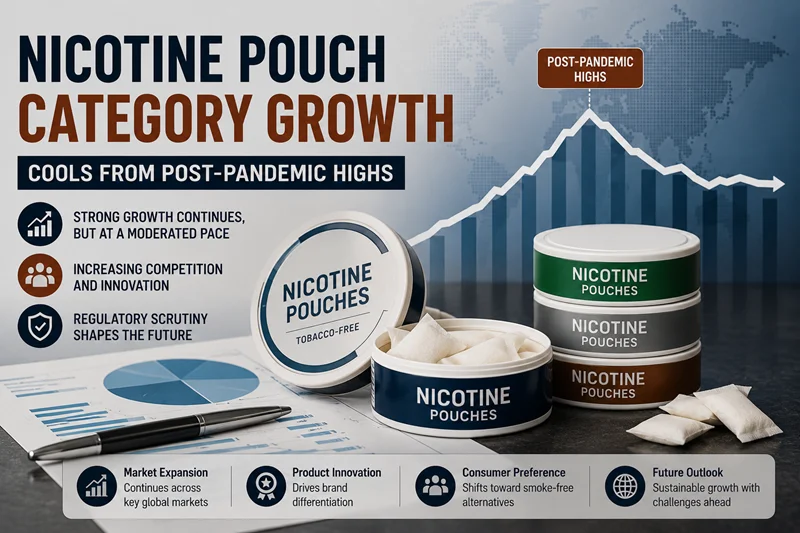
Nicotine Pouch Market Moves Into a More Mature Growth Phase
The global nicotine pouch market continues to attract significant attention from manufacturers, suppliers and investors. However, after several years of rapid expansion, nicotine pouch category growth is beginning to move toward a more normalized pace in several established markets.
The category remains one of the most dynamic segments of the broader nicotine industry. Nicotine pouches offer consumers a smoke-free and tobacco-leaf-free format, which has helped support their adoption in markets where these products are permitted.
At the same time, the market is becoming more competitive, while governments are paying closer attention to product composition, flavours, nicotine strength, marketing and youth access.
Post-Pandemic Expansion Created a High Growth Base
The nicotine pouch category experienced significant momentum following the pandemic period. Greater consumer awareness of alternative nicotine products, expanded retail availability and product innovation helped manufacturers build a rapidly growing market.
As the category has matured, however, maintaining the exceptionally high growth rates seen during the early expansion phase has become more difficult.
This does not necessarily mean that demand is declining. Instead, the market may be entering a stage where percentage growth naturally moderates as the overall consumer base becomes larger.
For manufacturers, this shift changes the focus from simply acquiring new customers to maintaining customer loyalty, improving products and expanding into new markets.
Demand Remains Strong in Major Markets
Recent industry data continues to show substantial demand for nicotine pouches.
Haypp Group reported 28% volume growth in the nicotine pouch category during Q4 2025, indicating that the category continued to expand despite increasing market maturity.
In the United States, nicotine pouches also continued gaining share within the oral tobacco category. Data reported for Q4 2025 showed nicotine pouches accounting for 56.9% of the oral tobacco category, representing a significant increase from the previous year.
These figures suggest that the market remains healthy even though the extraordinary growth rates associated with the category’s earlier development may be becoming harder to replicate.
Competition Between Brands Is Increasing
As nicotine pouches become more established, competition between manufacturers is intensifying.
Companies are developing different nicotine strengths, pouch formats, flavours and packaging designs to differentiate their products. Product innovation has become increasingly important as brands attempt to retain existing consumers and attract adult consumers where regulations permit.
This competitive environment could benefit manufacturers that can maintain consistent product quality while responding quickly to changing market requirements.
For suppliers, consistency in raw materials and manufacturing specifications may also become increasingly important as customers demand reliable quality across larger production volumes.
Regulation Could Affect Future Category Growth
Regulatory developments are another major factor shaping the future of the nicotine pouch industry.
Governments and public-health authorities are increasingly examining nicotine pouch products, particularly issues related to flavours, nicotine levels, packaging, advertising and youth access.
The World Health Organization has called for stronger regulation of nicotine pouches, including measures addressing flavours, marketing, nicotine levels and packaging.
Different regulatory approaches between countries could make international expansion more complicated. A product that is permitted in one market may face different requirements—or may not be permitted—in another.
Manufacturers therefore need to monitor regulatory developments before launching products or expanding distribution into new countries.
Product Innovation May Drive the Next Growth Phase
With competition increasing, product innovation is likely to remain an important part of the market’s development.
Manufacturers may focus on improving pouch quality, consistency, nicotine delivery characteristics, packaging and product formats while remaining within applicable regulations.
The next phase of market growth may therefore depend less on rapid category adoption and more on product differentiation, consumer retention, regulatory compliance and market expansion.
Established companies with strong distribution networks may have an advantage, while smaller manufacturers could compete through specialized products and targeted markets.
Emerging Markets Could Provide New Opportunities
Although several established markets are becoming more mature, opportunities may remain in countries where nicotine pouch awareness and availability are still developing.
However, entering these markets requires careful assessment. Import requirements, product classification, taxation, age restrictions, flavour rules and marketing regulations can vary considerably.
For international suppliers, understanding local requirements before entering a market can help reduce regulatory and logistical risks.
What This Means for Nicotine Manufacturers and Suppliers
The changing nicotine pouch category growth pattern has several implications for businesses operating in the sector.
Manufacturers may need to focus on:
- Consistent product quality
- Reliable nicotine raw-material supply
- Product innovation
- Regulatory compliance
- Market-specific packaging and labelling
- Efficient distribution
- Long-term consumer retention
Suppliers that can provide dependable raw materials and maintain consistent specifications may become increasingly important as manufacturers scale production.
Outlook for the Nicotine Pouch Industry
The nicotine pouch market appears to be transitioning from an early high-growth phase toward a more mature stage.
While growth rates may moderate from exceptional post-pandemic levels, current market data indicates that demand remains substantial in major markets. Competition, regulation and product innovation are likely to determine which companies perform best during the next stage of development.
For manufacturers, exporters and suppliers, the opportunity remains significant—but sustainable growth will increasingly depend on quality, compliance, innovation and market-specific strategies.
Conclusion
Nicotine pouch category growth is cooling from the extraordinary levels seen during the post-pandemic expansion, but the category continues to grow in important markets.
The next phase of the industry is likely to be defined by stronger competition, tighter regulation and greater emphasis on product quality and innovation.
For businesses involved in the global nicotine supply chain, monitoring market trends and regulatory developments will remain essential as nicotine pouches continue to evolve.