How to Build a Regulatory Document Checklist for Cross-Border Nicotine Shipments
Cross-border nicotine shipments require careful documentation, accurate product information, and destination-specific regulatory checks. A regulatory document checklist for nicotine shipments helps B2B buyers, suppliers, logistics teams, and customs representatives identify the paperwork that may be required before a shipment is dispatched.
Nicotine is a hazardous substance that requires appropriate handling and regulatory attention. The documents needed for an international shipment can vary according to the product’s form, concentration, intended use, origin country, destination country, transport method, and applicable laws. Therefore, businesses should confirm the requirements with the relevant authorities, licensed customs professionals, and qualified logistics providers before shipment.
This guide explains how to organize a practical documentation checklist for cross-border nicotine procurement.
Why Is a Regulatory Document Checklist Important?
International shipments may involve several parties, including exporters, importers, customs brokers, freight forwarders, carriers, and regulatory authorities. Each party may need specific information to verify the product, process the customs declaration, assess transport requirements, or confirm that applicable permissions are in place.
A structured checklist helps businesses:
- Identify missing documents before dispatch.
- Keep product descriptions and shipment details consistent.
- Confirm whether licences, permits, or notifications may be required.
- Support product identification and batch traceability.
- Coordinate documentation between buyers, suppliers, and logistics partners.
- Maintain organized records for future audits and procurement reviews.
A checklist is a preparation tool, not a substitute for confirming the legal requirements of the specific shipment.
1. Confirm the Product Classification and Destination Requirements
Start by identifying the exact product being shipped. Record its product name, chemical identity, grade, concentration where applicable, packaging details, intended use, and relevant classification information.
The exporter and importer should verify the applicable customs or HS code rather than relying on a generic description. They should also determine whether the product is subject to special chemical controls, import restrictions, licensing requirements, or other regulatory conditions.
The checklist should capture:
- Origin and destination countries.
- Product identity and commercial description.
- Applicable customs classification.
- Intended use and recipient details.
- Import permissions or export authorizations, where required.
- Any applicable restrictions or notification requirements.
Requirements differ across jurisdictions, so a document accepted in one country may not be sufficient in another.
2. Prepare the Commercial and Customs Documents
Commercial paperwork helps establish what is being shipped, who is involved in the transaction, and the declared value and quantity.
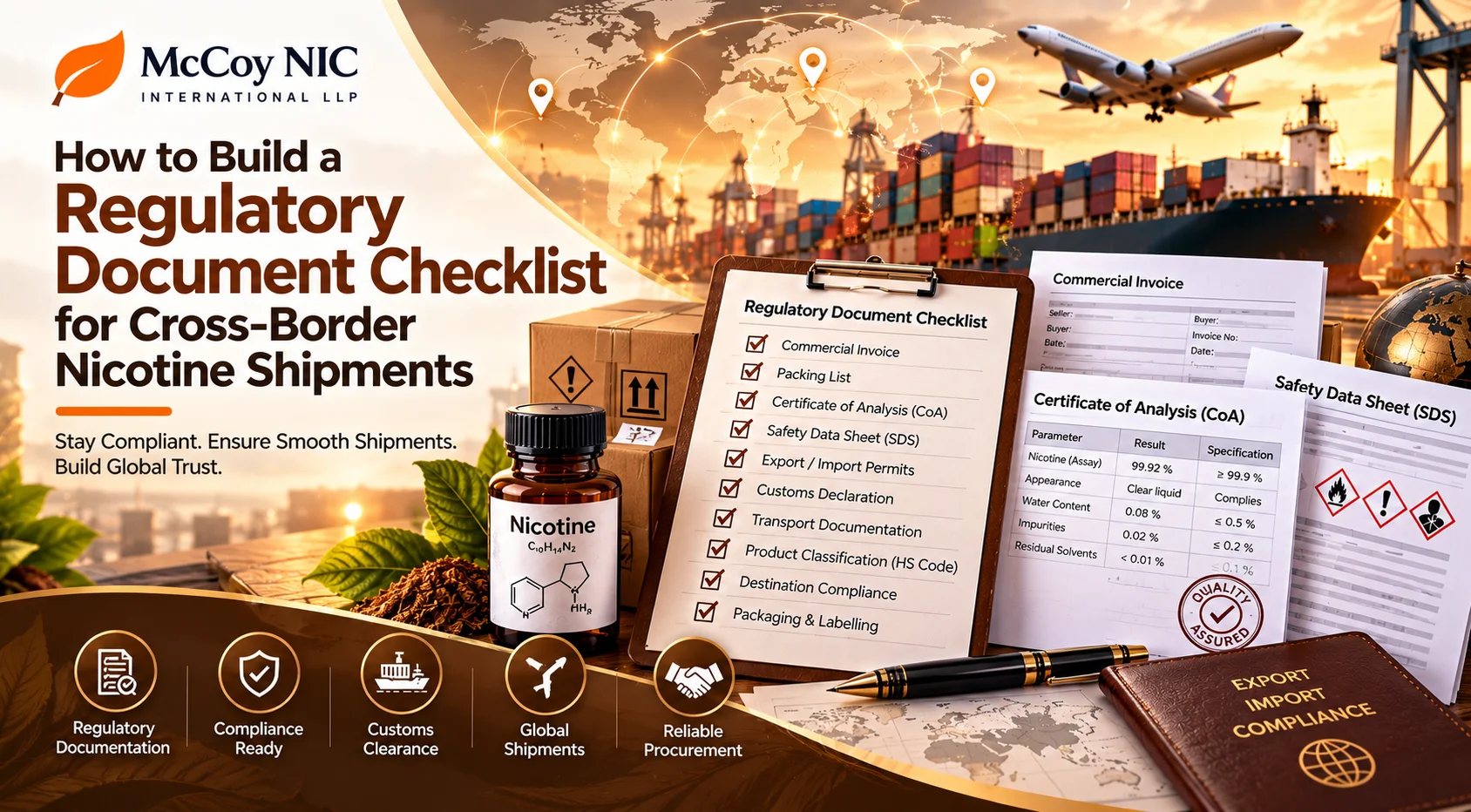
Depending on the transaction and destination, the documentation file may include:
Commercial invoice: Identifies the seller, buyer, product description, quantity, unit price, total value, currency, and agreed trade terms.
Packing list: Records package count, packaging type, net and gross weights, and other shipment details required by the carrier or customs process.
Customs declaration: Provides the information required for the applicable export or import clearance procedure.
Certificate or declaration of origin: May be needed to establish the product’s origin or support a preferential tariff claim, depending on the trade arrangement and destination requirements.
Transport document: Such as an air waybill, bill of lading, or other transport record appropriate to the shipping method.
Check that the product description, quantity, package count, consignee details, and other relevant fields match across the documents. Additional records may be necessary for a particular route or transaction.
3. Include the Safety Data Sheet (SDS)
A current, product-specific Safety Data Sheet (SDS) is an important part of chemical shipment preparation. It communicates relevant hazard information, handling precautions, storage conditions, emergency measures, and other safety information.
Before dispatch, verify that:
- The SDS corresponds to the actual product and concentration.
- Product identification and supplier information are consistent.
- Hazard classification and safety information are appropriate to the product.
- The document is current and available to the parties who need it.
- Required language, format, labelling, and transport information have been checked for the destination and transport mode.
An SDS does not replace a transport declaration, permit, or other legally required document. Where dangerous-goods transport rules apply, confirm the applicable classification, packaging, marking, labelling, and carrier documentation with a qualified dangerous-goods professional.
4. Attach the Certificate of Analysis (CoA), Where Applicable
A Certificate of Analysis (CoA) records analytical results for a specified product batch or lot. Buyers may use it to review product identity, assay or purity results, specified quality parameters, and other test information relevant to their purchase requirements.
When reviewing a CoA, check:
- Product name and grade.
- Batch or lot identification.
- Test parameters and reported results.
- Applicable specifications and test methods.
- Report date and issuing laboratory or authorized party.
- Consistency with the purchase specification and supplied product.
A CoA is a quality document; it does not by itself establish import authorization or regulatory approval. The buyer should confirm whether a CoA is required for the specific shipment and whether any prescribed format or additional certification applies.
For more information, see McCoy NIC’s Certificate and Quality Documentation page and Pure Nicotine 99.9% product information.
5. Verify Licences, Permits and Regulatory Notifications
Before dispatch, determine whether the product, transaction, or destination triggers any special authorization requirements. Depending on the jurisdiction and circumstances, these may include an import licence, export authorization, chemical permit, registration, prior notification, or end-use documentation.
The compliance review should answer the following questions:
- Is the product restricted, controlled, or subject to special chemical rules?
- Does the exporter require an authorization or notification?
- Does the importer hold the permissions required to receive the product?
- Are there restrictions based on the intended use or end user?
- Are there country-specific labelling, packaging, reporting, or recordkeeping requirements?
- Have the relevant authorities or qualified trade professionals confirmed the requirements?
For shipments originating in or entering India, businesses should check the applicable requirements through the relevant Indian authorities and official trade systems. The Department of Chemicals and Petrochemicals provides information on India’s SCOMET framework for regulated dual-use items and technologies. Applicability must be determined for the specific product and transaction.
6. Check Packaging, Labelling and Transport Documentation
The physical shipment and its paperwork must be consistent with the applicable safety and transport requirements. The appropriate controls depend on the product’s hazard classification, quantity, packaging, transport mode, and route.
Before collection, verify:
- Packaging suitability and integrity.
- Required hazard labels and package markings.
- Any applicable dangerous-goods declaration.
- Carrier acceptance and transport conditions.
- Emergency and handling information required by the carrier.
- Consistency between package labels and shipment documents.
Do not assume that the same packaging or transport documentation is suitable for every nicotine product or shipping route. Confirm the requirements with the selected carrier and an appropriately qualified dangerous-goods specialist.
7. Create a Shipment-Specific Document Register
A document register makes the checklist easier to use and helps teams identify outstanding items. Each shipment should have its own record with a clear owner and review status.
A practical register can include:
| Document or check | Purpose | Review status |
|---|---|---|
| Commercial invoice | Transaction and declared value | Pending / Complete |
| Packing list | Package and weight details | Pending / Complete |
| Customs declaration information | Clearance requirements | Pending / Complete |
| Transport document | Carrier and shipment record | Pending / Complete |
| Product-specific SDS | Safety and handling information | Pending / Complete |
| CoA, where applicable | Batch quality information | Pending / Complete |
| Origin document, if required | Origin verification | Pending / Complete |
| Required licences or permits | Regulatory authorization | Pending / Complete |
| Transport safety documents, if applicable | Compliance with transport rules | Pending / Complete |
| Destination-specific documents | Local import requirements | Pending / Complete |
This is an illustrative working checklist, not a universal list of mandatory documents. Remove irrelevant items and add every requirement confirmed for the specific shipment.
8. Perform a Final Pre-Dispatch Review
Before releasing a shipment, assign a responsible person to review the complete documentation file.
The final review should confirm that:
- Product identity, classification, quantity, and intended use have been checked.
- The buyer and receiving party are correctly identified.
- Applicable licences, permits, and notifications have been verified.
- Commercial documents are consistent with the shipment.
- Required safety, quality, and transport documents are available.
- Packaging and labelling meet the applicable requirements.
- The importer, customs broker, and carrier have received the necessary information.
- Copies of the final documents are stored in an organized record.
If an essential document is missing or a classification is uncertain, pause dispatch until the issue is resolved with the responsible compliance professional or authority.
Common Documentation Mistakes to Avoid
Cross-border shipments can face delays or additional checks when the paperwork is incomplete or inconsistent. Common issues include:
- Using an incorrect or unverified product classification.
- Providing an outdated or mismatched SDS.
- Omitting batch details from quality documentation where needed.
- Showing different product descriptions or quantities across documents.
- Assuming an origin certificate or CoA is always mandatory—or never required.
- Overlooking destination-specific permissions.
- Treating an SDS or CoA as a replacement for a required licence.
- Failing to confirm carrier-specific dangerous-goods requirements.
A document review before dispatch is generally easier than resolving missing information after a shipment has entered the customs or transport process.
How McCoy NIC Supports B2B Documentation Reviews
McCoy NIC International LLP provides product information and quality-documentation resources to support B2B procurement discussions. Buyers evaluating nicotine products can review the company’s product information, Certificate and Quality Documentation page, and Request CoA / Price page to identify the information relevant to their enquiry.
For procurement planning, buyers should communicate their product requirements, destination country, intended application, and documentation needs early in the process. Any required documents, product specifications, authorizations, and shipment conditions should be confirmed for the individual transaction.
Frequently Asked Questions
What documents may be needed for cross-border nicotine shipments?
Depending on the shipment, documents may include a commercial invoice, packing list, customs declaration, transport document, SDS, CoA, origin documentation, licences, permits, and transport-safety paperwork. The exact requirements depend on the product, route, and applicable laws.
Is a Certificate of Analysis sufficient for customs clearance?
No. A CoA provides analytical or batch-quality information. It does not replace a customs declaration, import licence, permit, or other required authorization.
Is an SDS required for every nicotine shipment?
SDS and other safety-document requirements depend on the product, applicable regulations, and transport conditions. Confirm the requirements for the specific shipment with the relevant authority and carrier.
Who should verify the final document checklist?
The exporter and importer should coordinate with their customs broker, carrier, and qualified regulatory or dangerous-goods professionals. The responsible parties should verify the current requirements before dispatch.