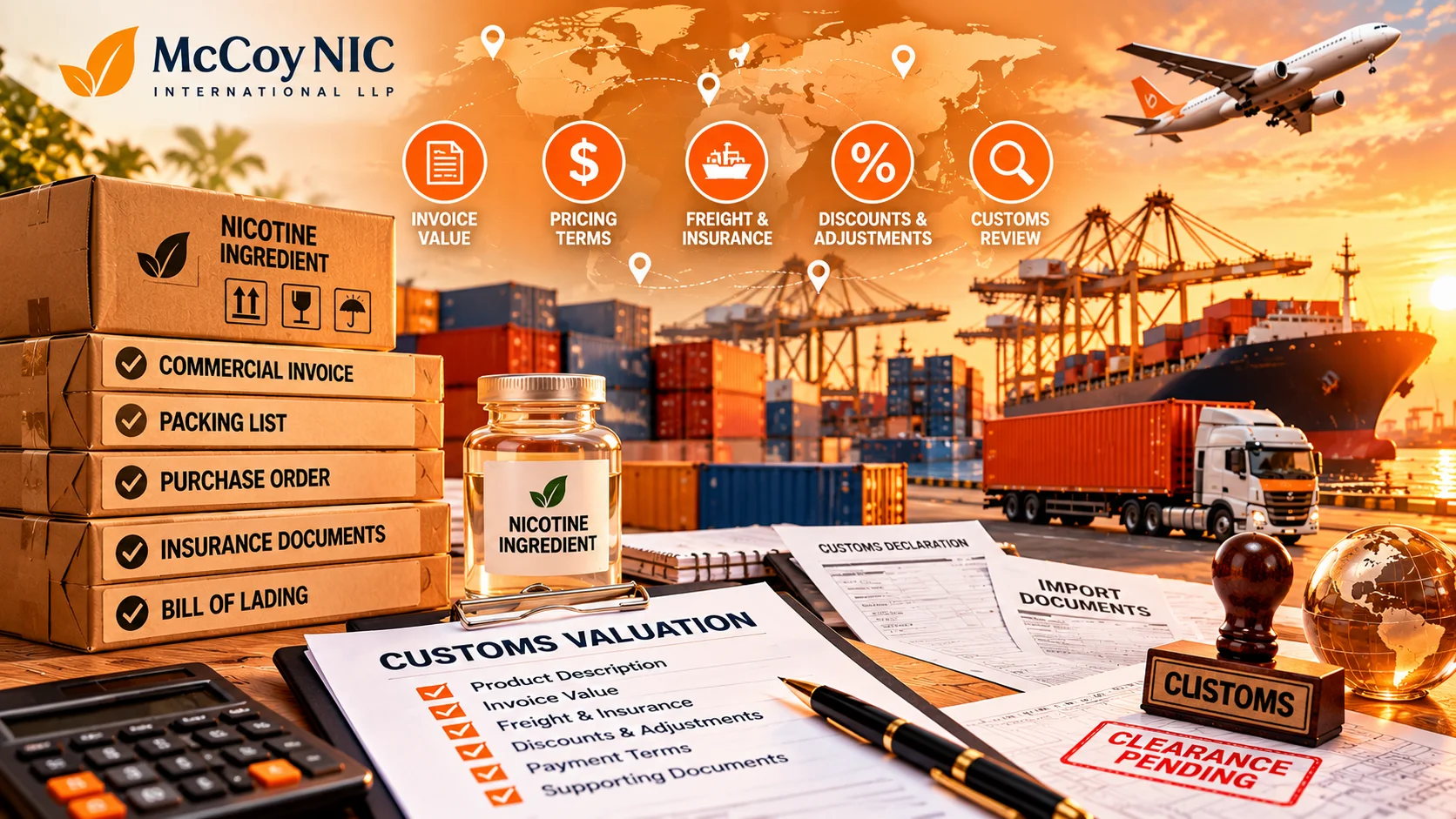
Customs Valuation Questions That Can Delay Ingredient Shipments
Customs valuation for ingredient shipments is an important consideration for international B2B buyers, importers, and ingredient suppliers. When customs authorities need clarification about an invoice value, additional charges, discounts, or supporting commercial documents, the clearance process may take longer than expected.
For businesses importing industrial ingredients and specialty chemicals, such delays can affect delivery schedules, inventory planning, production timelines, and procurement costs. Preparing accurate documentation and maintaining consistency across shipment records can help reduce avoidable questions during customs clearance.
What Is Customs Valuation?
Customs valuation is the process of determining the value of imported goods for customs purposes, including the calculation of applicable duties where relevant.
Under the World Trade Organization (WTO) Customs Valuation Agreement, the primary method is generally the transaction value—the price actually paid or payable for goods sold for export, subject to specified conditions and adjustments. If this method cannot be used, other prescribed valuation methods may apply. <a href=”https://www.wcoomd.org/en/topics/valuation/overview/wto-valuation-agreement.aspx“>World Customs Organization guidance on customs valuation</a> explains this framework.
For ingredient shipments, the declared value should be supported by accurate commercial information and assessed under the rules of the importing country.
Why Do Customs Authorities Ask Valuation Questions?
Customs authorities may request clarification when information in the import declaration and supporting documents appears incomplete, inconsistent, or requires further verification. Common areas of review include the following.
1. Differences Between Invoice and Declared Values
One important question concerns whether the declared customs value is consistent with the commercial invoice and the applicable valuation rules.
Differences may arise because of invoice amendments, currency conversion, discounts, separate charges, or data-entry errors. Buyers should ensure that the invoice, purchase order, payment records, and import declaration accurately reflect the same transaction.
2. Freight, Insurance, and Other Charges
The treatment of freight, insurance, packing, handling, and other charges can affect customs valuation. The exact treatment depends on the applicable national rules and the terms of the transaction.
Importers should retain relevant freight invoices, insurance documents, and shipping records. Where an adjustment is required, the supporting calculation should be clear and traceable.
3. Discounts and Special Pricing Arrangements
Bulk purchases, promotional discounts, contractual price adjustments, and long-term supply agreements can create questions if their terms are not adequately documented.
Buyers should retain the relevant contract, purchase order, supplier correspondence, and credit or debit notes. A discount should not simply be assumed to reduce customs value in every situation; its treatment depends on the applicable rules and transaction circumstances.
4. Transactions Between Related Companies
Imports between related companies may receive additional scrutiny if customs authorities need to understand how the relationship affects the price.
A relationship between buyer and seller does not automatically make a transaction value unacceptable under the WTO framework. However, importers should be prepared to provide relevant pricing information and supporting evidence if requested.
5. Incomplete Product and Commercial Information
Ingredient shipments may involve technical specifications, different grades, varying concentrations, or distinct product descriptions. If the commercial invoice, packing list, purchase order, and technical documents describe the goods differently, clarification may be needed.
Clear product descriptions, consistent quantities, correct units of measurement, and accurate product identifiers help importers explain what has been shipped and how the transaction has been recorded.
How Valuation Questions Can Delay Ingredient Shipments
When a valuation issue requires additional review, the importer may need to provide further documents or explanations before customs processing can be completed.
Potential consequences include:
- Extended clearance timelines: Additional questions and document reviews may delay release.
- Higher operational costs: Storage, demurrage, or other charges may arise depending on the shipment and applicable arrangements.
- Inventory planning challenges: Delayed ingredients can affect manufacturing schedules and replenishment plans.
- Procurement uncertainty: Buyers may need to revise delivery forecasts or coordinate with suppliers and logistics partners.
These outcomes are not automatic. The impact depends on the nature of the query, the country’s customs procedures, and how quickly the importer can respond.
Documents Buyers Should Prepare Before Shipment
A well-organized document set can help answer common customs valuation questions.
Before shipment, B2B buyers should check the following:
- Commercial invoice: Confirm the seller, buyer, product description, quantity, unit price, currency, and total value.
- Purchase order and contract: Ensure the agreed pricing and payment terms are documented.
- Packing list: Verify quantities, package details, and product descriptions against the invoice.
- Freight and insurance records: Keep supporting documents for charges relevant to the customs valuation.
- Payment evidence: Retain payment records and explanations for any differences from the invoiced amount.
- Product specifications: Maintain suitable technical information to identify the imported ingredient accurately.
- Quality documents: Where applicable, keep the Certificate of Analysis (CoA) and Safety Data Sheet (SDS) available for product identification and other regulatory requirements.
Not every document is required for every shipment. Importers should confirm the specific requirements of the destination country and the relevant product category.
A Practical Customs Valuation Checklist for B2B Importers
Procurement and logistics teams can reduce avoidable discrepancies by reviewing the shipment before dispatch.
- Match the purchase order with the final commercial invoice.
- Confirm the currency, quantity, unit price, and total value.
- Document discounts, rebates, amendments, and special pricing terms.
- Review freight, insurance, and other charges under the destination country’s valuation rules.
- Check that product descriptions are consistent across commercial and technical documents.
- Keep supplier communications and payment evidence organized.
- Coordinate with the customs broker or qualified trade professional before shipment if a valuation issue is unclear.
Early review is particularly useful for recurring shipments, high-value ingredients, and transactions involving complex pricing arrangements.
The Role of Supplier Documentation in Reliable Ingredient Procurement
Supplier documentation supports more than product identification. Clear commercial records and consistent technical information can help buyers coordinate procurement, logistics, quality review, and import preparation.
For businesses sourcing nicotine and related ingredients, the product’s identity and technical specifications should be documented separately from the commercial details used for customs valuation. A Certificate of Analysis helps communicate batch-specific quality results; it does not, by itself, establish the customs value of a shipment.
Buyers can explore the following McCoy NIC resources for related product and procurement information:
- Pure Nicotine 99.9% — product information for buyers reviewing high-purity nicotine.
- Tobacco-Derived Nicotine — information about tobacco-derived nicotine.
- Certificates and Quality Information — quality and certification information.
- Request CoA or Price Information — a contact route for relevant product enquiries.
- Factors That Affect Bulk Nicotine Procurement — additional considerations for bulk procurement planning.
These links provide product and procurement context; they should not be interpreted as customs or legal advice.