
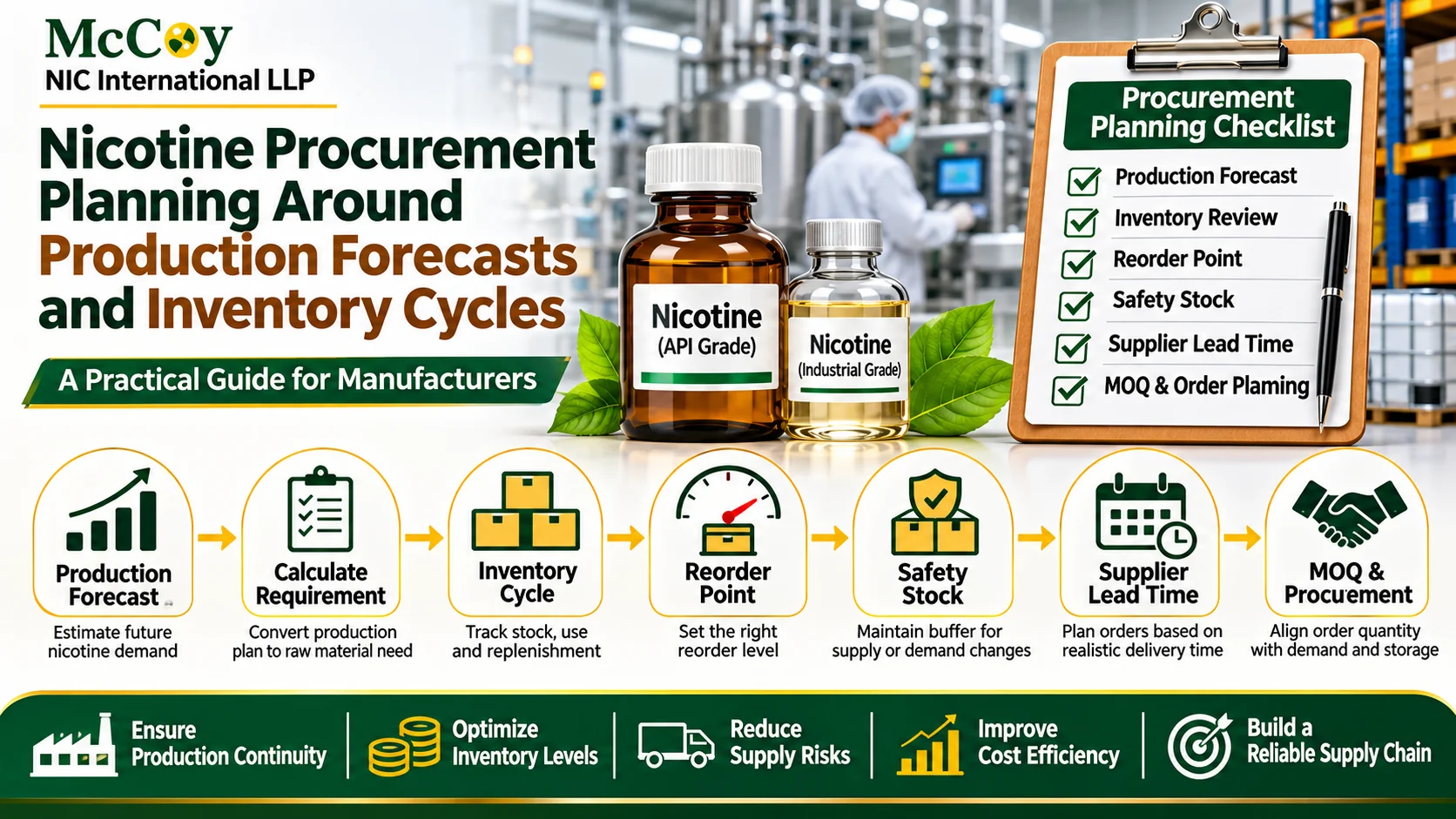
Nicotine Procurement Planning Around Production Forecasts and Inventory Cycles: A Complete Guide
Effective nicotine procurement planning is essential for manufacturers that depend on a consistent supply of raw materials. Purchasing decisions should not be based only on current stock levels or immediate production requirements. Businesses should also consider future production forecasts, inventory cycles, supplier lead times, minimum order quantities, and expected customer demand.
For manufacturers, poor procurement planning can result in production interruptions, excess inventory, higher storage costs, and unnecessary pressure on working capital.
A structured procurement strategy connects production planning with purchasing activities and helps businesses maintain a more predictable supply of nicotine raw materials.
1. Why Production Forecasts Matter in Nicotine Procurement
A production forecast estimates the quantity of products a manufacturer expects to produce during a specific period.
It provides procurement teams with an estimate of the raw materials required to support planned production.
When preparing a nicotine procurement forecast, manufacturers should review:
- Expected monthly or quarterly production volumes.
- Confirmed customer orders.
- Historical raw-material consumption.
- Planned production schedules.
- New product launches or formulation changes.
- Existing inventory and incoming shipments.
- Supplier production and delivery lead times.
Forecasts should be reviewed regularly because actual production requirements may change due to customer demand, operational capacity, or changes in manufacturing schedules.
For a broader overview, read How Manufacturers Can Plan Nicotine Inventory for Seasonal Production.
2. Calculate Nicotine Requirements from Production Plans
Once the production forecast is available, procurement teams can estimate the quantity of nicotine required.
A basic planning formula is:
Expected Nicotine Requirement = Forecast Production Quantity × Nicotine Required per Production Unit
For example, if a manufacturer plans to produce 10,000 units and its approved production formulation requires a defined quantity of nicotine per unit, the procurement team can calculate the corresponding raw-material requirement.
The calculation should use the actual approved formulation, process specifications, and expected production yield.
Procurement teams should also consider:
- Material already available in approved inventory.
- Quantities already ordered but not yet received.
- Expected production losses, where applicable.
- Quality approval and rejection considerations.
- Additional requirements for planned production changes.
This helps businesses avoid purchasing the same material requirement twice or overlooking quantities already committed to incoming deliveries.
3. Understand Inventory Cycles
An inventory cycle refers to the process of receiving, storing, consuming, reviewing, and replenishing raw materials.
For nicotine procurement, businesses should establish a regular inventory review process based on their production frequency and supply arrangements.
An inventory review should cover:
Opening Inventory: Quantity available at the beginning of the review period.
Receipts: New quantities received and accepted after the required checks.
Consumption: Material used in approved production activities.
Closing Inventory: Remaining available stock after consumption.
A simplified formula is:
Closing Inventory = Opening Inventory + Accepted Receipts − Consumption
Procurement teams should distinguish between physical stock and available stock. Material awaiting quality approval, under investigation, or already allocated to production may not be available for new requirements.
Regular inventory reviews provide better visibility into upcoming purchasing needs.
4. Establish Reorder Points
A reorder point is the inventory level at which a business should initiate a replenishment order.
It helps procurement teams place orders before available stock becomes insufficient for planned production.
A commonly used formula is:
Reorder Point = Expected Demand During Lead Time + Safety Stock
For example, if a manufacturer expects to consume 100 kg of a particular approved nicotine grade during the supplier lead-time period and maintains 30 kg as safety stock, the indicative reorder point would be 130 kg.
The actual reorder point should reflect demand variability, supplier reliability, delivery uncertainty, and the company’s inventory policy.
Businesses should not use the same reorder point for every product. Different grades, packaging formats, and supply arrangements may require different planning assumptions.
5. Consider Supplier Lead Times Before Placing Orders
Supplier lead time is the period between placing an order and receiving the material in an acceptable condition for use.
For international nicotine procurement, lead time may include several stages:
- Order confirmation.
- Supplier production or material allocation.
- Quality testing and batch release.
- Packaging and preparation.
- Export documentation.
- Freight and transportation.
- Customs clearance, where applicable.
- Receiving inspection and quality approval.
Procurement teams should discuss realistic delivery timelines with suppliers rather than relying only on an initial estimated dispatch date.
A supplier with consistent communication and predictable delivery performance can help manufacturers coordinate procurement with production schedules.
For more information, read Nicotine Supply Chain Challenges: How Manufacturers Can Improve Supply Reliability.
6. Plan Safety Stock According to Supply Risk
Safety stock is additional inventory maintained to help manage unexpected demand changes or supply delays.
For manufacturers using nicotine as a critical raw material, an appropriate safety-stock policy can support production continuity.
However, maintaining excessive inventory can increase storage requirements, working-capital costs, and inventory-management complexity.
Before setting safety-stock levels, businesses should consider:
- Variations in production demand.
- Supplier delivery performance.
- Lead-time uncertainty.
- Availability of alternative qualified suppliers.
- Material storage and handling requirements.
- Shelf life or retest requirements, where applicable.
- Financial and operational inventory limits.
Safety stock should be determined through a documented inventory policy rather than an arbitrary quantity.
7. Include Minimum Order Quantity (MOQ) in Procurement Planning
Minimum Order Quantity (MOQ) is the minimum quantity a supplier is willing to accept for a particular product or commercial arrangement.
MOQ can influence purchasing decisions, particularly when a manufacturer’s immediate requirement is smaller than the supplier’s minimum quantity.
Before confirming an order, procurement teams should compare:
- Forecast production requirements.
- Current available inventory.
- Incoming purchase orders.
- Expected future consumption.
- Supplier MOQ.
- Storage capacity.
- Working-capital availability.
- Delivery frequency and freight costs.
If the MOQ exceeds immediate demand, businesses may discuss commercially suitable delivery schedules or order arrangements with the supplier.
Any such arrangement should also consider product storage, packaging, quality, and traceability requirements.
8. Avoid Stockouts and Excess Inventory
Two common procurement problems are stockouts and overstocking.
Stockouts
A stockout occurs when available inventory is insufficient to support planned requirements.
Potential causes include:
- Inaccurate production forecasts.
- Delayed purchase orders.
- Unexpected increases in demand.
- Longer supplier lead times.
- Inadequate safety stock.
- Delayed quality release of incoming material.
Excess Inventory
Excess inventory occurs when purchasing quantities are significantly higher than expected consumption and reasonable inventory requirements.
It can lead to:
- Increased working-capital requirements.
- Higher storage costs.
- Additional inventory-management work.
- Greater exposure to material ageing or expiry risks, where applicable.
- More complicated stock reconciliation.
The objective should be to maintain appropriate inventory based on demand, lead time, supply risk, and material-specific requirements.
9. Coordinate Procurement, Production, Quality and Finance
Nicotine procurement planning works best when different departments use the same information.
Production Team: Shares production schedules, forecast volumes, and changes in manufacturing requirements.
Procurement Team: Calculates material requirements, checks supplier lead times, obtains quotations, and places purchase orders.
Quality Team: Reviews specifications, COAs, batch information, and required documentation before material approval.
Finance Team: Reviews purchasing budgets, payment terms, cash-flow requirements, and working-capital availability.
Logistics Team: Coordinates expected dispatch, transport arrangements, shipment documentation, and delivery schedules.
Regular communication between these departments can help identify procurement issues before they affect production.
10. Use a Rolling Procurement Forecast
A rolling forecast is a procurement plan that is updated regularly as new information becomes available.
Instead of relying on a fixed annual purchasing estimate, businesses can review their expected requirements monthly or quarterly.
A practical rolling procurement process may include:
- Review the latest production forecast.
- Calculate the required nicotine quantity.
- Check available and incoming inventory.
- Identify the expected reorder date.
- Confirm supplier MOQ and lead time.
- Review the procurement budget.
- Place orders according to the approved plan.
- Track deliveries and quality approval.
- Compare actual consumption with the forecast.
- Update the next procurement cycle.
This approach gives procurement teams better visibility into upcoming requirements and allows them to respond to changes in production schedules.
11. Evaluate Supplier Performance for Recurring Purchases
For businesses with regular nicotine requirements, supplier evaluation should continue after the first purchase.
Procurement teams can review supplier performance using factors such as:
- Delivery against agreed schedules.
- Consistency with approved specifications.
- Availability of batch-specific documentation.
- Communication and order updates.
- Ability to support recurring quantities.
- Handling of quality discrepancies.
- Accuracy of commercial and shipping documents.
Businesses should also maintain records of supplier performance and review alternative qualified sources where appropriate.
For additional guidance, read Building a Reliable Nicotine Raw Material Supply Chain.
12. Monitor Forecast Accuracy and Improve Future Procurement Cycles
Forecasting is not a one-time exercise. Businesses should compare actual material consumption with their original estimates.
Useful performance measures include:
- Forecast versus actual production.
- Forecast versus actual nicotine consumption.
- Inventory turnover.
- Stockout frequency.
- Supplier delivery performance.
- Purchase-order fulfilment.
- Excess or obsolete inventory.
- Procurement budget variance.
These measures can help companies identify where planning assumptions need improvement.
A more accurate forecast can support better purchasing decisions, reduce avoidable inventory pressure, and improve coordination between procurement and production.