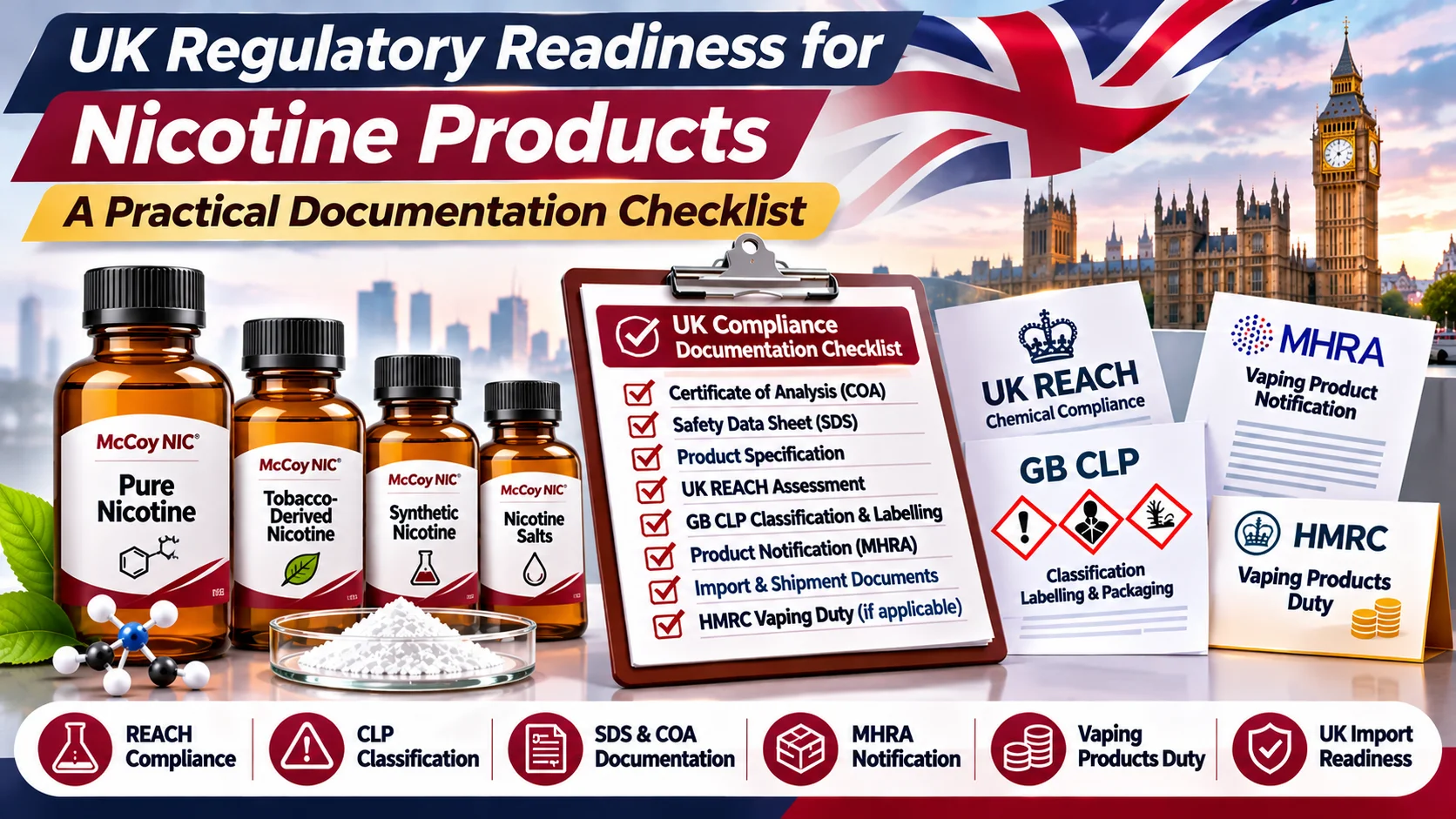
UK Regulatory Readiness for Nicotine Products: A Practical Documentation Checklist
The UK Regulatory Readiness for Nicotine Products requires manufacturers, suppliers, importers and distributors to understand the regulatory framework applicable to the specific product they handle. From chemical safety documentation and ingredient traceability to product notifications, labelling and import records, businesses must prepare the right documents before placing products on the UK market.
For international nicotine suppliers, regulatory readiness is not limited to providing a Certificate of Analysis (COA). Buyers and UK importers may also need Safety Data Sheets (SDS), specifications, impurity information, hazard classification, manufacturing details and supporting evidence that helps establish the safe use and traceability of the material.
This practical guide explains the key documentation areas businesses should review when supplying nicotine ingredients or finished nicotine-containing products to the United Kingdom.
1. Understand Which UK Regulations Apply to Your Product
The first step is to identify the product category and its intended use. Regulatory requirements may differ depending on whether the shipment contains bulk nicotine as a chemical ingredient, nicotine-containing e-liquid, a consumer vaping product or a nicotine medicine.
For Great Britain (England, Scotland and Wales), chemical substances are generally covered by UK REACH and GB CLP. Northern Ireland operates under a different arrangement, where EU REACH and relevant EU product rules may continue to apply.
The UK Health and Safety Executive explains the scope of UK REACH, including its application to substances manufactured in or imported into Great Britain.
Businesses should establish:
- Whether the product is a substance, mixture or finished consumer product.
- Whether it is intended for industrial use, further manufacturing or direct consumer use.
- Whether UK REACH registration or another chemical compliance obligation applies.
- Whether GB CLP or EU CLP requirements are relevant.
- Whether additional product-specific rules apply to vaping products or medicinal products.
A supplier should not assume that compliance documentation for a bulk chemical automatically satisfies the requirements for a finished consumer product.
2. Prepare a Complete Certificate of Analysis (COA)
A Certificate of Analysis is one of the most important documents in a nicotine ingredient supply chain. It provides analytical information about a particular batch and helps buyers evaluate whether the material meets the agreed specification.
A useful COA should include:
- Product name and grade.
- Batch or lot number.
- Manufacturing or testing date.
- Assay or purity result.
- Test methods used.
- Relevant impurity results.
- Appearance and other specification parameters, where applicable.
- Name of the testing laboratory or authorised quality department.
- Authorised approval or signature.
The COA should be consistent with the product specification and batch identification used on the packaging and shipping documents.
For businesses sourcing pure nicotine, tobacco-derived nicotine or synthetic nicotine, the analytical documentation should clearly identify the material and its agreed quality parameters.
3. Maintain an Updated Safety Data Sheet (SDS)
The Safety Data Sheet communicates information about chemical hazards, safe handling, storage, exposure controls and emergency measures.
For chemical substances and mixtures supplied to professional users, an SDS may be required under the applicable chemical safety framework. Its content should reflect the actual composition, classification and intended supply conditions.
Before dispatch, businesses should review whether the SDS includes:
- Product and supplier identification.
- Hazard identification and classification.
- Composition and ingredient information.
- First-aid measures.
- Fire-fighting and accidental-release measures.
- Handling and storage recommendations.
- Exposure controls and personal protection.
- Physical and chemical properties.
- Stability and reactivity.
- Toxicological and ecological information.
- Disposal and transport information.
- Applicable regulatory information.
The SDS should be current, consistent with the product’s hazard classification and available in the appropriate language and format for the destination market.
4. Review UK REACH Responsibilities
UK REACH regulates most chemical substances manufactured in or imported into Great Britain, whether supplied individually or as part of a mixture.
Manufacturers and importers must identify and manage the risks associated with substances they place on the GB market and communicate appropriate safe-use information throughout the supply chain.
Businesses should review:
- The identity of the UK manufacturer or importer.
- The substance identity and composition.
- Applicable registration status and tonnage obligations.
- Any relevant exemptions or specific provisions.
- Available safety and exposure information.
- Supply-chain communication responsibilities.
- Evidence supporting safe use and risk management.
Some UK REACH registration obligations apply at one tonne or more per year, subject to the relevant provisions and exemptions. This threshold should not be treated as a blanket exemption from every other chemical safety obligation.
Importantly, UK REACH and EU REACH operate independently. A business supplying Great Britain and Northern Ireland may need to assess the two frameworks separately.
Official guidance: HSE – UK REACH explained.
5. Check GB CLP Classification, Labelling and Packaging
The GB CLP Regulation establishes requirements for the classification, labelling and packaging of hazardous substances and mixtures placed on the Great Britain market.
Importers must ensure that relevant substances and mixtures are correctly classified, labelled and packaged before being placed on the market. Classification should be based on appropriate scientific information and performed by someone with the necessary competence.
A practical review should cover:
- Correct product and chemical identifiers.
- Applicable hazard classification.
- Required hazard pictograms.
- Signal words and hazard statements, where applicable.
- Precautionary statements.
- Supplier identification and contact details.
- Suitable packaging and closure requirements.
- Consistency between the label and SDS.
The HSE’s official guidance for GB-based chemical importers explains importer responsibilities, including record retention and classification updates.
6. Prepare Product Notifications for Nicotine-Containing Vaping Products
Finished nicotine-containing e-cigarettes and refill containers are subject to product-specific requirements under the Tobacco and Related Products Regulations 2016 (TRPR), as amended.
The MHRA manages the notification scheme for nicotine-containing vaping products in Great Britain and Northern Ireland.
The applicable requirements include product notification before sale, ingredient information, relevant toxicological data, packaging and labelling rules. The framework also includes limits on nicotine strength, refill-container volume and tank capacity.
For example, the current MHRA guidance identifies these requirements for covered consumer products:
- Maximum nicotine strength of 20 mg/ml.
- Maximum 10 ml volume for a nicotine-containing refill container.
- Maximum 2 ml tank capacity.
- Child-resistant and tamper-evident packaging.
- Required warnings and labelling.
- Product notification and publication before sale.
The requirements apply to the relevant finished vaping products, not automatically to every bulk nicotine ingredient supplied for further manufacturing.
Manufacturers and importers should consult the MHRA’s e-cigarette regulations guidance and its ingredient guidance.
7. Review the New UK Vaping Products Duty Requirements
An important development for businesses dealing in finished vaping liquids is the introduction of UK Vaping Products Duty from 1 October 2026.
HMRC confirms that the duty applies to vaping liquids manufactured in or imported into the UK, whether they contain nicotine or not, subject to the applicable rules and exclusions.
The published rate is £2.20 per 10 ml. Imported vaping products are generally subject to duty on arrival and must have the required duty stamp attached before arrival unless they enter an authorised duty-suspension arrangement.
Businesses should review:
- Whether their product falls within the legal definition of a vaping product.
- Whether they are a manufacturer, importer or warehousekeeper liable for the duty.
- Applicable HMRC approval requirements.
- Customs declaration and duty-payment arrangements.
- Vaping duty stamp requirements.
- Stock movement and record-keeping procedures.
Read the official HMRC guidance on preparing for Vaping Products Duty and the Vaping Duty Stamps Scheme.
This duty should not be confused with a general excise duty on every bulk nicotine chemical shipment. Product classification and intended use must be assessed first.
8. Maintain Traceability and Shipment Documentation
Documentation should allow the buyer or importer to connect the supplied material to its manufacturer, batch, quality records and shipment.
A typical commercial shipment file may include:
- Commercial invoice.
- Packing list.
- Certificate of Analysis.
- Safety Data Sheet.
- Product specification.
- Batch or lot identification.
- Country-of-origin documentation, where required.
- Transport and dangerous-goods documents, where applicable.
- Customs classification and import information.
- Relevant regulatory or registration evidence.
The exact documents depend on the product, route, classification, contractual requirements and importer responsibilities.
Suppliers should ensure that product names, batch numbers, quantities and packaging descriptions remain consistent across the COA, invoice, packing list and labels.
9. Practical UK Nicotine Regulatory Documentation Checklist
Before accepting an order or dispatching a shipment, businesses can use the following checklist to review documentation readiness.
| Document or requirement | Purpose |
|---|---|
| Certificate of Analysis (COA) | Confirms batch-specific quality results |
| Product Specification | Defines agreed quality parameters |
| Safety Data Sheet (SDS) | Communicates hazards and safe handling |
| Substance Identity Information | Supports chemical identification |
| Impurity and Analytical Data | Supports quality and safety assessment |
| UK REACH Assessment | Identifies applicable registration obligations |
| GB CLP Assessment | Supports correct classification and labelling |
| Product Notification Evidence | Relevant to covered finished vaping products |
| Label and Packaging Review | Checks applicable product and chemical rules |
| Invoice and Packing List | Supports commercial and customs records |
| Batch Traceability Records | Links shipment to manufacturing and testing |
| HMRC Duty Assessment | Relevant to covered vaping products |
Not every item applies to every product. The checklist should be adapted to the product category, destination within the UK and the legal role of the supplier or importer.
10. How Nicotine Suppliers Can Support UK Buyers
International nicotine suppliers can make the procurement process more efficient by maintaining consistent technical and quality documentation.
A supplier’s documentation package should clearly identify the material, provide batch-specific analytical results and support the buyer’s assessment of chemical safety and intended use.
For buyers evaluating different nicotine sources, it is useful to distinguish between tobacco-derived nicotine, synthetic nicotine and other nicotine grades. The origin and specification of the material should be supported by accurate documentation rather than assumed from a product description.
Businesses can also review the supplier’s quality systems, manufacturing traceability, change-control procedures and ability to provide updated technical documents when required.