Nicotine Pouch Market Access: Comparing Product Notification Pathways in Key Regions
Nicotine pouch market access requires manufacturers, importers and distributors to understand the regulatory framework of each destination market. Product notification, premarket authorization, ingredient disclosure, packaging requirements and national restrictions can vary significantly across the European Union (EU), United Kingdom (UK) and United States (US).
Although nicotine pouches are tobacco-free products, they are not automatically exempt from nicotine-related regulations. Their legal classification depends on the jurisdiction, product characteristics and applicable legislation.
For businesses involved in pure nicotine, tobacco-derived nicotine and synthetic nicotine, understanding these differences is important when evaluating product specifications, documentation and potential market-entry requirements.
This article compares the main regulatory pathways and identifies the official sources businesses should consult before entering these markets.
1. Understanding Nicotine Pouch Market Access
Market access is not simply a matter of registering a product or submitting a notification. Depending on the country, businesses may need to complete one or more regulatory steps before a nicotine pouch can be legally marketed.
These may include:
- Product classification and regulatory assessment.
- Ingredient and composition disclosure.
- Product notification to a national authority.
- Premarket authorization or marketing approval.
- Packaging and labelling compliance.
- Safety and quality documentation.
- Importer and manufacturer registration.
- Ongoing reporting and regulatory updates.
A notification should not be confused with product approval. In some systems, notification is a submission of product information rather than a scientific assessment or authorization to sell.
2. European Union: National Product Notification Pathways
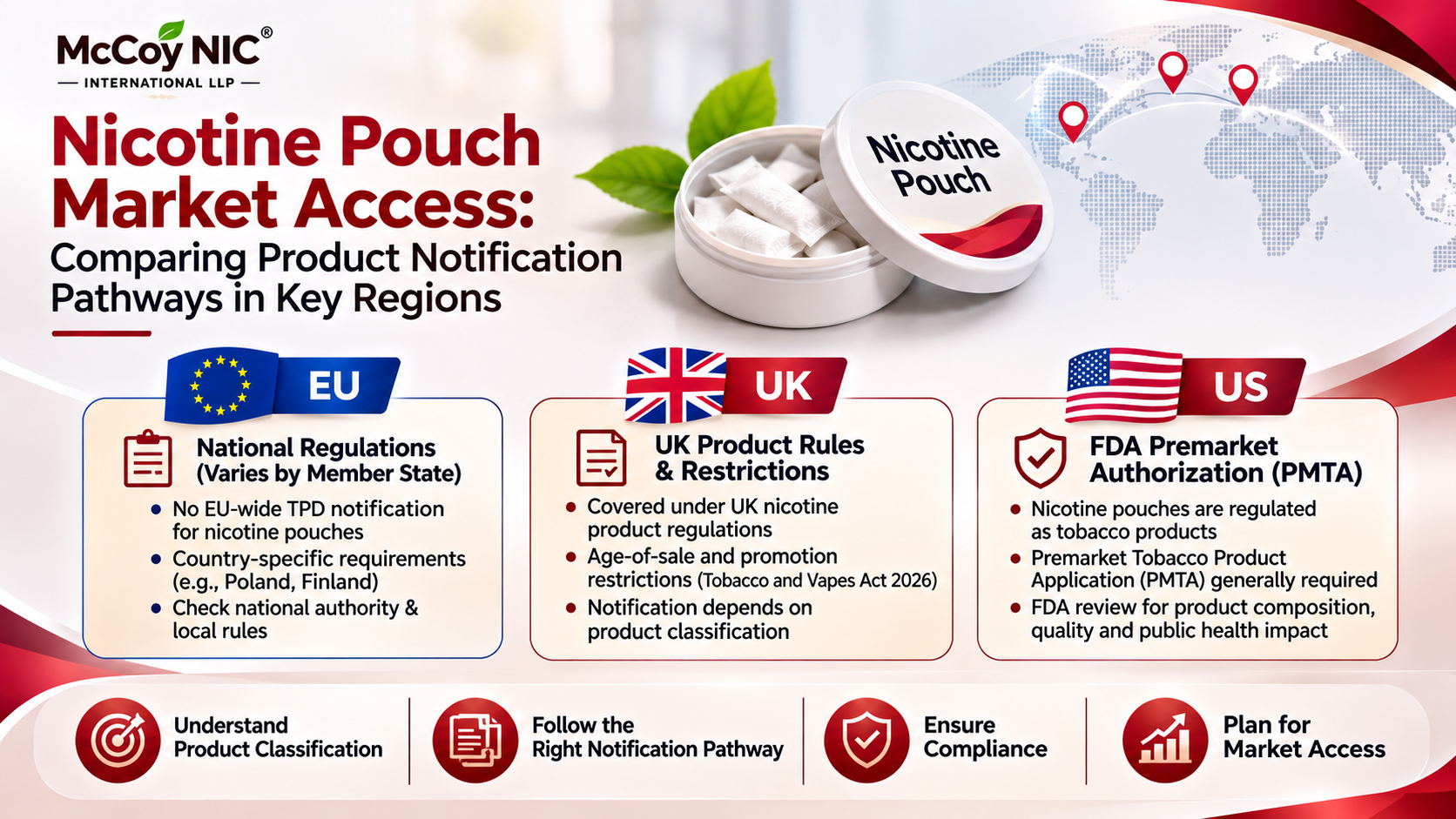
The EU does not currently have one harmonised nicotine-pouch-specific notification system under the Tobacco Products Directive (TPD).
The European Commission has confirmed that nicotine pouches are outside the scope of Directive 2014/40/EU. However, individual EU Member States may introduce national measures, subject to applicable EU law.
Official reference: European Commission – Response on the Regulation of Nicotine Pouches (20 August 2025)
A. EU Tobacco Products Directive and EU-CEG
The Tobacco Products Directive 2014/40/EU establishes requirements for specified tobacco products, electronic cigarettes and refill containers.
Manufacturers and importers of products covered by the Directive use the European Union Common Entry Gate (EU-CEG) to submit relevant product information to Member State authorities.
However, businesses should not assume that the standard EU-CEG notification route automatically applies to every tobacco-free nicotine pouch.
Official references:
B. National Notification Requirements
Some Member States have introduced specific requirements for nicotine pouches.
Poland: From 5 July 2025, manufacturers and importers have been required to notify nicotine pouch products to the President of the Bureau for Chemical Substances. The Polish authority provides instructions for ingredient disclosure, submitter identification and electronic submission.
For products not yet placed on the Polish market, the notification must be submitted six months before the intended market-entry date under the published requirements.
Official reference: Poland – Notification of Nicotine Pouches
Finland: Finnish legislation includes advance notification requirements for smokeless nicotine products. The European Commission’s TRIS database records the national notification framework and information requirements, including ingredients, toxicological information and nicotine dosage and absorption information.
Official reference: European Commission TRIS – Finland Nicotine Product Notification
These examples demonstrate why a company should assess each EU destination country separately rather than relying on a single EU-wide checklist.
C. What Should Businesses Check Before Entering an EU Market?
Before placing nicotine pouches on an EU national market, manufacturers and importers should confirm:
- Whether nicotine pouches are permitted in the destination country.
- How the product is legally classified.
- Whether advance product notification is required.
- Which authority receives the notification.
- What ingredient and toxicological information must be submitted.
- Whether packaging, nicotine limits or flavour restrictions apply.
- Whether additional import, chemical or consumer-product obligations exist.
3. United Kingdom: Product Rules and Notification Distinctions
The UK has its own regulatory framework following its departure from the EU.
It is important to distinguish between the notification requirements for tobacco products and herbal products for smoking under the Tobacco and Related Products Regulations 2016 (TRPR), and the rules applying to tobacco-free nicotine pouches.
The UK Government’s tobacco-product notification guidance describes the Great Britain domestic notification system and the EU-CEG route for Northern Ireland for products covered by those requirements. This should not be interpreted as a universal nicotine-pouch notification process.
Official reference: GOV.UK – Notification of Tobacco Products and Herbal Products for Sale in the UK
A. Tobacco and Vapes Act 2026
The Tobacco and Vapes Act 2026 introduced additional rules for vaping and nicotine products.
From 29 October 2026, UK Government guidance confirms age-of-sale restrictions and restrictions on promotional free distribution and substantial promotional discounts for products within scope.
The guidance explicitly includes nicotine pouches and synthetic nicotine products within the relevant nicotine-product restrictions. Medicinal products are treated separately.
Official reference: GOV.UK – Selling Vaping and Nicotine Products
B. Key UK Market-Entry Checks
Businesses considering the UK market should review:
- Product classification and intended use.
- Whether the product falls under consumer-product or medicinal-product rules.
- Applicable age-of-sale and promotional restrictions.
- Packaging, labelling and product-safety obligations.
- Importer and distributor responsibilities.
- Any product-specific notification or reporting requirements.
Companies should confirm the applicable route with the relevant UK authority before treating a product as ready for sale.
4. United States: FDA Premarket Authorization Pathway
The United States follows a different approach through the Food and Drug Administration (FDA).
FDA identifies nicotine pouches as tobacco products for regulatory purposes. Under the Federal Food, Drug, and Cosmetic Act, products containing nicotine from any source and intended for human consumption can fall within FDA’s tobacco-product jurisdiction, subject to the statutory definitions and exclusions.
This includes products containing tobacco-derived nicotine and non-tobacco nicotine (NTN), such as synthetic nicotine.
Official references:
- FDA – Other Tobacco Products and Nicotine Pouches
- FDA – Regulation and Enforcement of Non-Tobacco Nicotine Products
A. Premarket Tobacco Product Application (PMTA)
For a new tobacco product subject to the PMTA requirement, manufacturers generally need to submit a Premarket Tobacco Product Application and obtain an FDA marketing granted order before legally marketing the product.
A PMTA is a scientific application. It is not simply an administrative product notification.
FDA evaluates whether the product is appropriate for the protection of public health. Its review can consider:
- Product composition and ingredients.
- Nicotine source and form.
- Manufacturing methods and quality controls.
- Product design and packaging.
- Toxicological information.
- Consumer-use and exposure information.
- Population-level risks and benefits.
Official reference: FDA – Premarket Tobacco Product Applications
B. Non-Tobacco Nicotine and Synthetic Nicotine
In 2022, federal legislation clarified FDA’s authority over tobacco products containing nicotine from any source, including synthetic nicotine.
Manufacturers cannot rely on synthetic nicotine as a general exemption from FDA tobacco-product requirements.
FDA also provides guidance on information relevant to nicotine source and enantiomeric purity in PMTA submissions.
Official reference: FDA – Requirements for Products Made with Non-Tobacco Nicotine
C. FDA Enforcement Developments
On 8 May 2026, FDA issued guidance describing enforcement priorities for certain unauthorized electronic nicotine delivery systems and nicotine pouch products.
The policy describes circumstances in which FDA does not intend to prioritize enforcement. It does not grant marketing authorization to products covered by that policy.
Businesses should therefore distinguish between a pending application, an enforcement-policy position and an actual marketing granted order.
Official reference: FDA – May 2026 Enforcement Priorities for Unauthorized ENDS and Nicotine Pouch Products
5. EU vs UK vs US: Comparing Market-Access Pathways
The following table provides a high-level comparison. The applicable route must still be checked for the exact product and destination.
| Regulatory area | European Union | United Kingdom | United States |
|---|---|---|---|
| Main framework | National laws and applicable EU legislation | UK legislation and product-specific rules | Federal FDA tobacco-product framework |
| Nicotine pouch-specific approach | No harmonised EU-wide TPD notification route | Specific nicotine-product rules; do not assume tobacco notification automatically applies | FDA regulates nicotine pouches as tobacco products |
| Notification / authorization | Varies by Member State | Depends on product classification and applicable rules | PMTA generally required for new products subject to the requirement |
| Key authority | National competent authorities and European Commission | Relevant UK government departments and authorities | FDA Center for Tobacco Products |
| Important distinction | National requirements can differ | Tobacco-product notification and nicotine-pouch rules are not interchangeable | Application submission is not marketing authorization |
6. Documents Businesses Should Prepare
Regardless of the destination market, manufacturers and suppliers should maintain accurate product and technical information.
Depending on the product and the applicable legal requirements, useful documents may include:
Product Composition
- Complete ingredient list.
- Nicotine source and chemical form.
- Nicotine concentration per pouch.
- Fill weight and pouch weight.
- Flavouring and other ingredient details.
Quality and Analytical Documentation
- Certificate of Analysis (COA).
- Safety Data Sheet (SDS).
- Nicotine assay and purity results.
- Relevant impurity profile.
- Analytical method information.
- Stability and storage information.
Regulatory Documentation
- Product classification assessment.
- Applicable national notification records.
- Submission acknowledgement or reference number.
- Authorization or marketing order, where required.
- Packaging and labelling review.
- Importer and manufacturer details.
For additional product-documentation information, refer to the McCoy NIC Certificates and Documentation page.
7. How to Build a Market-Access Checklist
A practical market-access process can be divided into five stages.
Stage 1 – Identify the destination market
Confirm whether the target market is an EU Member State, Great Britain, Northern Ireland or the United States.
Stage 2 – Confirm product classification
Identify whether the product is a tobacco-free nicotine pouch, tobacco-containing oral product, medicinal product or another regulated category.
Stage 3 – Identify the required pathway
Determine whether the product requires national notification, EU-CEG submission, a UK-specific process, FDA premarket authorization or another applicable regulatory procedure.
Stage 4 – Prepare supporting documents
Compile product composition, quality information, safety documentation and other information required by the relevant authority.
Stage 5 – Verify market readiness
Confirm submission status, applicable restrictions, effective dates and any required authorization before commercial distribution.
8. Common Market-Access Mistakes to Avoid
- Assuming that EU rules are identical across all Member States.
- Treating EU-CEG as a universal nicotine pouch notification portal.
- Confusing UK tobacco-product notification with nicotine-pouch requirements.
- Treating a PMTA submission as FDA marketing authorization.
- Assuming synthetic nicotine is exempt from US FDA jurisdiction.
- Relying on a COA alone as proof of regulatory approval.
- Using the same packaging and compliance documents for every destination market.
- Ignoring changes in national legislation and enforcement guidance.