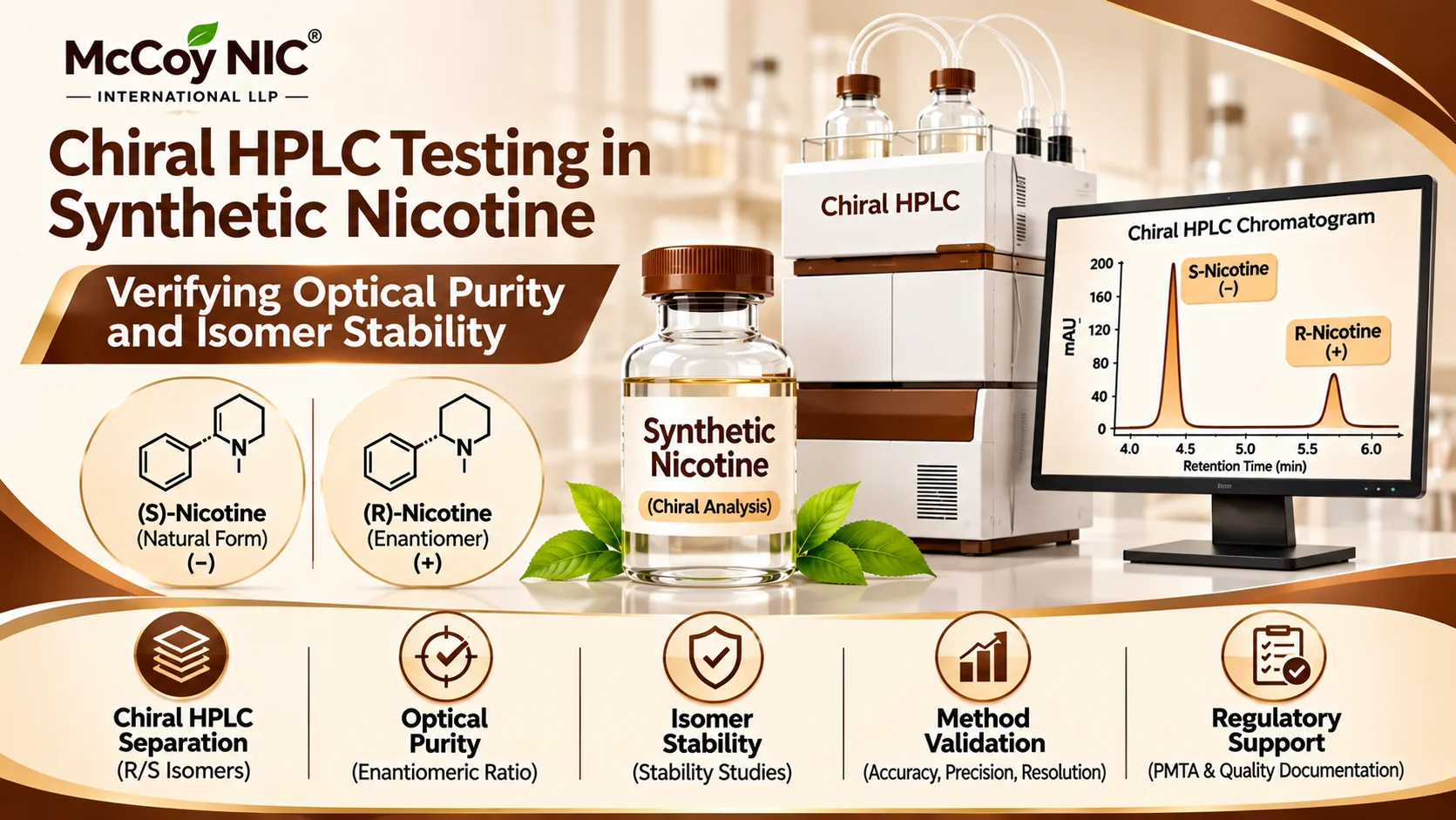
Chiral HPLC Testing in Synthetic Nicotine: Verifying Optical Purity and Isomer Stability
Chiral HPLC testing in synthetic nicotine is an important analytical approach for determining the optical purity and enantiomeric composition of nicotine. As manufacturers develop and supply synthetic nicotine for pharmaceutical and other regulated applications, accurately measuring the two nicotine isomers—R-nicotine and S-nicotine—can support product characterization, quality control and regulatory documentation.
Unlike conventional HPLC methods that measure total nicotine concentration, chiral HPLC uses a chiral stationary phase to separate the two mirror-image forms of nicotine. This allows laboratories to determine the relative proportion of each isomer and monitor changes in the measured profile during product stability studies.
For manufacturers evaluating synthetic nicotine specifications and product quality, chiral analysis can provide additional information beyond a standard nicotine assay.
1. Understanding Nicotine Chirality: R-Nicotine and S-Nicotine
Nicotine is a chiral molecule, meaning it exists in two mirror-image molecular forms called enantiomers:
- S-(-)-nicotine: The predominant naturally occurring nicotine form in tobacco.
- R-(+)-nicotine: The other enantiomer, which may be present in synthetic nicotine depending on the manufacturing route.
Although both enantiomers have the same molecular formula, their three-dimensional structures differ. This difference is important because their pharmacological properties are not identical.
Tobacco-derived nicotine typically contains more than 99% S-nicotine. Synthetic nicotine, depending on its production method, may contain predominantly S-nicotine or a mixture of R- and S-nicotine.
Scientific reference: Synthetic nicotine has arrived – Tobacco Control / PMC
2. What Is Chiral HPLC Testing?
High-Performance Liquid Chromatography (HPLC) is an analytical technique used to separate and quantify chemical compounds in a sample.
In conventional reversed-phase HPLC, R-nicotine and S-nicotine may not be adequately separated because they have very similar physical and chemical properties in an ordinary achiral environment.
Chiral HPLC addresses this challenge by using a chiral stationary phase. The two enantiomers interact differently with this phase, allowing them to produce separate chromatographic peaks.
A properly developed chiral HPLC method can provide:
- Separation of R-nicotine and S-nicotine.
- Quantification of individual enantiomers.
- Calculation of the R/S ratio.
- Measurement of enantiomeric composition.
- Monitoring of minor enantiomer levels.
- Analytical data for product characterization and quality control.
3. Why Optical Purity Matters in Synthetic Nicotine
Optical purity describes the relative proportion of one enantiomer compared with the other. In nicotine quality assessment, the enantiomeric composition can help establish whether a material is predominantly S-nicotine, predominantly R-nicotine or a mixture.
For example:
| Sample profile | S-Nicotine | R-Nicotine |
|---|---|---|
| Predominantly S-nicotine | 99% | 1% |
| Racemic nicotine | 50% | 50% |
| Example mixed profile | 95% | 5% |
These are illustrative examples, not product specifications or recommended acceptance limits.
A common way to express enantiomeric excess (ee) is:
Enantiomeric excess = |S − R| / (S + R) × 100
For a sample containing 99% S-nicotine and 1% R-nicotine, the enantiomeric excess is 98%.
This calculation helps communicate the relative dominance of one enantiomer. It should be interpreted alongside the analytical method, sample preparation and measurement uncertainty.
4. Chiral HPLC Method Development and Analytical Parameters
Developing a reliable chiral HPLC method requires careful selection of the stationary phase, mobile phase, modifiers, additives and operating conditions.
A 2025 peer-reviewed study published in Chirality investigated the effects of different alcohol modifiers and amine additives on the separation of nicotine enantiomers.
The researchers reported that changes in modifier and additive concentrations could significantly influence retention times and chromatographic resolution. Under the studied conditions, average resolution values ranged from 2.9 to 7.57, and the method detected approximately 1% of the minor R-enantiomer in the presence of the dominant S-enantiomer.
This demonstrates why laboratories should optimize and validate their own method rather than assume that one set of chromatographic conditions will work for every sample.
Research source: On the Influence of Additives and Modifiers on the Chiral HPLC Separation of the Enantiomers of Nicotine – Chirality, 2025
Important method-development parameters include:
- Chiral stationary-phase selection.
- Mobile-phase composition.
- Alcohol modifier concentration.
- Additive type and concentration.
- Flow rate and column temperature.
- Retention time and peak resolution.
- Detection wavelength and sensitivity.
- Repeatability and reproducibility.
5. How Laboratories Calculate the R/S Nicotine Ratio
After separating the two enantiomers, laboratories can calculate their relative proportions using the corresponding chromatographic peak areas, provided the method has suitable response characteristics.
A simplified calculation is:
S-Nicotine (%) = S peak area / (S peak area + R peak area) × 100
R-Nicotine (%) = R peak area / (S peak area + R peak area) × 100
These calculations assume that the analytical response is appropriate for comparing both enantiomers. Laboratories should establish the method’s suitability, calibration approach and any relevant response-factor considerations.
The resulting values can be used to compare batches, verify agreed product specifications and investigate changes during storage.
6. Monitoring Isomer Stability During Storage
Optical purity is not only a manufacturing-stage consideration. Manufacturers may also evaluate the enantiomeric composition of nicotine during stability studies.
A suitable stability programme can assess whether the measured R/S profile remains consistent under defined storage conditions.
Relevant study considerations include:
- Initial R/S ratio at the beginning of the study.
- Defined temperature and storage conditions.
- Protection from light and moisture where appropriate.
- Sampling at predetermined stability intervals.
- Nicotine assay and related-substance testing.
- Comparison of chromatographic profiles over time.
- Investigation of any significant changes in results.
A change in the measured R/S ratio should be investigated rather than automatically attributed to racemization. Sample preparation, analytical variability, matrix effects and other chemical changes may also influence results.
Chiral HPLC can therefore be one part of a broader stability-testing programme. It should be combined with suitable chemical assay, impurity profiling and other product-specific stability tests.
7. FDA PMTA Requirements and Enantiomeric Purity
The relevance of enantiomeric purity is also reflected in FDA’s February 10, 2026 PMTA roundtable discussion.
In the official transcript, FDA representatives stated that information about enantiomeric purity is needed for the scientific review of PMTAs involving non-tobacco nicotine.
The same discussion emphasizes that product-characterization methods should be validated and fit for the intended sample matrix and analytical purpose. FDA identifies accuracy, precision, selectivity and sensitivity among the key method-performance considerations.
This makes chiral-isomer data relevant when preparing scientific and analytical documentation for applicable NTN product submissions.
The roundtable transcript is a record of FDA’s scientific discussion. It should not be interpreted as a universal R/S ratio specification or a standalone regulatory limit.
Official source: FDA – February 10, 2026 PMTA Roundtable and Transcript
8. Chiral HPLC vs Other Analytical Techniques
Different analytical methods may be used to evaluate nicotine composition and related characteristics.
| Analytical technique | Main application |
|---|---|
| Conventional HPLC | Nicotine assay and related-substance profiling |
| Chiral HPLC | Separation and quantification of R- and S-nicotine |
| Chiral SFC | Enantiomer separation using supercritical fluid chromatography |
| Chiral GC | Enantiomer analysis using gas chromatography |
| LC-MS/MS | Sensitive identification and quantification of selected compounds |
A 2024 study published in the Journal of Chromatographic Science demonstrated chiral supercritical fluid chromatography for quantitative analysis of nicotine and nornicotine enantiomers.
The study reported detection limits of approximately 5 ng/µL and relative standard deviations below 2% under its optimized conditions.
Research source: Qualitative and Quantitative Analyses of the Enantiomers of Nicotine and Nornicotine Employing Chiral Supercritical Fluid Chromatography – PubMed
9. Can Chiral HPLC Confirm Whether Nicotine Is Synthetic or Tobacco-Derived?
Chiral HPLC can identify the relative proportions of R-nicotine and S-nicotine, but this information alone cannot conclusively establish the source of nicotine.
For example, synthetic nicotine may be manufactured with a predominantly S-enantiomeric profile. Therefore, a sample containing more than 99% S-nicotine cannot automatically be classified as tobacco-derived.
Research presented at the CORESTA Tobacco Science Research Conference has described the use of chromatographic techniques, including chiral HPLC-UV and chiral GC-MS, to help differentiate commercial tobacco-derived and synthetic nicotine samples.
Other chemical markers and analytical techniques may be needed to support source identification.
Research source: CORESTA – Distinguishing Tobacco-Derived Nicotine from Synthetic Nicotine
For buyers comparing tobacco-derived nicotine and synthetic nicotine, supplier declarations should be supported by appropriate product-specific analytical evidence.
10. What Should Be Included in a Chiral Nicotine COA?
A Certificate of Analysis can help buyers and manufacturers review the enantiomeric composition of a particular batch.
Depending on the product specification and intended application, a useful analytical report may include:
- Product name and batch identification.
- Total nicotine assay.
- S-nicotine percentage.
- R-nicotine percentage.
- Calculated enantiomeric excess, where applicable.
- Analytical method and chiral column details.
- Relevant chromatographic results.
- Method validation or verification information.
- Test date and laboratory identification.
- Applicable product specification and acceptance criteria.
A COA should report actual batch-specific results. A general specification sheet should not be treated as evidence that every batch has passed the same testing.
For additional supplier-documentation information, review McCoy NIC’s certification and documentation page.
Conclusion
Chiral HPLC testing provides an important analytical approach for measuring the optical purity and R/S isomer composition of synthetic nicotine. By separating and quantifying the two nicotine enantiomers, laboratories can support product characterization, batch comparison and stability monitoring.
Recent scientific research demonstrates how chromatographic conditions influence the quality of nicotine enantiomer separation. FDA’s February 2026 PMTA roundtable also highlights the relevance of enantiomeric-purity information in the scientific review of non-tobacco nicotine applications.
For manufacturers, suppliers and buyers, a reliable quality programme should combine validated analytical methods, batch-specific COAs, appropriate impurity testing and product-specific stability studies.