USP vs EP Nicotine Impurity Limits: Why Anatabine and Anabasine Matter
USP vs EP nicotine impurity limits are important quality considerations for pharmaceutical-grade nicotine manufacturers, suppliers and buyers. Both the United States Pharmacopeia (USP) and European Pharmacopoeia (EP) provide standards for evaluating nicotine identity, assay and related substances. Among the secondary alkaloids included in nicotine impurity profiling, anatabine and anabasine deserve particular attention because they can help characterize the impurity profile of nicotine raw materials.
For manufacturers sourcing pure nicotine for pharmaceutical and industrial applications, understanding these impurity requirements is an important part of supplier qualification, analytical testing and batch documentation.
1. Understanding USP and European Pharmacopoeia Standards
The USP and EP are official pharmaceutical compendia used as quality references in their respective regulatory environments. Their monographs establish requirements for the identity, strength, quality and purity of specified pharmaceutical substances.
The USP nicotine monograph identifies a series of nicotine-related reference compounds, including anatabine and anabasine. The European Pharmacopoeia’s nicotine-related substances profile also identifies these compounds among its specified impurities.
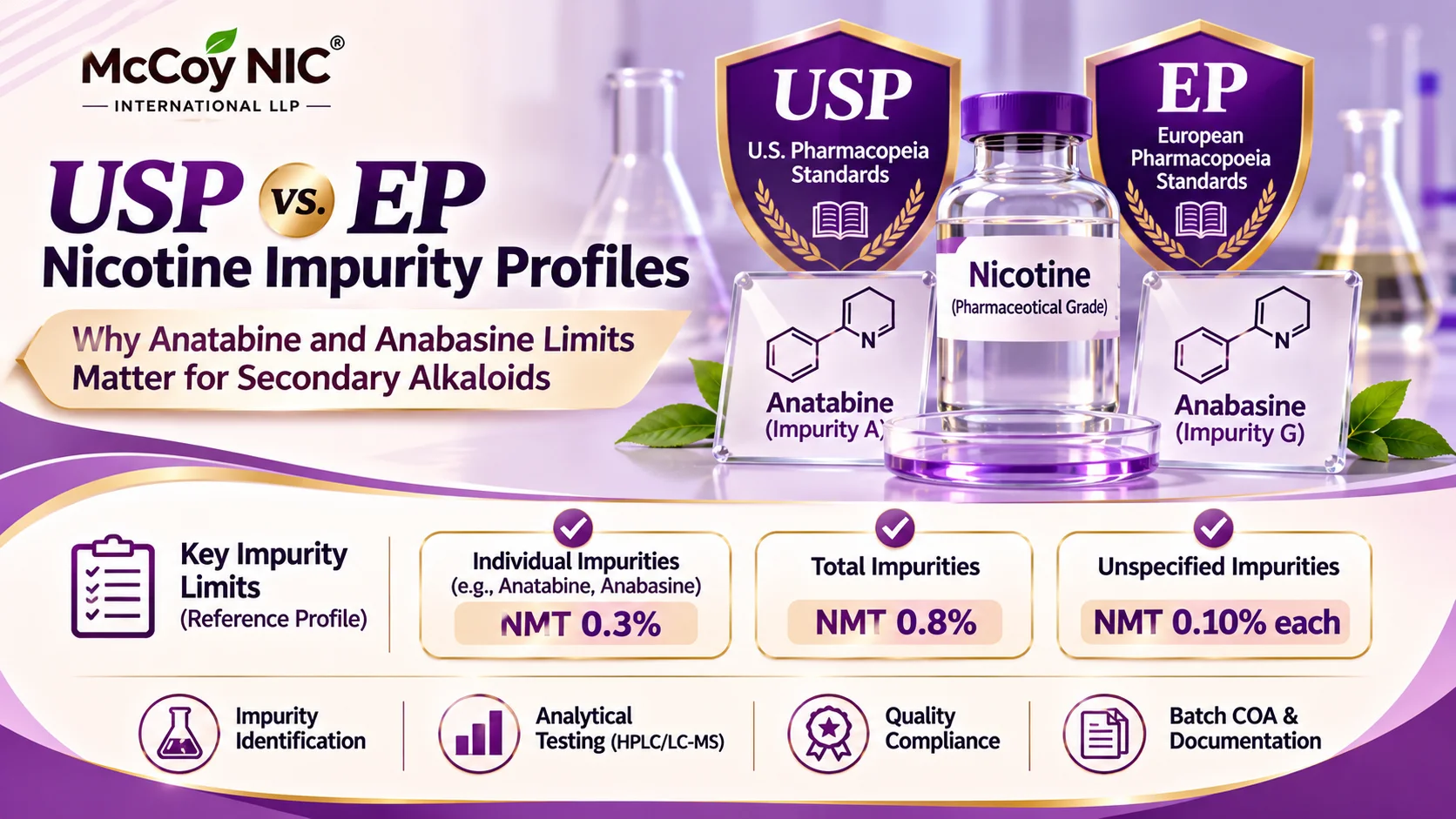
A published scientific comparison reports that the seven specified nicotine-related impurities are subject to individual limits of 0.3% and a combined total limit of 0.8% in the referenced compendial standards. The exact requirements should always be checked against the current official edition and applicable monograph.
Reference: USP–NF Nicotine Monograph | Scientific review of nicotine impurities
2. What Are Secondary Alkaloids in Nicotine?
Secondary alkaloids are related compounds that may occur alongside nicotine in tobacco-derived materials or arise during processing, storage or degradation. Their presence and concentration depend on the source material, manufacturing process and handling conditions.
Common nicotine-related impurities include:
- Anatabine
- Anabasine
- Nornicotine
- Myosmine
- Cotinine
- Nicotine-N-oxide
- β-Nicotyrine
These compounds are commonly evaluated through related-substances testing. A complete impurity profile provides more information than a total nicotine assay alone.
3. Anatabine: Why Impurity A Matters
Anatabine is a minor tobacco alkaloid and is identified as Impurity A in the relevant nicotine impurity profile.
Its concentration can provide useful information about the composition of tobacco-derived nicotine. Monitoring anatabine helps manufacturers assess whether the material meets the agreed related-substances specification.
In the referenced pharmacopoeial impurity profile, the reported individual acceptance benchmark for anatabine is not more than 0.3%.
For quality-control purposes, manufacturers should consider:
- Testing anatabine using a suitable validated analytical method.
- Comparing results with the applicable official monograph.
- Recording the batch-specific result in the Certificate of Analysis.
- Monitoring changes during storage and stability studies.
Scientific reference: Analysis and Toxicological Evaluation of Nicotine Degradants and Impurities in Oral Tobacco Products – ACS Omega
4. Anabasine: Why Impurity G Matters
Anabasine is another minor tobacco alkaloid identified as Impurity G in the referenced nicotine impurity profile.
Its measurement is useful when evaluating the related-substances composition of nicotine. Anabasine may be associated with tobacco-derived raw materials, although its detection or absence alone should not be treated as conclusive proof of a product’s source.
The reported individual acceptance benchmark in the referenced compendial profile is not more than 0.3%.
Manufacturers should evaluate anabasine together with other specified impurities rather than relying on a single analytical result to determine overall quality.
5. USP vs EP: Comparison of Nicotine Impurity Profiles
The following table summarizes the commonly cited seven-impurity profile and acceptance benchmarks reported in the literature.
| Impurity | USP related compound | EP impurity | Reported individual benchmark |
|---|---|---|---|
| Anatabine | Related Compound A | Impurity A | NMT 0.3% |
| β-Nicotyrine | Related Compound B | Impurity B | NMT 0.3% |
| Cotinine | Related Compound C | Impurity C | NMT 0.3% |
| Myosmine | Related Compound D | Impurity D | NMT 0.3% |
| Nicotine-N-oxide | Related Compound E | Impurity E | NMT 0.3% |
| Nornicotine | Related Compound F | Impurity F | NMT 0.3% |
| Anabasine | Related Compound G | Impurity G | NMT 0.3% |
| Unspecified impurities | Additional impurity evaluation | Unspecified impurities | NMT 0.10% each |
| Total impurities | Related-substances total | Related-substances total | NMT 0.8% |
NMT = Not More Than. These are reported reference benchmarks, not a substitute for checking the current official USP-NF and Ph. Eur. monographs. Confirm the applicable version, substance and test requirements before using them as release specifications.
References: USP nicotine monograph | European Pharmacopoeia impurity profile | Scientific comparison of nicotine impurities
6. Analytical Testing: How Are Anatabine and Anabasine Measured?
High-quality impurity profiling requires analytical methods capable of separating nicotine from its related compounds.
Liquid chromatography (LC), including HPLC with suitable detection, is commonly used for nicotine-related substances. More advanced methods such as LC-MS/MS may also be used where greater selectivity or sensitivity is required.
A suitable analytical testing programme should consider:
- Specificity and separation of target impurities.
- Accuracy and precision.
- Detection and quantification limits.
- Reference standards and system suitability.
- Method validation or verification.
- Sample preparation and stability.
- Batch-to-batch reproducibility.
The method must be appropriate for the sample matrix and intended purpose. A method designed for pharmaceutical-grade nicotine should not automatically be assumed suitable for finished nicotine pouches or other formulations without verification.
Analytical reference: Waters – Efficient Identification of Impurities in Nicotine
7. Tobacco-Derived vs Synthetic Nicotine: Why Profiles Can Differ
The manufacturing route can influence the impurity profile of nicotine.
Tobacco-derived nicotine is extracted and purified from tobacco material. Its initial composition can include naturally occurring minor alkaloids, depending on the tobacco source and purification process.
Synthetic nicotine is produced through chemical synthesis. Its impurity profile can differ because it depends on the synthesis route, starting materials, reaction conditions and purification process. Certain tobacco-associated alkaloids may be absent, but this should be demonstrated through suitable analytical testing rather than assumed.
For buyers comparing tobacco-derived nicotine with synthetic nicotine, the most useful approach is to request product-specific analytical data and batch documentation.
Research reference: Analysis and Differentiation of Tobacco-Derived and Synthetic Nicotine Products
8. What Should Buyers Check in a Nicotine COA?
A Certificate of Analysis should provide batch-specific evidence of the material’s tested quality. Buyers and quality teams should review more than the headline purity percentage.
A useful COA review may include:
- Nicotine assay and test basis.
- Anatabine result.
- Anabasine result.
- Other specified nicotine-related impurities.
- Unspecified and total impurity results, where required.
- Analytical method or reference to the applicable method.
- Batch number and date of analysis.
- Specification limits and reported results.
Where applicable, buyers should also request the relevant safety data sheet (SDS), product specification and supporting analytical documentation.
You can review McCoy NIC’s certification and documentation information as part of a supplier-documentation assessment. Always request the actual batch-specific COA for the material being purchased.
9. Why Impurity Monitoring Matters During Storage
Nicotine quality is not assessed only at the time of manufacture. Storage conditions, exposure to oxygen, light, heat and interactions with packaging materials may influence product stability.
A suitable stability programme can help identify changes in nicotine assay and related substances over time. Manufacturers should establish storage conditions and testing intervals appropriate to the product and its specification.
Monitoring anatabine, anabasine and other related substances can form part of a broader quality-control strategy. However, not every change in these compounds necessarily indicates the same degradation pathway; analytical results must be interpreted in context.
Conclusion
USP and EP nicotine impurity profiles provide important reference points for assessing pharmaceutical-grade nicotine quality. Anatabine and anabasine are two specified secondary alkaloids that should be considered alongside other nicotine-related impurities.
For manufacturers and buyers, a reliable quality assessment combines the applicable pharmacopoeial monograph, suitable analytical methods, batch-specific COA results and stability information. Rather than relying only on a stated nicotine purity percentage, companies should review the complete impurity profile and verify that the applicable specifications are met.