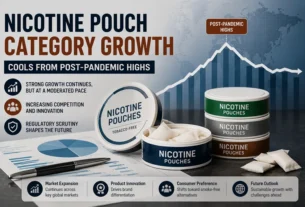
Nicotine Pouches Gain Strategic Importance in the Global Modern Oral Market
Nicotine pouches are becoming an increasingly important category within the global modern oral nicotine market, supported by expanding consumer interest, product innovation and growing investment from major nicotine companies.
Recent market research indicates that the global modern oral nicotine products market was valued at approximately US$7.9 billion in 2024 and is estimated to reach about US$11.9 billion in 2026. Nicotine pouches represented the largest product segment in 2024, highlighting their growing importance within the broader modern oral category.
At the same time, regulatory attention is increasing. Governments and public-health organisations are examining nicotine strength, flavours, packaging, marketing and youth access as nicotine pouches become more widely available in international markets.
Why Nicotine Pouches Are Gaining Market Importance
Nicotine pouches offer a tobacco-free oral format in which nicotine is delivered through the mouth. Their discreet format and absence of smoke or vapour have contributed to their expansion in several markets.
Market research estimates that the global nicotine pouch market could grow from approximately US$9.0 billion in 2026 to US$42.4 billion by 2033, although market estimates vary depending on methodology and market definition.
The category is therefore attracting increasing attention from manufacturers, raw-material suppliers, distributors and investors.
Modern Oral Nicotine Is Expanding Beyond Traditional Formats
The broader modern oral nicotine category includes several formats, including:
- Nicotine pouches
- Oral nicotine lozenges
- Nicotine gums
- Other discreet oral nicotine formats
This expansion reflects a wider transformation within the nicotine industry, where traditional combustible products are increasingly being complemented by alternative formats.
Euromonitor describes the wider nicotine market as undergoing a structural transition, with declining cigarette volumes being offset in part by products such as heated tobacco, e-vapour and nicotine pouches.
Product Innovation Is Shaping the Category
Innovation is becoming an important factor in the development of the modern oral nicotine market.
Manufacturers are exploring differences in:
- Nicotine strength
- Flavour profiles
- Pouch materials
- Moisture characteristics
- Dissolution behaviour
- Portion size
- Packaging formats
- Shelf-life performance
For B2B manufacturers, these changes create additional requirements for consistent raw materials and reliable technical specifications.
Buyers sourcing nicotine for oral applications may need to evaluate purity, concentration, batch consistency and supporting quality documentation before selecting a supplier.
For more information, see our guide on How International Buyers Can Evaluate an Indian Nicotine Supplier.
Nicotine Strength Is Becoming an Important Market Factor
Nicotine concentration is one of the most important technical characteristics of modern oral nicotine products.
Market research indicates that strong nicotine pouches, generally defined in one market segmentation as 4–6 mg per pouch, represented the largest strength segment in 2025.
However, nicotine strength is also becoming a regulatory issue.
Governments are increasingly considering whether maximum nicotine levels should be established for specific products. The Netherlands, for example, notified the European Commission in 2026 of proposed rules concerning maximum nicotine levels for tobacco-free nicotine products.
This means manufacturers may need to consider both consumer preferences and destination-market regulations when developing future products.
Regulation Could Influence Future Market Growth
The rapid expansion of nicotine pouches is occurring alongside a significant increase in regulatory scrutiny.
The World Health Organization reported in May 2026 that retail sales of nicotine pouches exceeded 23 billion units in 2024, representing an increase of more than 50% from the previous year. WHO also estimated the global nicotine-pouch market at nearly US$7 billion in 2025.
WHO has highlighted concerns relating to nicotine addiction, youth exposure, product flavours, high nicotine levels and marketing practices.
The regulatory environment therefore remains an important factor for companies planning international expansion.
Europe Presents a Fragmented Regulatory Environment
Europe is particularly important for the modern oral nicotine industry, but regulatory approaches differ between countries.
The European Commission’s 2026 assessment notes that nicotine pouches are currently outside the existing EU Tobacco Products Directive framework, while Member States have adopted different national approaches, including bans, nicotine limits, ingredient requirements, age restrictions, labelling rules and notification requirements.
This regulatory fragmentation can create additional complexity for manufacturers and distributors operating across multiple European markets.
Companies therefore need to distinguish between:
EU-level requirements
and
individual country requirements.
For example, the Netherlands has moved toward stricter controls, while other European countries have adopted different approaches.
Strategic Importance for B2B Nicotine Suppliers
The expansion of the modern oral nicotine market also creates opportunities for suppliers of pharmaceutical- and industrial-grade nicotine raw materials.
For B2B buyers, supplier selection increasingly involves more than simply comparing price.
Important evaluation factors can include:
- Nicotine purity
- Consistent batch quality
- Certificate of Analysis
- Safety Data Sheet
- Manufacturing documentation
- Batch traceability
- Packaging specifications
- Export documentation
- Technical communication
- Regulatory support
Companies can learn more about Pure Nicotine 99.9% and the associated technical specifications when evaluating raw-material requirements.
Why Batch Consistency Matters
As nicotine-pouch manufacturers develop different strengths and formulations, consistent raw-material quality becomes increasingly important.
Variations in nicotine purity or raw-material characteristics can affect formulation, testing and finished-product consistency.
A robust supply chain therefore requires appropriate quality controls from raw-material sourcing through production and final testing.
Our article on Nicotine Traceability: How Manufacturers Track Raw Material from Source to Finished Product can be used as a supporting resource for buyers researching supply-chain traceability.
Asia Pacific Could Become an Important Growth Region
Although North America currently represents the largest regional market for modern oral nicotine products, Asia Pacific is expected to experience strong growth.
One market analysis estimates an Asia Pacific CAGR of approximately 31.9% for modern oral nicotine products during the forecast period.
For manufacturers and suppliers, this creates potential opportunities across emerging markets, particularly where consumer demand, manufacturing capabilities and regulatory frameworks continue to develop.
However, market expansion will depend heavily on country-specific regulations and product compliance.
What Should Manufacturers Watch?
Companies operating in the modern oral nicotine sector should closely monitor several developments:
- Maximum nicotine levels
- Flavour restrictions
- Age-verification requirements
- Packaging and labelling rules
- Advertising and digital marketing restrictions
- Product notification requirements
- Import and market-placement rules
- Country-specific nicotine regulations
- Raw-material quality requirements
- Traceability and technical documentation
These factors could influence product formulation, market-entry strategies and supplier qualification.
Regulatory Developments May Reshape Product Strategy
The growth of nicotine pouches does not mean that the market will develop uniformly across countries.
The European Commission’s current regulatory review indicates that future EU rules may specifically address nicotine pouches and other emerging nicotine products.
This could eventually lead to greater harmonisation across European markets, although national requirements remain important today.
For manufacturers, flexibility and regulatory awareness may therefore become important competitive factors.
The Role of Reliable Nicotine Supply
As the modern oral nicotine market becomes more sophisticated, manufacturers are likely to place greater emphasis on reliable raw-material supply.
A qualified supplier should be able to provide clear information regarding:
- Product grade
- Purity
- Batch number
- Testing
- Documentation
- Packaging
- Storage requirements
- Export support
This is particularly relevant for companies developing products for multiple international markets.
For additional information, readers can explore Nicotine Extraction and Manufacturing and related quality and compliance resources from McCoy NIC.